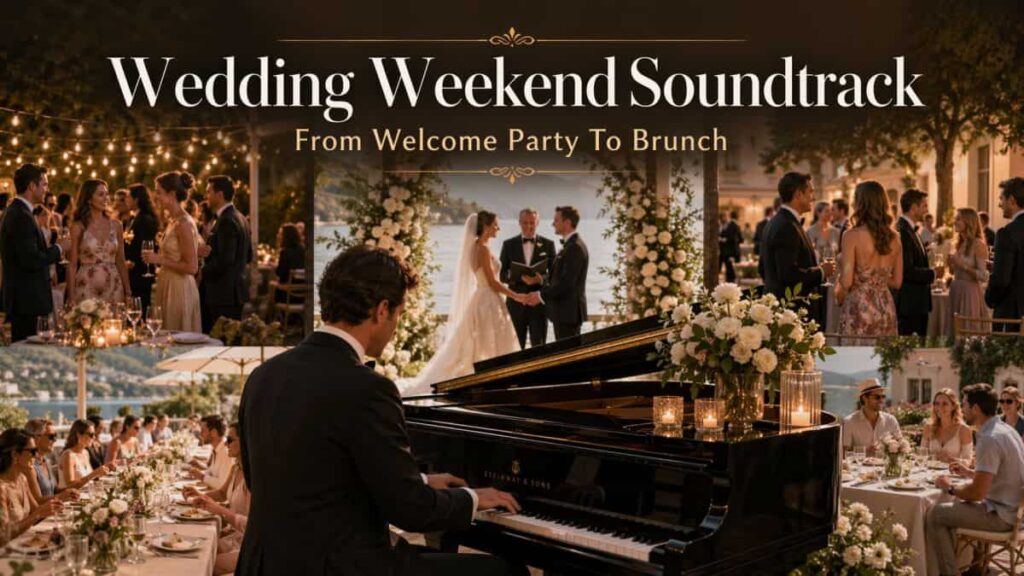
From Welcome Party To Farewell Brunch: Planning The Sound Of Your Wedding Weekend
A wedding weekend is not one event. It is a string of events that share the same guest list, run on different timelines, and demand different things from the music. The welcome party should not feel like the brunch. The cocktail hour should not feel like the after-party. The ceremony belongs in its own category entirely.
Most couples plan music event by event, often booking different vendors at different moments and never asking how the weekend should sound as a whole. That is how a Friday night welcome party ends up sounding identical to Sunday brunch, or how the cocktail hour drowns out the conversations that guests waited all day to have.
This guide walks through how to plan music across the full wedding weekend in NJ, NYC, and Philadelphia. Where live piano fits best. Where a DJ or playlist may serve you better. And how to keep each event feeling like itself.
Key Takeaways
What This Planning Guide Covers
- A wedding weekend needs one connected music plan, not five separate playlists chosen in isolation
- Each event has its own volume, mood, and purpose: welcome, ceremony, cocktail hour, dinner, after-party, and brunch all sit in different categories
- Live piano is strongest where guests are arriving, mingling, eating, or transitioning between moments
- An after-party with serious dancing usually wants a DJ or playlist, not piano as the main act
- Avoid the most common mistake: repeating the same mood from welcome party through farewell brunch
- Setup, power access, and room flow matter more across a multi-venue weekend than a one-room wedding
- Three details get the conversation started fast: which events need music, the venue and timing for each, and what role the music should play
The Fast Answer: How Should You Plan Music for a Wedding Weekend?
Plan music event by event, then check it as a whole.
Each wedding weekend event has a different job. The welcome party helps guests settle in. The ceremony has cues. The cocktail hour carries conversation. Dinner sits underneath toasts. The after-party shifts energy. Brunch winds the weekend down. If every event is treated the same way, the weekend starts to feel flat by Saturday night.
Live piano is at its strongest where the room needs warmth, conversation-friendly volume, smooth timing, and recognizable songs played at the right pace. That covers most of the wedding weekend. Welcome parties, ceremonies, cocktail hours, dinner sets, and farewell brunches all sit comfortably inside what a live pianist does well.
An after-party with full dancing is the main exception. If the goal is a packed dance floor at 11 p.m., a DJ or a strong prepared playlist with a sound system usually fits better than a solo piano. A hybrid plan can also work, with piano covering the early lounge hour and a DJ taking over for dancing.
For more on what live piano does best across the weekend, our live wedding music page outlines the most common coverage choices.
Why a Wedding Weekend Needs a Music Plan, Not Just a Playlist
A regular wedding day is one timeline. A wedding weekend is three or four timelines stacked across two or three days. The music plan has to account for guests who travel in, families who are meeting for the first time, and a guest list that keeps showing up at one event after another.
Here is what makes the music side of a wedding weekend trickier than a single-day wedding:
- Out-of-town guests are tired at the welcome party and may want quieter music than the couple expects
- Families meet each other for the first time, often during the welcome party or rehearsal dinner, and music sets the comfort level
- Multiple venues mean different rooms, different acoustics, and sometimes different setup constraints
- The same guests hear the same instrumentation across two days, so repeating the exact same mood gets noticeable
- Multi-generational guests mix in different ratios at different events
- Energy peaks at the reception and needs to wind down before brunch, not stay flat
The fix is a music plan that gives each event its own purpose.
| Weekend Challenge | Why It Matters | Music Planning Fix |
|---|---|---|
| Out-of-town guests arriving tired | Loud welcome music makes a long travel day worse and discourages mingling | Start the welcome party with conversation-friendly background music, then warm up |
| Families meeting for the first time | Music sets the tone for whether new connections feel forced or natural | Use familiar instrumental music guests can talk over without yelling |
| Same guests across two days | Repeating the same mood makes the weekend feel monotonous | Vary tempo, song style, and energy by event so each one feels distinct |
| Multi-generational guest mix | Younger and older guests respond to different decades | Blend jazz standards, Broadway, soft rock, and modern instrumentals |
| Multiple venues or rooms | Setup, power, and acoustics may all change | Confirm setup details for each venue separately, not just the main reception |
| Energy needs to wind down | Brunch should feel like a soft goodbye, not a rerun of cocktail hour | Plan the brunch playlist or live set as a noticeably lighter, warmer close |
A wedding weekend works best when each event has its own musical purpose. The welcome party should not feel exactly like the brunch, and the cocktail hour should not feel exactly like dinner.
Arnie Abrams
The Wedding Weekend Soundtrack Map
Here is a practical overview of how each wedding weekend event should be planned. Use it as a quick check while you build your timeline.
| Wedding Weekend Event | Main Guest Experience | Best Music Approach | Planning Watchout |
|---|---|---|---|
| Welcome Party | Travel-tired guests arriving over a long window, meeting people for the first time | Live piano or warm instrumental background music at conversation volume | Avoid loud or fast playlists that discourage mingling |
| Rehearsal Dinner | Family and wedding party in a more intimate setting | Soft jazz, classical, or piano background; toasts often included | Music that competes with toasts is the most common mistake |
| Ceremony | Formal, emotional, tightly timed | Live pianist who can read processional cues and adjust on the fly | Pre-recorded music struggles with timing changes and venue layouts |
| Cocktail Hour | Guests mingling, drinks in hand, conversation everywhere | Live piano carrying recognizable instrumental songs at a moderate volume | Music that demands attention pulls focus away from conversation |
| Reception Dinner | Plated or buffet courses, toasts, slideshows, table conversation | Soft live piano or low-volume background music, paused cleanly for speeches | Dance-energy music too early kills dinner conversation |
| After-Party | Late-night, smaller crowd, often dancing | DJ or playlist for dancing; piano fits a lounge-style after-party | Live piano alone rarely sustains a true late-night dance party |
| Farewell Brunch | Tired guests, long goodbyes, casual mood | Light, warm instrumental music that supports lingering conversation | Repeating cocktail hour energy makes brunch feel stale |
Welcome Party Music Should Help Guests Settle In
The welcome party is the first time most guests see each other. Some are jet-lagged. Some are seeing the wedding party for the first time in years. Some are meeting in-laws and cousins they have only heard about. The music has one main job: make the room feel friendly without making it hard to talk.
That usually means warmth over volume. A live pianist working through a mix of jazz standards, soft rock favorites, and familiar instrumentals can carry the first hour as guests trickle in. The volume can come up later as the room fills.
Live piano works especially well in:
- Hotel lounges with a piano on-site or room for a digital keyboard
- Restaurant private rooms used for the welcome gathering
- Country clubs hosting an early-evening drinks reception
- Rooftop bars in NYC or Philadelphia with limited but flexible setup space
- Private homes hosting a smaller welcome reception
For deeper coverage of welcome party music planning, see our blog post on live music for wedding welcome parties and kickoff events.
A Note on Welcome Party Volume
The welcome party is not the reception. Guests are not there to dance. They are there to find their people. Keep the music at a level where two people standing six feet apart can hear each other clearly. As the room fills, volume can come up gradually, but it should never reach reception levels.
Ceremony Music Needs Timing, Cues, and Emotional Control
The ceremony is the most tightly choreographed event of the weekend. Prelude music covers guest arrival. The processional has to match how each person walks down the aisle. Family entrances may have their own song. The recessional should land with the right energy as the couple exits.
This is where live piano shows the biggest advantage over a playlist. A pianist watches the back of the aisle, adjusts pace, holds a chord when the flower girl freezes, and lands the recessional cleanly when the kiss runs long. A pre-set playlist cannot do any of that.
Plan the ceremony music separately from the rest of the weekend. The repertoire is different. The role is different. The pacing is different. Keep ceremony songs sacred to the ceremony so the cocktail hour does not feel like a reprise of the processional.
For ceremony-specific planning, our wedding ceremony music page covers prelude, processional, and recessional planning in detail.
Cocktail Hour Is Where Live Piano Can Carry the Room
Cocktail hour is the bridge between ceremony and reception. Guests are catching up. The wedding party may be away taking photos. Drinks are flowing, appetizers are circulating, and the room needs music that holds attention without grabbing it.
Live piano is one of the strongest fits for cocktail hour for a simple reason: a pianist can play recognizable songs at conversation-friendly volume, blend decades fluidly, and adjust pace as the room fills or thins. Familiar instrumentals from the Great American Songbook, soft pop covers, jazz standards, and movie themes all work well.
This is also a strong moment for guest engagement. A pianist can take a few requests, recognize a song someone is humming, or shift styles when the guest mix shifts. A playlist commits to whatever was loaded weeks ago.
What Cocktail Hour Music Is Actually Doing
Cocktail hour music is not background filler. It is signaling the tone of the entire reception. Guests will form their first impression of the evening based on what is playing while they stand around with a drink. Calm, polished, recognizable instrumental music tells guests this is going to be a relaxed, well-paced evening. A playlist of loud club tracks tells them something else.
For a closer look at how cocktail hour music shapes the reception, read our blog post on what your cocktail hour music says about your event.
Plan One Connected Wedding Weekend
If you are planning a wedding weekend in New Jersey, New York City, or Philadelphia and want help thinking through how live piano fits across the welcome party, ceremony, cocktail hour, dinner, or farewell brunch, reach out with your dates and venues.
Ask About AvailabilityCall or text Arnie directly: (732) 995-1082
Reception Dinner Music Should Support Conversation
Dinner is a different beast from cocktail hour. Guests are seated. Toasts are coming. Servers are moving. Slideshows may run between courses. Whatever music is playing has to sit underneath all of that without competing with it.
A common mistake is treating dinner like an extension of cocktail hour at the same volume. A second issue is jumping straight from ceremony into dance-floor energy before guests have eaten. Dinner music should hold a calmer middle ground.
Live piano fits dinner well because:
- It can sit at a lower volume than recorded music without losing presence
- It can pause cleanly when toasts begin and return softly when they end
- It can adjust style as the room shifts from older guests at one course to younger guests at another
- It can play familiar songs across multiple decades, which keeps a multi-generational table feeling included
If your dinner crowd spans across grandparents, parents, friends from college, and small kids, the music should reflect that mix. For more on this, our piece on multi-generational piano music that connects all ages goes deeper.
After-Party Music Needs a Different Energy Plan
This is where the music plan often shifts away from live piano as the main act, and that is fine. The after-party is supposed to feel different from everything else. Late-night, smaller crowd, looser energy, drinks at a faster pace. The music should match.
Three common after-party styles each call for a different approach:
| After-Party Style | Best Music Fit | Why It Works | Watchout |
|---|---|---|---|
| Hotel lounge or bar takeover | Live piano lounge set, possibly with vocalist | Keeps the room intimate and conversational, fits a smaller crowd | Not designed for a packed dance floor |
| Dance-focused after-party | DJ or prepared playlist with proper sound system | Sustains high energy and song-to-song flow that piano alone cannot | Live piano forced into this role usually under-delivers |
| Hybrid lounge-to-dancing | Piano for the first 60 to 90 minutes, then DJ or playlist | Smooth shift from quiet conversation to dancing without one big jolt | The handoff has to be planned, not improvised |
The honest answer for most couples: if dancing is the goal, lead with a DJ or playlist. If the after-party is more of a relaxed last drink, live piano can carry it beautifully. For a deeper walkthrough of after-party planning options, our blog post on how to plan live piano music for a wedding after-party covers both directions.
Farewell Brunch Music Should Feel Relaxed, Not Replayed
The farewell brunch closes the weekend. Guests are tired. Some flew in late and are flying out early. Long goodbyes happen at the buffet, in the parking lot, by the front desk. The music should feel like a soft landing, not a continuation of last night.
The biggest mistake here is using the cocktail hour playlist again. Even if the songs are great, guests have already heard that energy. Brunch should sit lower and warmer.
Good farewell brunch music:
- Sits comfortably under conversation without demanding attention
- Leans toward familiar, easy-listening favorites rather than dance tempos
- Stays at a volume where extended goodbyes are easy
- Wraps the weekend rather than reopening it
Hotel brunches, restaurant private rooms, country club mornings, and home gatherings all work well with a soft live piano set or a thoughtful playlist. For more, see our post on piano music for wedding brunch and farewell events.
Live piano is often strongest where people are arriving, talking, eating, or moving from one part of the celebration to the next. Those moments need warmth and pacing, not volume.
Arnie Abrams
How to Avoid Repeating the Same Mood All Weekend
This is the single most common wedding weekend music problem: every event ends up feeling the same. Often it is because the couple loves a certain mood, picks similar songs for each event, and never compares how the moods will land back to back.
The fix is to give each event a distinct job, then check the weekend as a whole.
| Event | Mood to Avoid | Better Direction |
|---|---|---|
| Welcome Party | Loud reception-style energy | Warm, easygoing background that supports first introductions |
| Ceremony | Generic processional songs that do not match the couple | Selections tied to the couple, played at the ceremony’s actual pace |
| Cocktail Hour | Fast-tempo dance music too early | Familiar instrumentals at conversation volume |
| Reception Dinner | Continuing cocktail hour energy through dinner | Lower-volume, calmer music that supports conversation and toasts |
| After-Party | Live piano forced into a dance role it was not built for | DJ, playlist, or hybrid plan if dancing is the goal |
| Farewell Brunch | Cocktail hour playlist on repeat | Lighter, warmer music that wraps the weekend gracefully |
Couples often think variety means picking radically different genres. It does not. It means giving each event the right volume, tempo, and energy for what guests are actually doing in that moment.
Live Piano vs. Playlist vs. DJ Across the Wedding Weekend
No single music option fits every wedding weekend event. The honest comparison looks like this:
| Music Option | Best For | Main Limitation | Smart Weekend Use |
|---|---|---|---|
| Live Piano | Welcome parties, ceremonies, cocktail hours, dinners, farewell brunches | Solo piano alone cannot sustain a packed late-night dance floor | Anchor the events where warmth, timing, and conversation matter most |
| Prepared Playlist | Casual welcome receptions, after-parties, brunch background | No flexibility for cues, no real-time room reading, no requests | Use for events where pacing is predictable and budget is tighter |
| DJ | Reception dancing, after-party dancing, transitions between energies | Often overpowered for ceremony, welcome party, or quiet dinner moments | Bring in for the moments when energy and dancing are the point |
| Piano + DJ Hybrid | Couples who want polish early and dancing later | Requires planned handoff timing | Strongest combination across a full wedding weekend |
Many wedding weekends use more than one of these options. Live piano for welcome party, ceremony, cocktail hour, and dinner. DJ for the reception dance set and after-party. Soft live piano returning for Sunday brunch. The trick is matching the right option to the right moment.
The pacing decisions across the weekend follow some of the same principles we cover in our post on how music pacing affects guest experience.
Venue, Setup, Power, and Room Flow Matter More Across a Full Weekend
One-venue weddings are simpler. The pianist sets up once, plays through ceremony and cocktail hour, then breaks down. A wedding weekend may move across two or three venues, each with its own logistics. Hotel lounge for welcome party. Garden for ceremony. Ballroom for reception. Restaurant private room for brunch.
That changes the planning conversation. Setup details have to be confirmed for each venue separately, not assumed.
| Planning Factor | Why It Matters | Common Problem | Best Early Step |
|---|---|---|---|
| On-site piano vs. digital keyboard | Some venues have a piano; others do not | Couple assumes a piano is on-site when it is not | Confirm with each venue and pass that information along |
| Power access | Outdoor ceremonies and rooftops may have limited power | No nearby outlet for keyboard and small PA | Confirm power location during the venue walk-through |
| Setup window | Hotels and country clubs often have tight load-in times | Vendor arrives but cannot enter the room yet | Get the venue’s load-in policy before booking |
| Volume control | Rooftops, courtyards, and gardens behave differently than ballrooms | Music carries too far or gets swallowed | Ask the venue about previous outdoor music setups |
| Room placement | Where the pianist sits affects what guests hear | Pianist tucked in a corner where the sound dies | Discuss placement during the floor plan review |
| Outdoor weather | Rain plans need to include the music too | Plan B venue cannot fit the same setup | Build a music rain plan, not just a ceremony rain plan |
If your weekend includes any outdoor element, especially at a Jersey Shore venue, our outdoor wedding music for the Jersey Shore page covers the most common setup considerations. For the on-site piano question specifically, our post on grand piano vs. digital keyboard for your venue walks through what each option fits best.
One Setup Detail Couples Forget
The chair. Most pianists need a flat, armless chair or bench at the right height. Some venues do not have one. Confirm what kind of seating the venue can provide, or plan for the pianist to bring their own. It sounds small, but the wrong chair affects how an entire two-hour set plays.
What Arnie Abrams Needs From You
For a wedding weekend conversation to be useful on the first call, three pieces of information matter most:
- Which wedding weekend events need music. Welcome party, ceremony, cocktail hour, dinner, after-party, brunch, or some combination. This shapes coverage, length, and pricing direction.
- Venue, timing, and room setup for each event. Hotel ballroom, garden ceremony, restaurant private room, country club brunch. Whether a piano is on-site or a keyboard is needed. Outdoor or indoor. Approximate start and end times.
- What role the music should play in each event. Background, ceremony cues, conversation under dinner, dancing, transitions, or a soft farewell. This determines tempo, repertoire, and volume planning.
That is enough to give you a clear, honest answer about availability, fit, and what would actually work across the weekend. The rest of the planning, song selection, run of show, and final timeline gets refined later.
For more on what experienced pianists wish couples knew before reaching out, see our post on what Arnie Abrams wishes clients knew.
Once I know the timing, the room, and what each event is supposed to feel like, it becomes much easier to shape the music around the weekend instead of around a single afternoon.
Arnie Abrams
Quick Decision Guide: Where Should You Use Live Piano During the Wedding Weekend?
Use this quick guide as a sanity check while you build your weekend plan.
Live Piano Is Probably the Right Fit If
- The event involves arrival, mingling, eating, or transitions. Welcome party, cocktail hour, dinner, and brunch all sit here.
- The ceremony has cues and timing changes. A live pianist adjusts in real time; a playlist cannot.
- You want a polished, conversation-friendly atmosphere. Piano holds a room without demanding attention.
- Your guest mix spans multiple generations. Familiar instrumental music across decades works for nearly everyone.
- The room is intimate or the venue is restrictive on volume. Piano sits comfortably at lower levels.
A DJ or Playlist Is Probably the Better Fit If
- Dancing is the main goal. A solo piano cannot sustain a packed dance floor for two hours.
- The event is a casual, late-night after-party. A DJ or playlist with a real sound system fits the energy.
- You want continuous high-tempo flow with no pauses. A pianist takes natural breaks; a DJ or playlist does not.
A Hybrid Plan Often Works Best When
- You want polish early and dancing later. Piano for welcome party, ceremony, cocktail hour, and dinner; DJ for reception dancing and after-party.
- The reception runs long. Live piano can return for the farewell brunch even if a DJ handled Saturday night.
- Different events have very different vibes. Mixing music vendors lets each event sound like itself.
If you are not sure where your weekend lands, that is what the first conversation is for. Most couples have a rough sense of which events feel like piano events and which feel like DJ events, even before they can articulate it.
Related Reading on Wedding Weekend Music
Frequently Asked Questions About Wedding Weekend Music
What is a wedding weekend music plan?
A wedding weekend music plan is a single, connected approach to music across all events that share your wedding guest list. That usually includes the welcome party, rehearsal dinner, ceremony, cocktail hour, reception dinner, after-party, and farewell brunch. Instead of choosing music for each event in isolation, the plan considers how the weekend should sound as a whole, with each event playing its own distinct role.
Is live piano a good fit for a wedding welcome party?
Live piano is one of the strongest fits for a wedding welcome party. Guests are arriving over a long window, often after travel, and many are meeting each other for the first time. A live pianist can play warm, familiar instrumental music at conversation-friendly volume, then warm up the room as more guests arrive. It works in hotel lounges, restaurant private rooms, country clubs, rooftops, and private homes.
Should we use live piano for the ceremony and cocktail hour?
Yes. Live piano covers ceremony and cocktail hour better than almost any other option. A pianist can read processional cues in real time, adjust pace when a family member walks slowly, and land the recessional cleanly. Cocktail hour benefits from familiar instrumental music played at conversation volume, with the flexibility to take a few requests and shift styles as the room changes.
Is live piano right for a wedding after-party?
It depends on the after-party. A lounge-style after-party with a smaller crowd and casual mood fits live piano well, especially in a hotel lounge or private bar. A dance-focused after-party with a packed floor and high energy usually fits a DJ or prepared playlist better. A hybrid plan, with piano for the first hour and a DJ taking over for dancing, works for couples who want both feels.
What kind of music works best for a farewell brunch?
Farewell brunch music should feel lighter and warmer than the rest of the weekend. Guests are tired, goodbyes are happening, and the room should support lingering conversation. Soft live piano or a calm playlist of familiar instrumental favorites works well. Avoid repeating the cocktail hour energy or playlist, which makes the brunch feel like a rerun rather than a graceful close to the weekend.
Can Arnie play for multiple wedding weekend events?
Yes. Many couples book Arnie for a combination of events across the weekend, such as welcome party plus ceremony, ceremony plus cocktail hour, or ceremony plus brunch. Booking the same pianist across multiple events helps the weekend sound connected without sounding repetitive, since the music plan can vary tempo, repertoire, and energy for each event while keeping a consistent level of polish.
Do we need an on-site piano?
An on-site piano is helpful but not required. If your venue has a tuned piano in good condition, that often provides the best sound. If not, a digital keyboard with a small amp setup works well in nearly any space, including outdoor ceremonies and rooftops. The choice depends on the venue, the room, and any setup limits like load-in windows or power access.
What details should we send when asking about wedding weekend music?
Three pieces of information get the conversation started fast: which events need music, the venue and approximate timing for each event, and what role the music should play. From there, Arnie can give an honest answer on availability, what setup is needed, and what kind of coverage fits each event. Final song lists, run of show, and timing details get refined closer to the date.
Can Arnie Abrams provide wedding weekend music in NJ, NYC, and Philadelphia?
Yes. Arnie performs across New Jersey, New York City, and Philadelphia, including the Jersey Shore, Central Jersey, North Jersey, South Jersey, Manhattan, Brooklyn, Center City Philadelphia, the Main Line, Bucks County, and surrounding areas. Wedding weekends often involve multiple venues across these regions, and Arnie can typically coordinate coverage across them when timing and travel allow.
Final Planning Guide for a Wedding Weekend That Feels Connected
A wedding weekend that sounds right is not about packing every event with live music. It is about giving each event the right music for what guests are actually doing in that moment.
The simple framework:
- List every event that shares the wedding guest list. Welcome party, rehearsal dinner, ceremony, cocktail hour, reception, after-party, brunch. Skip nothing.
- Define each event’s purpose. Arrival and mingling, ceremony cues, conversation, dinner, dancing, or a soft goodbye.
- Match the music option to the purpose. Live piano for warmth and conversation, DJ or playlist for dancing, hybrid where the energy shifts.
- Check the weekend as a whole. Is one event echoing another in a way that flattens the weekend? If yes, vary the tempo, energy, or instrumentation.
- Confirm the practical details for each venue. Setup, power, piano availability, room placement, and weather plans.
The goal is a wedding weekend where every event feels like itself, where guests walk away remembering moments instead of music choices, and where the music supports the people in the room rather than pulling attention away from them.
Talk Through Your Wedding Weekend Music
If you are planning a wedding weekend in New Jersey, New York City, or Philadelphia, share your dates, venues, and which events need music. Arnie Abrams will help you assess timing, room fit, setup, guest mix, tone, and availability so the weekend sounds like one connected celebration instead of five separate ones.
Request a ConsultationCall or text Arnie directly: (732) 995-1082