
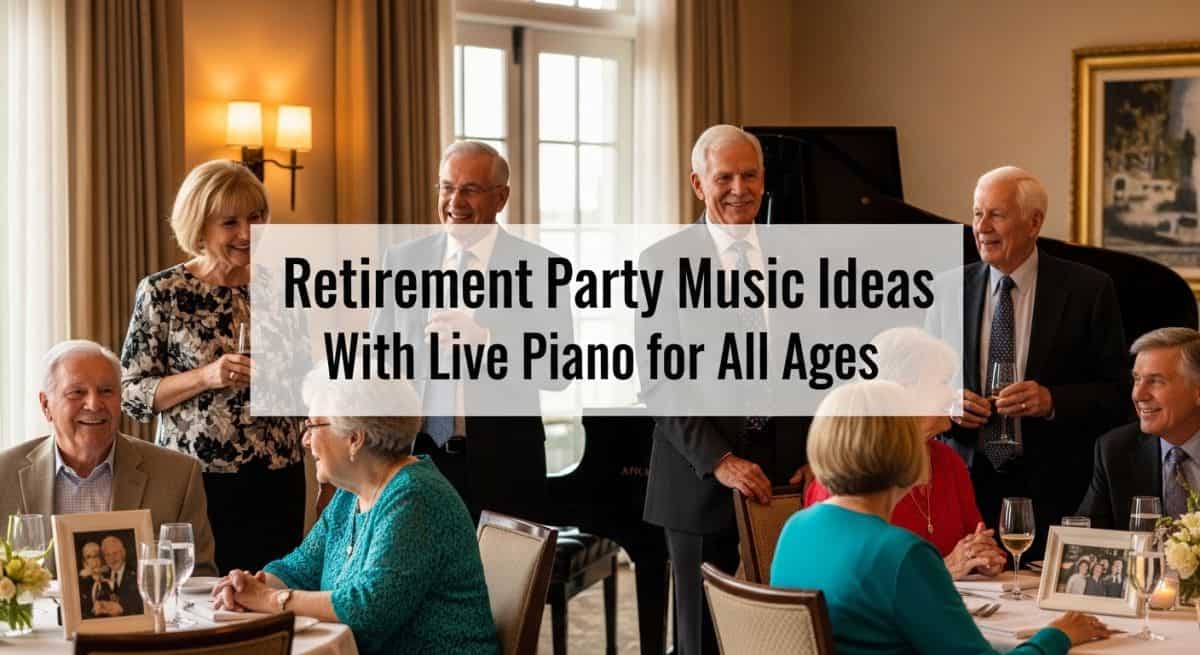
Why Retirement Parties Need a Different Music Plan
A retirement party sits in its own category. It is part workplace event, part family gathering, part tribute, and part regular party. Coworkers, parents, kids, longtime friends, and a few neighbors may all be in the same room. The music has to work for every one of them without pulling focus from the person being honored.
This guide walks through what kind of music actually fits a retirement celebration, where live piano helps most, how to plan around speeches and tribute videos, and how to keep the room feeling warm and gracious without slipping into anything corny or too loud.
Key Takeaways
- The best retirement party music is familiar, warm, and easy to talk over, not a tightly themed retirement playlist.
- Live piano fits best during arrival, mingling, dinner, and the closing send-off, with planned pauses for speeches and tribute videos.
- Mixed-age guests change the plan more than people expect; the music has to welcome coworkers, family, and friends at the same time.
- A pianist can read the room and adjust on the fly; a fixed playlist cannot.
- Slideshows, toasts, and tribute moments need their own micro-plan, not just a generic background track.
- Hosts in NJ, NYC, and Philadelphia should share venue type, timing, guest mix, and tribute moments early so the music plan has time to take shape.
The Fast Answer: What Kind of Music Works Best at a Retirement Party?
The short version: familiar, warm, low-pressure music that supports conversation and gives the tribute moments room to breathe. For most retirement parties, that means instrumental piano covering arrivals, mingling, and dinner, with thoughtful coordination around speeches and any slideshow.
The biggest mistake hosts make is treating a retirement party like a wedding reception or a high-energy birthday. It is closer to a polished private dinner with a few standout moments built in. The retiree is the focus, but they are usually not the type of person who wants the spotlight on them all night.
Live piano works because it can shift gently with the room. As guests arrive, it carries the space without making anyone shout. During dinner, it stays under the conversation. When a speech is about to start, it pauses cleanly. When the speeches are done, it picks back up and the room flows again. A pre-set playlist cannot do any of that.
If you are planning a retirement party in New Jersey, New York City, or Philadelphia, the planning principles are the same; the venues just look different.
Why Retirement Parties Need a Different Music Plan
A retirement party is not a wedding, a milestone birthday, a memorial, or a normal office mixer. It borrows a little from each, which is exactly what makes the music harder to plan than people expect.
Consider what is actually happening in the room. A retiree may have worked at the same company for 25 or 35 years. Some guests are coworkers who saw them every day. Others are family who only know the work life through stories. A few are old friends from outside the office. Kids may be present. So might a former boss the retiree has not seen in a decade.
That guest mix changes everything. The music cannot be too workplace-coded or family will tune out. It cannot lean only on one decade or genre or half the room will feel left out. It cannot be too sentimental or the energy crashes after the first toast. And it cannot be too upbeat or the tribute moments feel disrespectful.
This is why “just make a playlist” usually falls short. A playlist commits to one mood and tempo for blocks of time. Real retirement parties shift mood three or four times in a single evening.
| Event Type | Main Goal | Best Music Approach | Biggest Mistake |
|---|---|---|---|
| Wedding reception | High energy and dancing | DJ or band with peaks built in | Treating it as background only |
| Milestone birthday | Personal celebration of one person | Mix of background and dance music | Forgetting the quiet moments |
| Office mixer | Networking and easy conversation | Subtle background music | Anything that pulls focus |
| Retirement party | Honor the retiree, welcome mixed-age guests, support tribute moments | Live piano background with planned pauses | Picking one mood for the whole event |
The Real Goal Is to Honor the Retiree Without Losing the Room
A good retirement party feels personal, but it does not pin every moment on the retiree. The music should reflect who they are without turning into a one-person tribute concert.
Two extremes to avoid:
- Too sentimental. If every song is a tearjerker or a slow ballad about endings, the energy in the room sinks fast. Guests start checking their watches.
- Too jokey. Leaning hard on parody songs, novelty tracks, or “office life” gag music makes the event feel unserious. The retiree gave decades to this work. The room should reflect that.
The middle path is familiar background music, with a small handful of personal touches placed thoughtfully. A favorite jazz standard during arrivals. A song the retiree loved during dinner. Something warm and recognizable as the speeches begin to wind down. Most of the music should feel like a great room, not a personal tribute concert.
A retirement party usually works best when the music helps people settle in, talk, and enjoy the room instead of feeling like they are at a show.
Arnie Abrams
Where Live Piano Fits Best During a Retirement Party
Live piano is not a one-size tool. It works in some moments better than others. Knowing where it fits helps you build a realistic plan instead of asking the music to do everything.
| Party Moment | What Guests Are Doing | Best Music Approach | Main Planning Watchout |
|---|---|---|---|
| Guest arrival | Walking in, finding nametags, greeting the retiree | Warm familiar piano at conversation volume | Starting too loud or too dramatic |
| Mingling and cocktail period | Standing, drinks, small groups talking | Light jazz and pop standards in the background | Letting energy drift too low |
| Lunch or dinner | Seated, eating, conversation at tables | Soft instrumental piano under the conversation | Volume creep as the room warms up |
| Slideshow or tribute video | Watching, reacting, sometimes emotional | Either silence or very soft underscore | Music competing with the video audio |
| Speeches and toasts | Listening, then responding | Music paused fully, then a soft return | Coming back in too quickly |
| Closing send-off | Final mingling, goodbyes, photos | Familiar feel-good music, slightly more present | Ending music too early |
Notice that not every moment calls for music at full attention. Live piano shines because it can sit underneath the room when needed and step forward when the moment calls for it.
The Best Retirement Party Music Usually Feels Familiar, Warm, and Easy to Talk Over
A common mistake is treating background music as filler. It is not filler. It is what gives a room its tone. Done well, guests barely notice the music while it is happening, but the room feels noticeably better with it than without it.
Three things make background music work at a retirement party:
- Familiar songs. Even as background, people recognize melodies they know. A few bars of “What a Wonderful World” or a Sinatra standard register without anyone having to listen closely.
- Conversation-friendly volume. The music should sit just below the natural volume of small-group talk. Guests should never have to lean in to be heard.
- Variety without whiplash. Moving from a jazz standard to a soft-rock favorite to a Beatles tune feels natural. Jumping from a quiet ballad to a high-energy show tune does not.
Practical note on volume
If guests are starting to raise their voices to talk to people right next to them, the music is too loud. If guests cannot hear the music at all when they pause to listen, it is too quiet. Live piano lets a musician adjust in real time as the room fills up, dinner starts, and conversation gets louder.
Mixed-Age Guests Change the Music Plan More Than People Expect
The Music Should Welcome Coworkers, Family, and Friends at the Same Time
A retirement party may include a 30-year-old new hire, the retiree’s 80-year-old aunt, and a teenage grandchild, all in the same room. Each one brings a different set of musical reference points. The music plan has to make all three feel like the event is for them.
This is one reason a familiar, mixed-decade approach beats a single-decade nostalgia set. A song from the retiree’s prime years is meaningful, but if every track stays in one decade, younger guests will quietly check out. A few well-placed contemporary instrumentals keep the room balanced without making it feel like two events stitched together.
For a deeper look at how music can connect different generations in one room, the post on multi-generational appeal covers song selection, pacing, and reading the room across age groups.
One more practical point: do not let one person’s favorite songs run the whole event, including the retiree’s. A plan built only around the guest of honor’s tastes can leave the rest of the room feeling like spectators. The retiree should hear songs they love. The other 40 to 100 people should hear music that fits them too.
Live Piano vs. Playlist for a Retirement Party
Both options have their place. The right choice depends on the venue, the guest count, the format, and how much the music is being asked to do.
| Approach | Best For | Main Limitation | Best Use Case |
|---|---|---|---|
| Fixed playlist | Small casual gatherings, tight budgets, very short events | Cannot adjust to the room or pause cleanly for speeches | An hour-long office cake-and-coffee farewell with 15 to 20 people |
| Live piano | Seated meals, mixed-age groups, events with speeches and tribute moments | Requires advance planning, setup, and a suitable space | A 2 to 4 hour retirement luncheon, dinner, or evening reception with 30 to 150 guests |
| Live piano plus short playlist | Events with a brief dance segment after dinner | Need to coordinate two sound sources and timing | A retirement reception where guests want a few familiar dance songs at the end |
Live piano earns its keep at the moments a playlist cannot manage well: a speech that runs three minutes longer than expected, a slideshow with a different audio track, a tribute moment that calls for silence and then a soft return, or a room that fills up faster than planned and needs a quieter setting earlier than the playlist would have allowed.
For a closer look at how live music shapes the feel of professional and private gatherings, see the post on the psychological impact of live piano at corporate events.
Slideshows, Speeches, Toasts, and Tribute Moments Need Their Own Music Plan
Tribute moments are where most retirement parties succeed or struggle. A small amount of planning here changes the entire feel of the event.
Slideshow and tribute video
If the slideshow has its own music track, the live piano should pause. Two music sources playing at once is uncomfortable to listen to and pulls attention from the photos on screen. If the slideshow is silent, a soft underscore on piano can make a real difference. Either way, the choice should be made in advance, not during the event.
Speeches and toasts
The music should drop fully before the first speaker takes the microphone. A clean pause is much better than a fade that lingers under someone’s voice. After the speeches, the music can come back in softly, giving the room a moment to reset before normal conversation picks up again.
The tribute pause
Sometimes the most powerful moment in a retirement party is a brief silence. A gift presentation, a long hug, a quiet thank-you from the retiree. Music does not have to fill every second of the evening. Knowing when to stop playing is part of the job.
Plan tribute moments with the musician, not at the musician
Sharing the rough timeline at least a week in advance gives the pianist time to plan the transitions in and out of speeches, the slideshow, and the gift presentation. Surprises in the moment usually mean clunky transitions guests notice.
Venue, Setup, Power, and Instrument Choice
The venue does as much to shape the music as the song selection. A private dining room at a restaurant, a country club ballroom, a corporate conference center, and a host’s home all need different setups.
| Planning Factor | Why It Matters | Common Problem | Best Early Step |
|---|---|---|---|
| Piano on-site or keyboard | Determines what the musician brings | Assuming a venue piano is in playable shape | Confirm with the venue and let the musician know |
| Power access | A digital keyboard and small amp need an outlet | Outlet across the room, no extension cord planned | Confirm outlet location during the venue walkthrough |
| Speaker needs | Affects how the music carries in the room | Sound too thin or too overpowering for the space | Share the room size and ceiling height ahead of time |
| Setup window | Pianist needs time before guests arrive | Setup overlapping with guest arrival | Build in 45 to 60 minutes of setup time |
| Floor space and placement | Where the piano sits affects sightlines and sound | Tucked into a corner where the music does not carry | Identify a placement spot during planning, not on the day |
| Microphone for speeches | Who handles audio for toasts | No mic, or a mic that does not coordinate with the music setup | Confirm whether the venue or the musician handles speech audio |
For a deeper look at planning details that often get missed, the post on what Arnie Abrams wishes clients knew covers the practical questions that come up before almost every event.
What Hosts Should Think Through Early
A few decisions made early make every later step easier. None of these need to be finalized before reaching out, but having rough answers helps the conversation move quickly.
- Event format. Lunch, dinner, evening reception, or open-house style? The format shapes the music plan more than anything else.
- Guest count and mix. Roughly how many people, and what is the age spread? A 25-person family dinner is a different plan than a 120-person workplace reception.
- Tribute moments. Will there be speeches? A slideshow? A gift presentation? A toast from the retiree?
- Retiree’s preferences. A few favorite artists, songs, or styles to know early. Not a full request list, just a sense of the person.
- Do-not-play notes. Songs or styles to avoid, even if guests request them. This often matters more than the favorites list.
- Venue details. Type of space, size, whether a piano is on-site, and any setup constraints.
Planning a Retirement Party in NJ, NYC, or Philly?
If you are weighing whether live piano fits the event, the easiest first step is a short conversation about the venue, timing, and guest mix. Arnie Abrams can help you think through what kind of music coverage actually makes sense, even if not every detail is finalized yet.
Ask About Availability Or call directly: (732) 995-1082Common Mistakes That Make Retirement Party Music Feel Wrong
Most music problems at retirement parties trace back to a small set of mistakes. Knowing them in advance is half the fix.
- Music too loud. The most common one. Guests end up shouting and the room feels exhausting after an hour.
- Too sentimental from start to finish. Heavy ballads stacked back-to-back drag the energy down before the speeches even begin.
- Leaning on joke songs. A novelty track once is fine. Three or four start to make the event feel unserious.
- Ignoring slideshow audio. Music and a video soundtrack playing on top of each other is one of the most jarring sounds at any event.
- Planning only around the retiree’s taste. The retiree should be honored, but the room is full of people who came to honor them. Both matter.
- Discussing setup too late. Power, placement, and timing details that come up the day-of usually mean compromises.
- Assuming a small room needs no plan. A small space actually needs more careful volume control, not less.
- Skipping the timeline. A pianist with no sense of the schedule cannot pace the music properly.
Once I know the guest mix, the timing, and where the tribute moments fall, it gets much easier to shape the music around the event instead of guessing.
Arnie Abrams
When Live Piano Makes the Biggest Difference at a Retirement Party
Live piano is not the right answer for every retirement event. A 20-minute office cake cutting in a breakroom does not need a pianist. A 3-hour evening reception with toasts and a slideshow almost certainly does. Some specific settings where live piano carries the most weight:
- Private restaurant rooms. Mid-size dining rooms where guests are seated, conversation matters, and a DJ would feel out of place.
- Country clubs and banquet rooms. Spaces designed for polished events, often with a built-in expectation of live music.
- Office farewell receptions held at a real venue. Workplace events that move out of the office into a hotel, restaurant, or rented space.
- Family-hosted retirement dinners. Gatherings hosted at home or at a private venue, where the tone is warm and personal.
- Lunch events. Daytime celebrations where energy should stay gracious without dipping too low.
- Open-house style celebrations. Events where guests come and go over a few hours and the music helps the room feel continuous.
For broader context on how live piano shapes private celebrations, the post on live piano for birthdays covers similar planning principles for milestone parties.
One quick distinction worth making: a retirement party is not the same as senior center entertainment. The latter is a regular programmed performance for residents, often interactive. A retirement party is a one-time celebration with a different structure, audience, and goal. Both involve live piano, but the planning approach is different.
The 3 Things Arnie Abrams Needs From You
To shape a useful music plan quickly, three pieces of information do most of the work:
- Event type, venue, and basic room setup. Knowing whether the event is a private restaurant lunch, a country club reception, an office space, or a home gathering tells the pianist what to plan for in terms of sound, setup, and instrument choice.
- Timing, guest mix, and what the music should support. A rough schedule, an estimated guest count, and a sense of the age range help shape the pacing of the music across the event.
- Any tribute moments, speeches, or favorite styles to know early. Knowing where speeches fall, whether there is a slideshow, and a few of the retiree’s preferred styles or songs makes the music feel personal without needing a full request list.
Even rough answers help. Final timelines and song choices can be refined later. The early conversation is more about whether live piano is a good fit for the event you are building.
Quick Decision Guide: Is Live Piano the Right Fit for This Retirement Party?
Answer these quickly
Will guests be seated for at least part of the event?
If yes, live piano fits well. Seated time is when background music does the most work.
Are there speeches, toasts, or a slideshow planned?
If yes, live piano is a strong fit. The musician can pause cleanly and return softly without anyone managing playlist transitions.
Is the event longer than 90 minutes?
If yes, live music keeps the room from feeling stale across a longer event.
Will guests span more than two generations?
If yes, a pianist reading the room generally serves a mixed crowd better than a fixed playlist.
Does the venue have space for a piano or keyboard setup with a small footprint?
If yes, the setup is straightforward. Most private rooms, banquet spaces, and home settings work fine.
Is this a brief 20 to 30 minute office gathering?
If yes, a short playlist may be enough. Live piano usually shines for events of an hour or more.
If most of the answers point toward live piano, the next step is a short conversation about the basics. The fit usually becomes clear once the event purpose, guest mix, and timing are on the table.
Final Planning Guide for a Retirement Party That Feels Warm, Polished, and Personal
Pulling everything together, a strong retirement party music plan usually looks something like this:
Retirement Party Music Planning Framework
- Lock in the venue and the rough timeline first; the music plan follows from those.
- Map out the moments that matter: arrival, mingling, dinner, slideshow, speeches, send-off.
- Decide what each moment needs: background music, soft underscore, full pause, or something more present.
- Gather a short list of the retiree’s preferred songs, artists, or styles, plus any do-not-play notes.
- Confirm whether the venue has a piano on-site or a keyboard is needed.
- Confirm power access, setup window, and where the pianist will be placed in the room.
- Coordinate slideshow audio and microphone needs in advance, not on the day.
- Share the timeline with the pianist a week or more before the event.
- Plan the closing send-off so the music ends the evening on the right note instead of trailing off.
The goal is simple: the room should feel welcoming when guests arrive, comfortable through dinner, focused during the speeches, and warm during the send-off. The music is one of the quietest tools that makes all of that happen.
If you want to compare other event types and planning resources, the site map is a good way to see how retirement parties fit alongside corporate events, private parties, and milestone celebrations.
Frequently Asked Questions
Is live piano a good fit for a retirement party?
For most retirement parties longer than an hour, yes. Live piano works especially well for seated meals, receptions with speeches, and events with mixed-age guests. The music can sit quietly under conversation, pause cleanly for toasts and tribute videos, and return softly afterward. Brief 20 to 30 minute office gatherings usually do not need live music; a short playlist is enough for those.
What kind of music works best for a retirement celebration?
Familiar, warm, conversation-friendly music covers most of the event well. Instrumental piano versions of jazz standards, soft rock favorites, Beatles tunes, Broadway, and the Great American Songbook work across age groups. A few personal touches tied to the retiree’s favorite songs or artists add meaning without making the whole event feel like a single-person tribute concert.
Is live piano too formal for a retirement party?
No, and that surprises people. Live piano can be as casual or as polished as the event calls for. A relaxed family dinner with live piano feels warm, not stiff. The instrument itself does not dictate the mood; the song selection, volume, and pacing do. A pianist used to private events knows how to match the music to the room.
Can music continue during speeches and slideshows?
Music should pause fully during speeches so the speaker is easy to hear. For slideshows, it depends on whether the video has its own audio track. If it does, the live music pauses. If the slideshow is silent, soft underscore on piano can support it. The plan should be set in advance so transitions are clean.
Does a retirement party need a full piano?
Not at all. Most venues do not have a piano on-site, so a quality digital keyboard with a small amplifier is standard. A keyboard setup has a small footprint, sets up in under an hour, and sounds excellent in the kinds of rooms most retirement parties use. If the venue does have a piano, that can be used instead.
Can Arnie play for office and family retirement parties?
Yes. Office-hosted, family-hosted, and friend-hosted retirement parties all follow similar planning principles. The differences usually show up in venue type and tone. Office events often happen at restaurants, hotels, or country clubs. Family events may happen at homes or smaller private rooms. The music plan adjusts to fit each setting.
Does location in NJ, NYC, or Philadelphia affect planning?
The planning principles are the same across the tri-state area, but venue styles vary. New Jersey and Pennsylvania often involve country clubs, banquet halls, and restaurant private rooms. New York City events more often happen in hotels, private clubs, or restaurant spaces with tighter footprints. Knowing the venue early helps shape the setup plan.
What information should I send when I inquire?
The most useful early details are event type, date, venue, rough start and end time, estimated guest count, and whether there will be speeches or a slideshow. A few notes on the retiree’s preferred music styles and any songs to avoid help too. Final details can be refined later; the first conversation is mostly about whether live piano fits the event you are planning.
Plan a Retirement Party That Feels Warm, Polished, and Personal
If you are putting together a retirement celebration in New Jersey, New York City, or Philadelphia, a short conversation can help you decide whether live piano fits the event. Arnie Abrams can help you think through venue, timing, guest mix, tribute moments, and setup so the music plan matches the room and the retiree.
Call or text directly: (732) 995-1082