
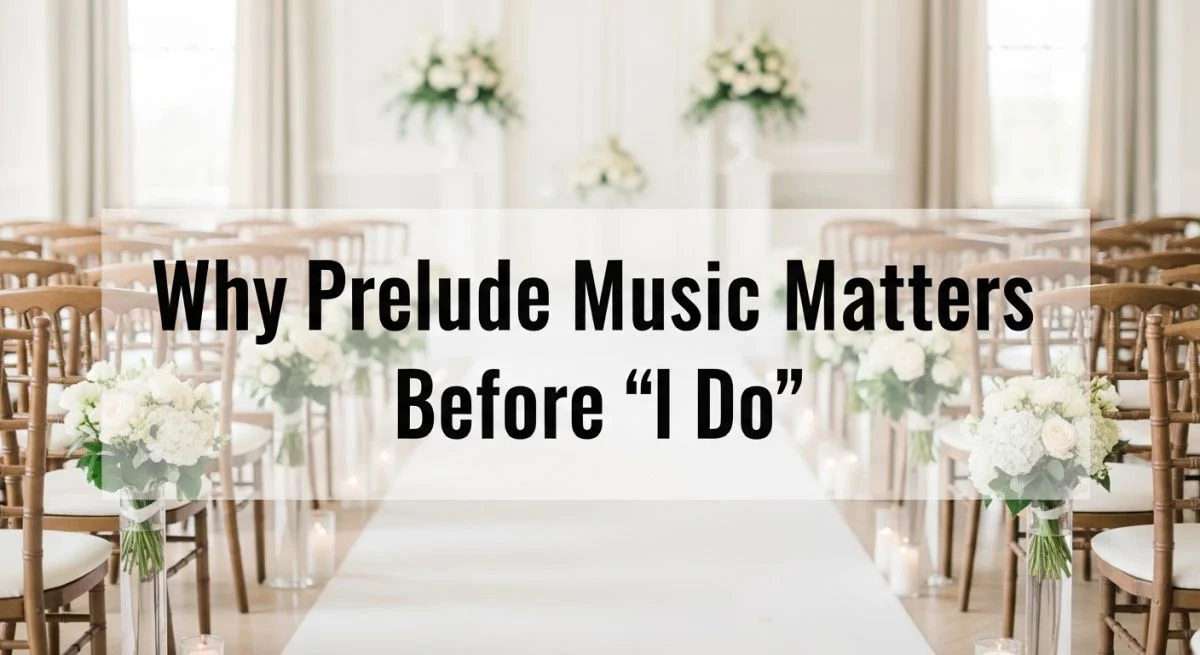
How Guest Arrival Music Sets the Tone Before the First Walk Down the Aisle
Think about the last wedding ceremony you attended. You probably remember the processional, the vows, maybe a reading. But do you remember what the room felt like when you first sat down? Whether it felt settled and warm, or scattered and restless? That early impression was shaped almost entirely by what was (or was not) playing during the last 15 to 20 minutes before the ceremony started.
That window of time is called the prelude. And for most couples, it gets almost no planning at all. The processional song gets debated for weeks. The prelude gets a shrug. The result is a ceremony that starts cold, with guests still chatting at full volume and no clear signal that something important is about to begin.
The Last 20 Minutes Before I Do: Why Prelude Music Matters
Those final minutes before the ceremony are doing real work. The right prelude music shapes the energy in the room, quiets scattered conversation, and builds a natural bridge into the processional. Plan it well, and every guest is already in the right frame of mind before the first note of the processional sounds.
Key Takeaways
- Prelude music is the 15 to 20 minutes of live or recorded music guests hear while being seated before the ceremony begins.
- It shapes guest attention, quiets conversation, and sets emotional tone before the processional starts.
- The pacing of prelude music should gradually shift from relaxed to focused as the ceremony nears.
- Live piano works especially well because a pianist can read the room, adjust volume, and handle real-time timing changes.
- Common mistakes include starting too dramatically, playing too loud, running out of music, and skipping the transition into the processional.
- A well-planned prelude makes the transition into the processional feel intentional instead of abrupt, giving the first entrance its full impact.
- Couples only need to share three details with their musician to build a strong prelude plan: venue setup, guest arrival timeline, and preferred music style.
The Fast Answer: Why Prelude Music Matters
Prelude music is the music that plays while guests are arriving and taking their seats, starting roughly 15 to 20 minutes before the ceremony. It is not filler and it is not a warm-up act. It does several things at once:
- Gives the room a consistent emotional backdrop that shifts attention from socializing to settling in.
- Covers the natural noise of guest arrival, seat shuffling, and chatter so the space does not feel chaotic.
- Creates a clear sonic boundary between the social part of the day and the ceremony itself.
- Provides a pacing track that helps coordinators, ushers, and the wedding party manage timing.
Live piano often works especially well here because a pianist can adjust tempo and volume in real time. If guests are still streaming in, the music can stay relaxed. If the room has mostly settled, the pianist can begin tightening the feel to prepare for the processional. A playlist cannot make those calls on the fly.
Most couples underestimate the prelude because it seems passive. It is “just the music playing while people sit down.” But there is a real difference between music that fills silence and music that actively shapes the room. The first is background noise. The second is preparation. When the prelude is planned well, guests shift from social energy to ceremonial focus naturally, without anyone needing to ask them to quiet down or pay attention.
The prelude is also the part of the ceremony timeline most likely to stretch. If the wedding party is running five minutes behind, or the photographer needs extra time, or traffic delays a few carloads of guests, the prelude is what keeps the room comfortable during the wait. Without it, those extra minutes feel empty and tense.
If you are planning a ceremony in New Jersey, New York City, or Philadelphia, the prelude window is worth a few minutes of real planning. It costs nothing extra to think through, and it makes the ceremony opening feel intentional instead of abrupt.
What Prelude Music Is Actually Doing in the Room
To understand why prelude music matters, it helps to think about what is actually happening in the space during those last 20 minutes.
Guest Arrival Energy
Guests show up in clusters. Some arrive early and sit quietly. Others rush in at the last minute, scanning for open seats. The energy in the room during this window is scattered. People are greeting each other, checking their phones, adjusting jackets, and looking around. Without music, this feels like a waiting room. With the right prelude music, it feels like an event that has already started.
Chatter Level and Volume
Music gives people a volume reference point. Soft, steady piano in the background naturally encourages quieter conversation. Guests do not consciously think about this, but it happens. Remove the music and the room gets louder because there is nothing holding the noise floor in place.
Emotional Tone
Prelude music tells guests how to feel before anyone says a word. A few minutes of gentle classical piano signals formality. Light jazz signals warmth and ease. Soft modern covers signal a personal, relaxed celebration. The couple gets to decide this tone in advance, and the prelude carries it.
Helping Late Arrivals Blend In
Guests who arrive close to start time often feel self-conscious walking to their seats in a quiet room. Prelude music provides acoustic cover. It lets latecomers settle in without drawing attention, which keeps the room calm and avoids awkward pauses. This matters more than couples realize, especially at ceremonies with 80 or more guests where a handful will always be running behind.
First Impressions Before the Ceremony Starts
The prelude is the first thing guests experience inside the ceremony space. Before any readings, vows, or music, the prelude sets the baseline expectation for the entire event. A guest who sits down to silence and shuffling chairs forms a very different first impression than a guest who sits down and immediately hears something gentle and intentional. That early impression carries forward. If the room already feels right, the processional lands harder and the ceremony feels tighter from the start.
Multi-Generational Guest Comfort
Wedding guest lists typically span three or four generations. Grandparents in their 80s are sitting next to cousins in their 20s. Children may be present. Each group handles waiting differently. Older guests tend to sit quietly but may become restless if the wait feels unstructured. Younger guests tend to talk more and check their phones. Children get fidgety fast. Prelude music gives every age group something neutral to settle into. It does not demand attention, but it fills the room in a way that keeps people comfortable regardless of how they naturally handle waiting.
Consider the difference between a ceremony with 150 guests in a large church and a ceremony with 30 guests in a private garden. In the church, the prelude does heavy lifting: managing noise from a large crowd, covering the echo of footsteps on stone floors, and pulling scattered attention toward a shared emotional center. In the garden, the prelude is lighter but still essential. Silence in an outdoor space can feel exposed, even awkward, especially when guests are sitting in open air with nothing between them and ambient noise.
Prelude Music vs Processional Music
These two are connected but serve very different purposes. The prelude is about the room. The processional is about the people walking down the aisle. Here is a side-by-side breakdown:
| Element | Prelude Music | Processional Music | Why the Difference Matters |
|---|---|---|---|
| Purpose | Set the atmosphere while guests arrive and sit down | Accompany the wedding party and couple as they walk down the aisle | The prelude shapes the room; the processional directs all attention to the aisle |
| Timing | 15 to 20 minutes before the ceremony | Starts once seating is complete and the officiant signals the beginning | Prelude needs to fill variable time; processional follows a fixed sequence |
| Emotional Intensity | Low to moderate, gradually increasing | Moderate to high, depending on the song | Starting too strong during the prelude steals the processional’s impact |
| Guest Attention | Casual and unfocused early, then slowly sharpening | Fully directed at the aisle | Prelude must manage distraction; processional assumes attention is already there |
| Flexibility | High. Songs can be extended, shortened, or swapped if timing shifts | Low. Each piece matches a specific entrance | A live pianist can stretch or compress the prelude based on real-time needs |
| Volume | Soft and ambient, staying below normal conversation | Louder, enough to clearly signal the ceremony is beginning | Volume contrast between the last prelude song and the first processional song creates a noticeable shift |
The handoff between prelude and processional is one of the most important transitions in the entire ceremony. A brief pause or a subtle shift in key and volume tells the room, “Here we go.” Without that contrast, the ceremony start feels flat.
When the transition is poorly handled, guests may not even realize the processional has begun. The officiant starts walking, or the doors open, and half the room is still mid-conversation. A strong handoff prevents that. The final prelude piece should bring the energy down to a focused, quiet point, followed by a clear pause of two to five seconds. Then the processional begins at a noticeably different volume and feel. That contrast is what gets everyone to turn, stand, and pay attention.
On the other hand, when there is no pause at all and the processional starts at the same volume and tone as the prelude, the transition disappears. The ceremony just sort of begins, and the emotional impact of that first entrance is lost.
The Final 20-Minute Timeline Before the Ceremony
Here is a practical breakdown of what should happen musically during the prelude window. Every ceremony is a little different, but this timeline gives a solid starting framework.
| Time Before Ceremony | What Is Happening | Music Goal | Suggested Feel |
|---|---|---|---|
| 20 to 15 min | Early guests arrive. Ushers are seating people. The room is filling slowly. | Provide a warm, welcoming background. Keep volume low and unobtrusive. | Light classical, soft jazz standards, or gentle modern instrumentals. Think background warmth. |
| 15 to 10 min | Most guests are now seated. The chatter level is at its peak. More seats are filling in. | Hold the emotional center. Keep things steady. Give the room a consistent feel. | Slightly more expressive pieces. A touch more depth, but nothing dramatic. |
| 10 to 5 min | The room is nearly full. Final guests arriving. Coordinator cueing wedding party backstage. | Start narrowing the emotional range. Music should begin to feel more intentional. | Slower, more lyrical selections. A bit more weight in the melody. Fewer upbeat pieces. |
| Final 3 to 5 min | All guests seated. The room quiets. Everyone senses the ceremony is about to begin. | Clearly signal a shift is coming. Emotional handoff to the processional begins. | One focused, slightly more emotional piece. Brief, clean pause before processional. |
In practice, this timeline often runs a few minutes longer or shorter than planned. Ushers may still be seating guests at the 10-minute mark. The coordinator may hold the processional for a few extra minutes while the wedding party finishes photos. A live pianist handles this naturally by reading the room and extending or compressing the middle segments. A playlist runs on its own clock, which is why timing mismatches are more common with recorded music.
The coordinator plays a key role here. They are the link between what is happening backstage (wedding party lineup, flower girl readiness, last-minute adjustments) and what the musician needs to know. If the coordinator signals “two more minutes,” the pianist can begin the final prelude piece. Without that communication, the pianist has to guess, and the handoff to the processional becomes uncertain.
Late arrivals also affect the timeline. At a ceremony with 100+ guests, it is common for a small group to arrive five minutes before the scheduled start. If the prelude has already wound down and a pause has begun, those latecomers walk in during silence, which is uncomfortable for them and distracting for the room. Planning a slightly longer prelude cushion prevents this.
Ask your venue coordinator or day-of planner to confirm the expected guest arrival window. If your ceremony starts at 4:00 PM and most guests will arrive between 3:35 and 3:50, you need roughly 20 to 25 minutes of prelude material. Having too little music is a common problem that leaves awkward silence at the end. Always prepare at least 5 extra minutes of material beyond your best estimate.
Common Prelude Music Mistakes Couples Make
Most couples do not plan prelude music poorly on purpose. They just underestimate how much this short window shapes the ceremony opening. Here are the mistakes that come up most often:
- Starting too dramatically. If the first song guests hear sounds like it belongs in the processional, there is nowhere for the music to build. The whole prelude goes flat because you started at the emotional ceiling.
- Playing too loud for the room. Prelude music should sit underneath conversation, not compete with it. In a small chapel or an intimate garden ceremony, volume control is critical. Guests should be able to talk comfortably without raising their voices.
- No real transition into the processional. The shift from prelude to processional should feel deliberate. If the prelude just fades out without any change in tone or a brief pause, the processional entrance loses its impact.
- Not enough music for the seating window. If guests start arriving 25 minutes before the ceremony and you have 12 minutes of prelude music prepared, you will run out. Silence followed by music feels disjointed. Always plan for more time than you think you need.
- Prelude style that clashes with the ceremony. An upbeat jazz set followed by a traditional church processional creates a disconnect. The prelude should feel like a natural lead-in to what comes next.
- Choosing pieces that are too recognizable too early. If guests hear the big emotional song during the prelude, it loses its punch later. Save the recognizable hits for moments where you want full attention. The prelude should feel warm but not spotlight-grabbing.
- Not accounting for ceremony delays. Ceremonies run late more often than they start early. If the prelude plan only covers exactly 15 minutes, a five-minute delay means five minutes of silence at the end. Build in a buffer.
- No clear final prelude piece. The last thing guests hear before the processional should feel like a deliberate closing. If the prelude just stops mid-song because the coordinator gave the cue, the transition feels abrupt and unplanned.
- Treating prelude as an afterthought. Many couples spend hours on the processional song but give the prelude no thought at all. The result is often a generic playlist that does nothing for the room.
| Mistake | Why It Hurts the Ceremony | Better Approach |
|---|---|---|
| Starting too dramatic | Nowhere for the energy to build; processional feels flat | Begin soft and build gradually over the full prelude window |
| Volume too high | Guests stop talking and start waiting; creates tension too early | Keep music below conversation level until the final minutes |
| No transition to processional | Ceremony start feels abrupt; guests miss the first entrance | End on one clear final piece, pause 3 to 5 seconds, then begin processional |
| Too little material | Silence at end of prelude feels awkward and exposes delays | Prepare at least 25 minutes of music even for a 15-minute window |
| Big recognizable song too early | Steals attention and reduces impact when used later | Save recognizable pieces for the last 5 minutes or the processional |
| No delay buffer | Dead air if the ceremony runs 5 to 10 minutes late | Always have extra material ready; a live pianist can improvise as needed |
The prelude is where you set the table for everything that follows. When couples skip it or rush through it, the ceremony has to work harder to pull the room together.
Arnie Abrams, PianistMatching Prelude Music to the Venue and Crowd
The best prelude music fits the space and the people in it. What works in a stone church will feel wrong in a beachfront ceremony. Here is how venue type affects prelude planning:
Churches and Houses of Worship
Stone, wood, and high ceilings create natural reverb. Sound carries further and lingers longer. Softer, slower pieces work best because the acoustics amplify everything. Classical selections or hymn-based instrumentals often suit the space. If the church has an organ or grand piano on site, the instrument itself adds to the tone. Many NJ and Philadelphia-area churches have a grand piano near the altar or in the choir loft, which means setup logistics are minimal. Ask the church coordinator about access and tuning status at least a month before the ceremony.
Hotel Ballrooms and Banquet Venues
These rooms tend to absorb sound more than churches. Carpet, drapes, and lower ceilings reduce natural reverb. A digital keyboard with a small amplifier often works well here because you can control the output precisely. The music can be slightly more contemporary without feeling out of place. For Manhattan hotel ceremonies where space is tight and load-in logistics can be complicated, confirm elevator access, freight entrance timing, and equipment storage with the hotel event manager. If you are considering NJ wedding venues with live music, ask about piano availability and setup early.
Garden and Park Ceremonies
Outdoor settings are the most variable. Wind, open air, ambient noise from nearby roads or water features all compete with the music. Volume needs to be higher than indoor settings, but the style should still be restrained during the prelude. Garden and park ceremonies benefit from portable keyboard setups that allow the musician to control volume and placement carefully. Position the keyboard where it projects toward guests without bouncing off walls or structures. In North Jersey estate gardens and Main Line properties, check whether the ceremony site has electrical access or if a generator is needed.
Beach and Jersey Shore Ceremonies
Wind and waves are the main challenges. Sound does not carry well in open beach settings, so amplification is almost always necessary. Battery-powered setups or generators with long cable runs become part of the planning. Prelude music at a Jersey Shore wedding needs to be clean and clear, even at moderate volume. Simple instrumental piano often cuts through beach noise better than complex arrangements. Sand, salt air, and direct sun can affect equipment, so plan for shade coverage and equipment protection.
Historic Venues and Estates
Older properties in areas like the Main Line or North Jersey estates often have specific load-in restrictions, fragile flooring, and room shapes that affect sound. Check with the venue about instrument placement before the wedding day. A grand piano in a large marble foyer sounds very different from a keyboard in a side parlor. The prelude music style should match the formality of the setting. Philadelphia and Bucks County estates in particular may have strict noise ordinances or load-in windows that affect timing.
Small Private Ceremonies
With fewer than 30 guests, every sound is more noticeable. Quiet, gentle prelude music works best. A solo pianist at moderate volume can fill a small room without overpowering it. In these intimate settings, the prelude period is shorter because guests are already close together and conversations are naturally quieter. Even 10 minutes of well-chosen piano can make the room feel composed and ready.
| Venue Type | Best Prelude Feel | Setup Note | Main Watch-Out |
|---|---|---|---|
| Church / House of Worship | Classical, hymn-based, gentle | Often has a grand piano on site; confirm tuning | Natural reverb amplifies volume; start quieter than expected |
| Hotel Ballroom | Contemporary or light jazz; slightly warmer feel | Digital keyboard with amplifier; confirm load-in and power | Sound absorption can muffle music; test volume during setup |
| Garden / Park | Soft instrumentals; nothing too delicate | Portable keyboard; may need generator or battery power | Wind and ambient noise compete with music; amplification needed |
| Beach / Jersey Shore | Clean, simple piano; clear melodies that cut through noise | Amplification required; weather protection for equipment | Wind, waves, sand, and salt air; always have shade and covers |
| Historic Estate | Formal and elegant; match the setting’s character | Check load-in restrictions and floor weight limits | Room acoustics vary; marble vs. wood floors change sound |
| Small Private Space | Quiet, gentle, understated | Solo piano at moderate volume; minimal equipment | Every sound is more noticeable; keep volume very controlled |
Planning Ceremony Music in NJ, NYC, or Philadelphia?
Arnie Abrams can help you plan the prelude, processional, and every other ceremony music moment. Share your venue details and ceremony timeline, and he will work with you on a prelude plan that fits.
Ask About Ceremony MusicLive Piano or a Playlist?
Not every ceremony needs a live musician for the prelude. Here is an honest look at when each option fits best.
When Live Piano Is the Better Fit
- The ceremony is formal or semi-formal and guests expect a polished atmosphere.
- The arrival window is unpredictable, and someone needs to manage the pacing in real time.
- The venue has a grand piano or acoustic piano already in the space.
- The prelude to processional handoff needs to be precise and coordinated with the wedding party.
- The couple wants their ceremony to feel personal and intentional from the very first note.
When a Simpler Setup May Be Enough
- The ceremony is small and casual with a flexible start time.
- Budget constraints make live music impractical for the ceremony portion.
- The venue already has a built-in speaker system and a coordinator managing music cues.
- The couple is comfortable with pre-selected songs and does not need real-time flexibility.
The Hybrid Approach
Some couples use a recorded playlist for the early portion of the prelude and bring in a live pianist for the final 10 minutes and the processional. This approach works well when budget matters but the couple still wants a live handoff into the ceremony. The playlist handles the background portion of guest arrival, and the pianist takes over once most guests are seated. The key is coordinating the switch cleanly so there is no awkward silence or audio overlap between the speaker system and the live instrument.
Scenario-Based Advice
Formal indoor ceremony (100+ guests, hotel ballroom or church): Live piano is the strongest fit here. The room is large, the crowd is big, and the processional handoff needs precision. A live pianist can manage the energy across 20+ minutes without any timing gaps.
Small private ceremony (under 30 guests, home or private venue): A thoughtfully arranged playlist can work well. The crowd is small, conversations are quieter, and the prelude window may only be 10 minutes. If the budget allows, a live pianist at low volume adds warmth, but it is not required.
Outdoor ceremony with shifting timing (garden, park, or beach): Live piano is strongly preferred. Outdoor ceremonies are the most likely to run behind schedule because of weather, transportation, or setup delays. A live pianist adjusts on the spot. A playlist runs on its own clock.
| Option | Best Fit | Main Advantage | Main Limitation |
|---|---|---|---|
| Live Pianist | Formal and semi-formal ceremonies, larger guest counts, venues with a piano on site | Real-time volume, pacing, and song adjustments; coordinated processional handoff | Higher cost; requires instrument access or keyboard setup |
| Pre-Built Playlist | Small, casual ceremonies with flexible timing | Lower cost; easy to set up with a venue speaker system | Cannot adjust to timing changes; handoff to processional is harder to nail |
| Hybrid (Playlist + Live) | Budget-conscious couples who want a live processional handoff | Saves cost on the early prelude while keeping live presence for the key transition | Requires careful coordination of audio switch between speaker and live instrument |
| Recorded Piano Music | Couples who want a piano sound without a live performer | Consistent sound; no setup logistics | No live interaction; volume and pacing are fixed |
Choosing Prelude Music Without Overthinking It
Couples sometimes stall on prelude planning because they feel pressure to pick exact songs. That level of detail is not usually necessary. Instead, focus on the overall feel and let your musician (or playlist) fill in the specifics.
Here are the categories that cover most prelude needs:
- Familiar instrumental pieces. Songs most guests would recognize if they heard them played softly on piano, like “Clair de Lune” or an Adele cover. These create a comfortable, warm feel without demanding attention.
- Light classical. Pieces by composers like Chopin, Debussy, or Satie that carry a gentle emotional tone. These suit churches and formal settings especially well.
- Modern piano covers. Instrumental versions of recent pop or indie songs. A soft piano version of something familiar can feel personal without being distracting.
- Understated romantic songs. Pieces that carry warmth without being heavy. Think of music you would hear in a quiet restaurant, not on a movie soundtrack.
A Simple 4-Step Approach
- Start with the room. What does the space look and feel like? A stone church calls for different music than a sunlit garden. Let the venue guide your instincts.
- Define the emotional tone. Calm and formal? Relaxed and warm? Quietly emotional? Name it in one or two words. That is your brief to the musician.
- Think about the guest mix. A crowd that skews older may connect more with jazz standards and classical pieces. A younger crowd may respond better to acoustic covers of modern songs. A mixed crowd benefits from a blend.
- Build toward the processional. The final prelude piece should feel like it is preparing the room for something specific. Work backward from the processional song and choose a final prelude piece that leads naturally into it without overlapping in mood.
If You Are Stuck, Start With the Room, Not the Song
Ask yourself: What should the room feel like when most guests are seated? Calm and formal? Relaxed and warm? Quietly emotional? Once you name that feeling, your musician can build a prelude set that fits. You do not need to provide a track list. You need to provide a direction.
For more on choosing ceremony music, including how the prelude fits within the broader ceremony structure, Arnie has written about that process in detail.
Volume, Tempo, and Flow Matter More Than Most Couples Expect
The song choices during the prelude matter less than how they are played. Three factors shape the guest experience more than the specific titles in the set:
Volume
Prelude music should sit below the level of normal conversation. Guests should be able to talk without raising their voices. If the music is too loud, people stop talking and start waiting, which makes the room feel awkward if the ceremony is still several minutes away. If it is too soft, it disappears entirely and the room feels empty.
Too loud in practice: In a small chapel seating 60 guests, a digital keyboard at full volume with an amplifier makes it hard for anyone in the first four rows to have a conversation. Guests stop talking, cross their arms, and wait. The room tenses up 15 minutes too early. Too soft in practice: In a large hotel ballroom, a keyboard without amplification gets lost under the noise of 150 guests chatting. The music may as well not be playing. Guests do not settle because there is no acoustic anchor holding the room.
Tempo
Aim for music that feels calm but present. Extremely slow music can make the wait feel longer than it is. Music that is too upbeat or rhythmic pulls focus from settling in. A moderate, steady tempo works best for most of the prelude. In the final few minutes, a slightly slower pace helps signal the transition ahead.
Too slow: Imagine a room of guests seated for 18 minutes listening to nothing but ultra-slow adagios. The energy drops so low that the room feels sleepy instead of focused. Too random: A playlist that jumps from an upbeat jazz number to a slow classical piece to a pop cover every three minutes creates a jarring, unfocused experience. The room never settles into a consistent mood.
Flow
The prelude should feel like one continuous musical arc, not a random shuffle. Songs should connect to each other in key, energy, or mood. A live pianist handles this naturally by choosing transitions in the moment. For playlists, the order matters more than couples usually realize. Arrange songs so the energy builds gently from start to finish.
In an outdoor ceremony where wind picks up and ambient noise shifts, a live pianist can raise the volume slightly and shift to cleaner melodies that carry better in open air. A playlist plays the same recording regardless of what is happening in the space. This is where the live advantage shows up most clearly during the prelude window.
I always plan the last prelude piece with the processional in mind. That final song needs to bring the room to a quiet, focused point so the first processional note lands the way it should.
Arnie Abrams, PianistPractical Setup Issues Couples Forget
Prelude music does not just happen. There are logistics involved, and a few common oversights can create problems on the day.
Is There a Piano on Site?
Many churches and some hotels have a grand or upright piano available. If the venue does, confirm its condition and tuning schedule. A piano that has not been tuned in months will sound off no matter how skilled the pianist is. If there is no piano on site, a digital keyboard with weighted keys is the standard solution. Most professional pianists bring their own keyboard as part of their standard setup.
Acoustic Piano vs Digital Keyboard
A venue grand piano sounds richer and more resonant, especially in churches and large halls with natural reverb. But it cannot be moved, volume-controlled, or amplified easily. A digital keyboard with weighted keys gives the pianist full volume control through an amplifier, works in any space with power access, and travels to outdoor and non-traditional locations. For prelude music, volume control matters more than tone quality. In most ceremony settings, a good digital keyboard sounds excellent and offers more flexibility than a venue piano that may be out of tune or poorly placed.
Instrument Placement in the Room
Where the keyboard or piano sits affects how the prelude sounds to guests. Placing the instrument too far from the seating area means the music may not reach the back rows. Placing it too close to the front can overpower people in the first few seats. The ideal placement is off to one side, angled to project sound across the seating area without dominating any single section. Ask the venue about typical musician placement during ceremony events.
Power and Setup Footprint
Digital keyboards need a power outlet within cable reach and enough floor space for the keyboard, bench, pedal, and a small amplifier if the room needs one. Confirm this with the venue in advance. Extension cords across a center aisle are a safety problem and an eyesore.
Outdoor Weather Concerns
Direct sunlight can damage a keyboard and make playing uncomfortable. Wind affects sheet music and can push sound unevenly. If the ceremony is outside, make sure there is shade over the instrument and a backup plan for sudden weather changes. For Jersey Shore and garden weddings, a tent or canopy over the instrument area is strongly recommended.
Load-In and Timing
The musician needs time to arrive, set up, tune, and sound check before guests start arriving. For most venues, that means the pianist should be on site at least 45 minutes to an hour before the ceremony. Check with the venue about load-in access and timing restrictions.
Who Gives the Processional Cue?
The prelude to processional handoff depends on clear communication. Your day-of coordinator or officiant should know exactly when to signal the pianist to end the prelude and begin the processional. A missed cue here creates an awkward gap or an abrupt start. Discuss this at the rehearsal. Establish a simple, visible signal: a hand gesture, a nod, or a discreet text message.
| Instrument Option | Best Fit | What It Solves | Main Limitation |
|---|---|---|---|
| Venue Grand Piano | Churches, concert halls, large ballrooms | Rich sound; no equipment to transport; impressive visual presence | May be out of tune; cannot control volume; fixed location |
| Upright Piano | Chapels, smaller indoor venues, private homes | Warmer acoustic tone; good for smaller rooms | Often poorly maintained; cannot amplify; hard to move |
| Digital Keyboard | Any venue, indoor or outdoor | Full volume control; portable; works with amplifier; reliable tuning | Requires power outlet or battery; slightly different touch feel |
| Recorded Backup | Emergency fallback for equipment failure | Ensures music continues if the live setup has a technical issue | No live interaction; fixed pacing and volume |
Share this with your venue coordinator or planner:
- Confirm whether a piano is on site and its current tuning status
- Identify power outlet location if a digital keyboard is needed
- Confirm musician load-in time and access
- Confirm instrument placement in the ceremony space
- Assign someone (coordinator, officiant, or usher) to cue the processional start
- Establish a clear cue signal (hand gesture, nod, or text)
- If outdoor: confirm shade, backup space, and wind protection for the instrument
- Share the guest arrival timeline with the musician at least two weeks out
- Have a recorded backup ready on a phone or tablet as a contingency
When Prelude Music Makes the Biggest Difference
Prelude music always helps, but it makes the strongest impact in certain situations:
- Formal indoor ceremonies with 75+ guests. Large guest counts mean more noise, more movement, and longer seating times. Without prelude music, these rooms feel chaotic until the processional starts.
- Outdoor ceremonies where silence feels awkward. Garden, park, and beach settings have ambient noise that makes a quiet room feel exposed. Music fills the space and gives the setting structure.
- Venues where the transition from social to ceremonial needs help. Some venues host the cocktail area and the ceremony space close together. Guests drift in without a clear signal that the ceremony experience has begun. The prelude music provides that signal.
- Ceremonies with extended seating windows. If the wedding party is running a few minutes behind or the couple wants extra time for photos, a longer prelude keeps the room comfortable instead of restless.
- Weddings with mixed-age guest lists. Live piano during the prelude appeals to a wide age range and feels welcoming to grandparents, young professionals, and children alike.
Scenario: A Large Church Wedding in North Jersey
The ceremony space seats 200 guests. The church has a grand piano near the altar. Guests arrive over a 25-minute window. Early arrivals sit in near silence for 10 minutes before the prelude begins. A live pianist playing light classical pieces from the start keeps the room feeling warm and settled the entire time. The natural reverb of the church fills the space without amplification. The final prelude piece is quiet and lyrical, followed by a clean five-second pause, and then the processional begins with full impact.
Scenario: A Manhattan Ballroom Ceremony
The ceremony is in a midtown hotel with 120 guests. The room has carpet and low ceilings. A digital keyboard with a small amplifier provides controlled, even sound. The prelude runs modern piano covers at a low volume while guests mingle. The coordinator signals two minutes before the processional. The pianist shifts to a slower, more focused closing piece. The transition is clear and sharp, and every guest knows the ceremony is starting.
Scenario: A Jersey Shore Outdoor Ceremony
The ceremony is on a beachfront deck with 80 guests. Wind and waves compete with the music. A keyboard with amplification projects clearly across the seating area. The prelude runs slightly louder than it would indoors, but the style stays relaxed. The pianist watches the coordinator for the processional cue. When it comes, the music drops to near silence for a few seconds before the processional begins at a higher volume, cutting through the ambient noise.
Guests do not usually say, “The prelude was great.” They say the ceremony felt natural and relaxed from the start. That is prelude music doing its job well.
Arnie Abrams, PianistThe 3 Things Arnie Abrams Needs From You
Arnie has planned prelude music for hundreds of ceremonies across New Jersey, NYC, and Philadelphia. From two decades of experience, he has found that a strong prelude plan comes together quickly when couples share just three details:
Is the ceremony indoors or outdoors? Is there a piano on site? How large is the space? Where will the instrument be placed? These answers shape what equipment is needed and how the sound will work in the room.
Will guests start arriving 30 minutes before the ceremony or 15? Is there a cocktail area nearby, or are guests going straight to their seats? This determines how much prelude material to prepare and how the pacing should work.
You do not need a specific song list. Just describe what you want the room to feel like. Classical and quiet? Warm and modern? Soft jazz? This gives the pianist everything he needs to build the right prelude set.
That is it. Three details, and the prelude plan falls into place.
Quick Decision Guide: Does Your Ceremony Need Prelude Music?
Not sure if prelude music is worth the planning time? Use this quick guide:
You Should Plan Prelude Music If:
- Your guest count is over 40
- The ceremony is formal or semi-formal
- Guests will be seated for 10+ minutes before the ceremony starts
- The venue is a church, hotel ballroom, estate, or large outdoor space
- You want a polished, intentional feel from the moment guests sit down
- The processional transition matters to you
You May Be Fine Without It If:
- Your ceremony has fewer than 20 guests in a private setting
- The seating window is under 5 minutes
- The vibe is extremely casual (backyard, elopement-style)
- Start time is fully flexible and there is no fixed processional
Final Planning Guide for a Smoother Ceremony Opening
Before you finalize the processional song, take 10 minutes to work through the prelude. The processional always gets more attention, but it lands harder when the prelude has done its job first. A ceremony that starts from silence has to build from zero. A ceremony that follows a well-paced prelude starts from a room that is already focused, quiet, and emotionally prepared.
Here is a simple framework to wrap up your prelude planning:
- Confirm the guest arrival window with your venue coordinator. How early will doors open? When will most guests be seated?
- Decide on the overall music style for the prelude. Classical, modern, jazz, or a blend? Name the feeling you want in the room.
- Share venue details with your musician. Indoor or outdoor, piano on site or keyboard needed, power access, instrument placement.
- Decide who cues the processional. Your coordinator, officiant, or a designated family member needs to signal the pianist when the prelude should end and the processional should begin.
- Plan for 5 extra minutes of music beyond what you think you need. If the timeline shifts, you want music covering the gap instead of silence.
- Discuss the handoff. The transition from the last prelude piece to the first processional entrance should be intentional. Talk about this with your pianist at least two weeks before the wedding.
The prelude window is short, but it sets the foundation for everything that follows. A few minutes of planning now means a ceremony that feels grounded and ready from the very first note. If you are working with a live wedding musician, this conversation is easy and fast. Most experienced pianists will walk you through it.
Frequently Asked Questions
What is wedding prelude music?
Wedding prelude music is the live or recorded music that plays while guests are being seated before the ceremony begins. It typically covers the final 15 to 20 minutes before the processional. The purpose is to create atmosphere, manage guest energy, and ease the room into a focused, ceremonial mood before the wedding party enters. It is separate from the processional, which begins once guests are fully seated.
Why does prelude music matter before a wedding ceremony?
Prelude music matters because it shapes how the room feels before anyone walks down the aisle. It covers arrival noise, guides guests from social conversation to a more settled state, and builds a natural transition into the processional. Without it, ceremonies often start abruptly, and the room takes longer to focus. It also gives the ceremony a sense of structure from the very beginning.
How is prelude music different from processional music?
Prelude music plays while guests arrive and are seated. It is softer, more flexible, and designed to set the mood gradually. Processional music starts once everyone is seated and accompanies the wedding party down the aisle. The processional is more structured, louder, and tied to specific entrances. The prelude prepares the room; the processional directs all attention to the aisle.
How long should prelude music last before the ceremony?
Plan for 15 to 20 minutes of prelude music as a baseline. If guests are expected to arrive earlier or if the timeline may shift, prepare up to 25 or 30 minutes of material. Running out of music before the ceremony starts creates an awkward silence that is hard to recover from. It is always better to have more material than you need.
Is live piano good for wedding prelude music?
Live piano is one of the most effective options for prelude music. A pianist can adjust volume, tempo, and song choices in real time based on what the room needs. If guests are arriving slowly, the music can stretch. If the ceremony is about to start early, the pianist can tighten the pacing and prepare the handoff to the processional immediately. Live piano also provides a stronger emotional transition between the prelude and the processional.
Do I need a piano at the venue already?
No. If your venue does not have a piano on site, a digital keyboard with weighted keys provides a similar sound and feel. Digital keyboards are portable, work with small amplifiers, and are easier to set up in outdoor or non-traditional spaces. Most professional pianists bring their own instrument as part of their standard setup. Your pianist can advise on the best option based on your venue.
What kind of music works best while guests are being seated?
Soft instrumental music works best during guest seating. This can include light classical pieces, jazz standards, or piano covers of familiar modern songs. The key is that the music should stay below conversation level, feel warm but not dramatic, and gradually become more focused as the ceremony approaches. Avoid anything too recognizable or emotionally heavy in the early minutes of the prelude.
Can prelude music include our favorite songs without feeling too personal too early?
Yes, as long as the arrangement is understated. A favorite song played softly as a piano instrumental feels different from the full original recording. The key is treatment and timing. Place personal favorites in the middle or late portion of the prelude where the room is already settling in, and keep the arrangement soft. Save the most emotionally significant piece for the final few minutes or the processional itself.
What should happen between the last prelude piece and the processional?
There should be a brief, intentional pause of about three to five seconds. The final prelude piece should wind down to a quiet, focused ending. Then the room goes silent for a moment. This pause signals to guests that the ceremony is about to begin. The processional then starts at a noticeably different volume and feel. That contrast is what makes the first entrance impactful.
Can Arnie Abrams help with wedding prelude music in NJ, NYC, or Philadelphia?
Yes. Arnie Abrams has over 20 years of experience performing ceremony music, including prelude sets, across New Jersey, New York City, and Philadelphia. He works with couples on venue-specific planning, timing, song selection, and the transition into the processional. Contact him directly to discuss your ceremony details.
Ready to Plan Your Ceremony Prelude?
Arnie Abrams works with couples across NJ, NYC, and Philadelphia to plan every detail of the pre-ceremony music. From venue assessment and equipment setup to music style and processional timing, he has done this hundreds of times.
Call or text (732) 995-1082 or reach out online.
Get in Touch