A Practical Guide to Choosing Between Solo Piano and a String Quartet
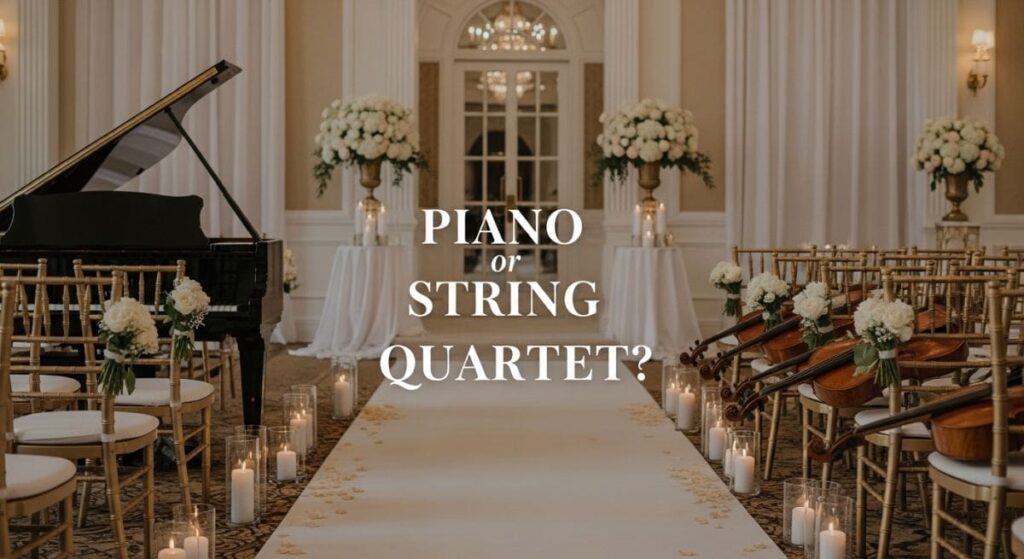
If you are comparing piano vs string quartet for your wedding ceremony, you are asking the right question at the right time. Most couples start thinking about ceremony music after they have locked in their venue and date, and the two options that come up most often are a solo pianist and a string quartet.
Both can sound beautiful. Both can play classical and modern music. But the right pick depends on factors that have nothing to do with musical taste alone. Your venue layout, your budget, your ceremony timeline, and even the surface your musicians will stand on all play a role.
This guide breaks down the comparison side by side. You will find cost differences, venue fit details, repertoire range, timing flexibility, and practical setup concerns so you can make a confident decision before reaching out for quotes.
If you are still early in the planning process, our guide on how to choose your wedding ceremony music covers the broader picture. This post focuses specifically on the piano vs. string quartet comparison.
Key Takeaways
- No universal winner exists. The right choice between solo piano and string quartet depends on your venue, budget, ceremony flow, and musical goals.
- Solo piano typically costs less and offers more real-time timing flexibility, making it a strong fit for ceremonies where plans may shift.
- A string quartet brings visual presence and layered sound that fills large, formal spaces like churches, ballrooms, and estate ceremonies.
- Venue logistics often decide the answer. Available space, piano access, outdoor conditions, and amplification needs can narrow your options fast.
- Both formats handle classical and modern music, but they handle them differently. Piano adapts pop songs more naturally; strings excel at classical depth.
- Combining piano and strings is an option for couples who want both, but it adds cost, space needs, and coordination.
The Fast Answer: Piano or String Quartet?
There is no blanket answer. A solo pianist is usually the better fit when you need flexibility with timing, a wide modern repertoire, and a smaller footprint. A string quartet is usually the better fit when you want layered classical sound, visual formality, and your venue has the space and acoustics to support four musicians.
Most couples narrow it down by answering three questions:
- Does your venue have a piano, or is a digital keyboard an option? If yes, solo piano stays on the table. If not, strings may be simpler to set up.
- Is your ceremony indoors or outdoors? Outdoor ceremonies add wind, sun, and surface concerns that affect both options differently.
- What is your ceremony music budget? A string quartet typically costs two to four times more than a solo pianist because you are hiring four musicians instead of one.
The rest of this guide walks through each factor so you can weigh them against your specific wedding plans.
Piano vs String Quartet at a Glance
This comparison table covers the factors couples ask about most. Use it as a quick reference before reading the detailed breakdowns below.
| Factor | Solo Piano | String Quartet | Best Fit |
|---|---|---|---|
| Cost | One musician fee | Four musician fees plus possible arranger fee | Piano for tighter budgets |
| Space Needed | Piano or keyboard plus bench | Four chairs, four music stands, room for bows | Piano for tight spaces |
| Volume Control | Very precise, one player adjusts instantly | Good, but four players need rehearsed dynamics | Piano for small rooms |
| Classical Repertoire | Strong (Bach, Debussy, Chopin, Pachelbel) | Excellent (rich harmonies, multi-voice pieces) | Quartet for deep classical |
| Pop and Modern Songs | Adapts quickly, wide catalog | Needs arranged parts, smaller catalog | Piano for modern variety |
| Timing Flexibility | High. One player reads cues and adjusts instantly. | Moderate. Quartet follows lead violinist cues. | Piano for unpredictable timing |
| Indoor Ceremonies | Excellent if piano is available or keyboard works | Excellent in most indoor spaces | Both work well |
| Outdoor Ceremonies | Keyboard needed; shade and power required | Acoustic; wind and sun affect comfort and tuning | Depends on setup |
| Visual Presence | Elegant, understated | Formal, dramatic, photogenic | Quartet for visual impact |
| Setup Needs | Minimal if piano exists; keyboard takes 10 minutes | Chairs, stands, tuning time, 15-20 minutes | Piano for fast setup |
Cost Differences Couples Notice First
Price is usually the first filter. A solo pianist is one musician with one fee. A string quartet is four musicians, each with their own rate, and sometimes a separate fee for custom arrangements.
In the NJ, NYC, and Philadelphia market, that difference is real. You are not just paying more for sound. You are paying for four people’s time, travel, rehearsal, and coordination.
What Drives the Cost of Each Option
Solo piano costs are driven by:
- Performer experience and demand
- Travel distance to the venue
- Length of the ceremony performance window
- Whether a digital keyboard rental is needed (if no piano is on site)
- Any custom arrangement requests
String quartet costs are driven by all of the above, multiplied by four, plus:
- Rehearsal time for the group
- Arrangement fees for non-standard songs (modern pop, film scores)
- Parking for four vehicles at urban venues
- Amplification equipment if the ceremony is outdoors
Pro Tip
Ask about all-in pricing when you request quotes. Some musicians quote per-player rates that do not include travel, setup, or custom arrangements. Getting a full number upfront avoids surprises later. Arnie Abrams provides all-in quotes that include travel within the NJ, NYC, and Philadelphia service area.
Hidden Cost Factors That Add Up
Some costs catch couples off guard regardless of which option they choose:
- Stairs and load-in access. If your venue requires carrying equipment up stairs or through narrow hallways, some musicians charge an additional load-in fee. This applies more to piano (keyboard, stand, amp) than to string players who carry their instruments by hand.
- Outdoor amplification. Both piano and strings may need amplification outdoors, but a quartet’s four-mic setup costs more than a single keyboard running through a speaker. For a closer look at outdoor music logistics, see our guide on outdoor wedding music at the Jersey Shore.
- Overtime. Ceremonies run late more often than couples expect. Know the overtime rate before signing a contract.
Venue Fit Matters More Than Most Couples Expect
The venue you have already booked may narrow your ceremony music options more than your personal taste will. Ceiling height, room shape, available floor space, and whether a piano exists on site all matter.
Churches and Chapels
Most churches have a piano or organ already on site, which removes the need to bring equipment. The acoustics in a church are usually designed for music, with high ceilings and hard surfaces that carry sound well. A solo pianist can fill a church with ease.
A string quartet also sounds stunning in a church. The natural reverb amplifies the layered harmonies. The main consideration is space near the altar or front area. Four players with stands and chairs take up more room than a single piano bench.
Edge: Both work well. Piano wins on convenience if the church already has one.
Historic Venues
Historic venues across New Jersey and Philadelphia often come with character and constraints in equal measure. Some have grand pianos in parlor rooms. Others have narrow doorways, uneven floors, or strict rules about what equipment can be brought inside.
If the venue has a piano, check its condition. A poorly maintained piano can sound worse than a quality digital keyboard. For more on this, our post on piano setups in historic NJ landmarks covers what to look for.
Edge: Depends entirely on the specific venue. Ask your venue coordinator what has worked before.
Hotel Ballrooms
Hotel ballrooms in Manhattan, North Jersey, and the Philadelphia Main Line usually have plenty of space for either option. Many hotels own a piano or can arrange one. The acoustics in a ballroom with carpet and drapes tend to absorb sound, which means a string quartet may need light amplification to carry across a large room.
A solo pianist with a quality keyboard and a small speaker can adjust volume precisely in these spaces.
Edge: Piano is simpler. Quartet works if the room is large enough and you plan for sound.
Estate Weddings
Estate weddings in New Jersey and the Philadelphia suburbs often combine indoor and outdoor spaces. You might have the ceremony in a garden and the cocktail hour inside a manor house. A string quartet looks and sounds beautiful in a grand estate setting with high ceilings and open rooms.
Piano works well too, especially if the estate has a grand piano in a main room. If the ceremony is outdoors, a portable keyboard is the go-to option for a pianist.
Edge: Quartet for visual grandeur. Piano for flexibility across indoor/outdoor transitions.
Outdoor Garden Ceremonies
Garden ceremonies present specific challenges for both options. Wind can blow sheet music off stands and push sound in unpredictable directions. Direct sunlight can overheat instruments and fatigue musicians. Grass and soft ground may be uneven, making it hard to place a keyboard stand or four chairs safely.
A pianist using a digital keyboard needs a power source and shade. A string quartet needs a flat, stable surface, shade, and ideally a windscreen or covered area for their music stands. For ceremony music in outdoor settings, read our guide on piano music for garden and park ceremonies.
Edge: Neither has a clear advantage. Logistics decide it.
Beach or Shore Ceremonies
Jersey Shore weddings add sand, salt air, and wind to the equation. Sand is hard on instruments and unstable for equipment. Salt air can corrode strings over time. Wind is the biggest challenge for a string quartet because it blows sheet music and affects bow control.
A pianist with a digital keyboard on a solid platform and a small speaker can work on a beach, but shade and power are non-negotiable.
Edge: Piano with a keyboard setup is typically more practical at beach venues.
Small Private Spaces
Intimate ceremonies in living rooms, private dining rooms, rooftop terraces, or boutique venues have limited floor space. A string quartet may feel crowded in a room where 30 guests are already seated. A solo pianist or keyboardist takes up far less room and keeps the focus on the couple.
Edge: Piano for small spaces, almost always.
The right ceremony music choice usually comes down to space, timing, and what kind of atmosphere the couple wants the room to feel. I always ask about the venue first.
Arnie Abrams • Pianist, 20+ Years
Repertoire and Musical Range
Both solo piano and string quartet can play a wide range of ceremony music, but they handle different styles in different ways.
Classical Pieces
A string quartet has a natural advantage with classical repertoire. Pieces like Pachelbel’s Canon in D, Bach’s Air on the G String, and Handel’s Water Music were written for strings or orchestral ensembles. A quartet plays these pieces in a way that is close to the original composition, with layered voices and rich harmonic texture.
A solo pianist can play these same pieces beautifully, but the arrangement is condensed. You hear one instrument covering all the parts. For some couples, that focused sound is exactly right. For others, the multi-voice depth of a quartet is what they want.
Instrumental Pop and Modern Love Songs
This is where piano often pulls ahead. A skilled pianist can adapt almost any modern song into an instrumental arrangement on the spot or with minimal preparation. Songs by artists like Adele, Ed Sheeran, John Legend, and Coldplay translate well to solo piano because the original recordings are already piano-driven.
A string quartet can play modern songs too, but it usually requires a written arrangement prepared in advance. That means more lead time and potentially an arrangement fee. The catalog of available string quartet arrangements is growing, but it is still smaller than what a pianist can cover on the fly. For examples of how modern songs translate to piano, see our post on modern piano adaptations for traditional ceremonies.
Hymn Support
If your ceremony includes hymns or congregational singing, a pianist provides a familiar foundation. Most church congregations are used to singing with piano or organ accompaniment. A string quartet can support hymns, but it is less common and may not give singers the strong rhythmic anchor they need to stay together.
Transitions Between Ceremony Moments
Ceremonies have distinct musical moments: prelude, processional, interlude, recessional. A solo pianist can move between these moments with a quick pause or a smooth modulation. A quartet can do the same, but the transition requires all four players to be in sync, which works best when the ceremony order is set in advance.
What Happens If You Want Both Classical and Modern Songs?
Many couples want a classical processional and a modern recessional, or a mix of both throughout the ceremony. A solo pianist handles this easily because the same performer plays everything. A string quartet can do it too, but the modern songs need to be arranged and rehearsed ahead of time. Make sure your quartet has the arrangements ready before the wedding day.
Ceremony Music Planning
Not Sure Which Option Fits Your Venue?Ceremony Flow and Timing Flexibility
Wedding ceremonies rarely go exactly as planned. The bride may take longer to walk down the aisle. A reading might run short. The officiant might add an unscripted moment. The flower girl might freeze. These are normal, and your musician needs to handle them without the guests noticing a gap or a rushed transition.
Delayed Entrances
A solo pianist can extend a piece, loop a section, or improvise a gentle transition while waiting for the next cue. This happens with a single decision by one performer. A quartet can also extend, but the lead violinist has to signal the group, and all four players need to follow the same loop. It works, but it is slightly less fluid than one person making the call.
Longer Aisle Walks
Some processionals are short. Others involve a long aisle, a slow pace, or multiple bridesmaids walking one at a time. A pianist can stretch or compress the processional music to match the actual walking time. For more on getting processional cues right, see 19 ceremony cue words to keep everyone in sync.
Repeated Sections
If the officiant pauses longer than expected or a unity ceremony takes extra time, the musician may need to repeat a section of the interlude music. A solo pianist can loop and vary the repeat naturally. A quartet follows a score, so repeats need to be planned or signaled on the spot.
Real-Time Cue Changes
Planners and officiants sometimes give last-second cue changes. A pianist watching the planner’s hand signal can shift instantly. A quartet’s lead violinist watches for cues too, but relaying that signal to three other players takes a beat longer.
Solo piano gives me a lot of control when ceremony timing shifts at the last minute. I can stretch a piece, cut it short, or change songs on the fly without anyone noticing.
Arnie Abrams • Wedding Ceremony Pianist
Space, Sound, and Setup Reality Check
Before you fall in love with the idea of one option or the other, check the practical details with your venue. These are the logistics that can change your decision.
No Piano On Site
Many ceremony venues do not have a piano. If you want a pianist, the performer will bring a professional digital keyboard. A quality stage keyboard sounds excellent, and an experienced performer will set it up with a weighted key action that responds like an acoustic piano. For a closer look at the difference, read our comparison of grand piano vs. digital keyboard for your venue.
The Digital Keyboard Option
A digital keyboard needs:
- A power outlet within reach (or an extension cord)
- A flat surface for the stand
- Shade if outdoors (direct sun on a black keyboard gets hot fast)
- A small speaker or amp for outdoor ceremonies
Setup takes about 10 minutes. Teardown is fast too, which matters if the ceremony space flips to another use.
String Quartet Footprint
A quartet needs roughly a 6-foot by 8-foot area to seat four players comfortably with their stands and instrument cases nearby. Add a few extra feet if the cellist needs room for their endpin. That is roughly the same area as a small dining table for eight.
Amplification
In an indoor ceremony with fewer than 150 guests, a string quartet usually does not need amplification. In a large ballroom, outdoors, or in a space with heavy sound absorption (thick carpet, draped ceilings), strings may need microphones.
A digital keyboard has built-in volume control and can run through a speaker, so amplification is simpler and cheaper for piano.
Wind and Weather
Wind is the biggest outdoor concern for a string quartet. Sheet music blows off stands, bows are harder to control, and tuning drifts faster in changing temperatures. A pianist using a digital keyboard does not use sheet music (most experienced pianists play from memory or a tablet) and the instrument is not affected by wind in the same way.
Watch Out
Rain and extreme heat can cancel outdoor music plans entirely. Always ask your venue about a backup indoor location for musicians. A good musician will ask you about this too. If your venue does not have a rain plan for the ceremony, have one ready before booking any live music.
Venue Restrictions
Some venues have noise restrictions, amplification rules, or limits on the number of vendors who can set up in a specific area. Ask your venue about:
- Maximum number of musicians allowed in the ceremony space
- Amplification rules (some historic properties do not allow speakers)
- Load-in access and timing restrictions
- Insurance or COI requirements for musicians (see our Philadelphia logistics and COI guide for details)
Which Choice Fits Your Ceremony Style?
Use this quick decision matrix to see which option lines up with your ceremony vision.
| Ceremony Style | Recommended Option | Why |
|---|---|---|
| Formal black-tie | String quartet | Visual formality matches the dress code; rich classical sound fills formal spaces |
| Intimate micro wedding | Solo piano | Smaller footprint, easier volume control, personal feel |
| Garden ceremony | Either (check logistics) | Both need shade and flat ground; piano needs power, strings need wind protection |
| Church ceremony | Either (piano if church has one) | Church piano is free to use; quartet sounds great in high-ceiling acoustics |
| Modern city wedding | Solo piano | Flexible setup, modern song catalog, works in lofts, rooftops, and restaurants |
| Mixed classical and pop | Solo piano | One performer handles both styles without needing separate arrangements |
| Family-focused ceremony | Solo piano | Hymn support, flexible timing for kids, easy volume adjustments |
| High-end estate | String quartet | Grand visual and musical presence matches estate settings |
When Piano Alone Is the Better Choice
Solo piano is often the stronger pick when:
- Your budget is tighter. One musician costs less than four, leaving room in your budget for other wedding priorities.
- Your ceremony timing is unpredictable. A solo pianist adjusts to delays, long aisle walks, and cue changes with no lag.
- You want a mix of classical and modern songs. A pianist can play Pachelbel for the processional and a pop ballad for the recessional without needing arranged parts.
- Your venue is small. A solo pianist or keyboardist takes up far less space than four string players with stands and chairs.
- Your ceremony includes hymns or congregational singing. Piano provides a strong rhythmic anchor for group singing.
- Your ceremony is outdoors. A digital keyboard is less affected by wind, temperature, and humidity than acoustic string instruments.
- You want the musician to stay through the cocktail hour too. A pianist can easily transition from ceremony to cocktail hour music without a gap.
None of this means strings are wrong for your wedding. It means piano is the simpler, more flexible, and more affordable path for a lot of ceremony situations.
When a String Quartet Is the Better Choice
A string quartet is often the stronger pick when:
- Your ceremony is in a large, formal venue. A quartet fills a cathedral, grand ballroom, or estate with layered sound that a single instrument cannot replicate.
- You want a strong visual presence. Four musicians in formal attire, playing together in sync, create a dramatic visual that photographs and films beautifully.
- Your music is mostly classical. If your processional, interludes, and recessional are all classical pieces, a quartet delivers those compositions the way they were intended to be heard.
- You want the ceremony to feel like a performance. A string quartet adds a sense of occasion and formality that sets the ceremony apart from the rest of the day.
- Your venue does not have a piano and cannot accommodate a keyboard setup. Some venues restrict electronics or lack power access in the ceremony area. A quartet is fully acoustic.
- Budget is not a primary concern. If you have room in the budget for four musicians, a quartet delivers a premium experience.
A string quartet has a visual and musical presence that can be a great fit in formal settings, but the venue has to support it. I always tell couples to check the space first.
Arnie Abrams • Venue Experience
When It Makes Sense to Add Strings to Piano
Some couples do not want to choose between piano and strings. They want both. A piano-plus-strings combination can sound stunning when the venue has room, the budget allows it, and the musicians rehearse together.
This option works best for:
- Large estate or ballroom ceremonies with space for five musicians
- Couples who want a classical processional with full ensemble sound and a modern recessional with piano leading
- Ceremonies where the visual impact of a small ensemble matters
Keep it realistic. Adding strings to piano doubles or triples the cost, requires more setup space, and needs coordination between the performers. For a deeper look at how the two formats work together, see our post on why piano and strings work well together for wedding music.
If your budget is stretched, start with the option that covers the most ground. For most ceremonies, that is piano. You can always add a violinist or cellist later if the budget opens up.
The 3 Things Arnie Abrams Needs From You
When you reach out about ceremony music, Arnie asks for three things. These three details let him build the right plan quickly, whether the answer is solo piano, strings, or a combination.
Your Ceremony Music Starter Kit
With those three pieces of information, Arnie can tell you which format fits best, suggest specific songs for each ceremony moment, and give you an accurate quote. No guessing, no back and forth.
Experience
to Start Planning
NJ • NYC • Philly
Frequently Asked Questions
Is piano or string quartet better for a wedding ceremony?
Neither is universally better. A solo pianist offers more timing flexibility, a wider modern song catalog, and a smaller footprint. A string quartet delivers richer classical sound and stronger visual presence. The right answer depends on your venue, budget, ceremony flow, and the musical atmosphere you want.
Is a pianist cheaper than a string quartet?
Yes, in most cases. A solo pianist is one musician with one fee. A string quartet includes four musicians, each with their own rate, plus potential arrangement fees for modern songs. In the NJ, NYC, and Philadelphia area, a quartet typically costs two to four times more than a solo pianist for the same ceremony window.
Can a pianist play modern wedding songs?
Yes. An experienced pianist can adapt most modern songs into instrumental arrangements quickly. Songs by Adele, Ed Sheeran, John Legend, and Coldplay translate naturally to piano because the originals are already piano-driven. Many pianists can learn a new song within a few weeks if given enough lead time before the ceremony.
Does a venue need to have a piano already?
No. If the venue does not have an acoustic piano, a pianist will bring a professional digital keyboard with weighted keys and high-quality sound. The keyboard needs a power outlet and a flat surface. For outdoor ceremonies, shade is also needed. Setup takes about 10 minutes.
Is a string quartet too much for a small ceremony?
It can be. A string quartet requires space for four players, four chairs, and four music stands. In an intimate venue with fewer than 50 guests, the quartet may physically crowd the space and produce more volume than the setting needs. Solo piano or a single violinist is usually a better fit for very small ceremonies.
What works better for outdoor wedding ceremonies?
A digital keyboard is often more practical outdoors because it is not affected by wind, humidity, or temperature changes the way acoustic string instruments are. However, it needs power and shade. A string quartet can play outdoors if the area is covered, flat, and sheltered from wind. Both options may need amplification outdoors.
Can piano and strings be combined for the ceremony?
Yes. A piano-plus-strings setup can sound beautiful for weddings with larger venues and budgets. The combination adds ensemble depth for classical pieces while keeping the flexibility of piano for modern songs. It does cost more, takes up more space, and requires coordination between the performers.
How do couples decide between piano and string quartet?
Start with three questions: Does your venue have space and a piano (or room for a keyboard)? Is your ceremony mostly classical, mostly modern, or a mix? What is your ceremony music budget? Those answers will narrow the decision quickly. From there, a conversation with your musician about the specific ceremony order and venue details will confirm the right choice.
Final Decision Guide for Couples
Here is how to move forward:
- Check your venue. Find out if a piano is on site, how much space is available for musicians, and whether there are any restrictions on amplification or equipment.
- Set your ceremony music budget. Know how much you can spend on live music before you start requesting quotes.
- Decide on your musical style. If you want mostly classical, a quartet may be the right fit. If you want a mix of classical and modern, piano gives you more range. If you want both, budget for a combination.
- Reach out early. Experienced ceremony musicians in NJ, NYC, and Philadelphia book up during peak wedding season. The earlier you start the conversation, the more options you have.
Whether you choose solo piano, a string quartet, or a combination, the goal is the same: music that supports the ceremony you have planned, fits the space you have booked, and sounds the way you imagined it.
Plan Your Ceremony Music
The Right Sound for Your Ceremony
Arnie Abrams has performed at hundreds of wedding ceremonies across New Jersey, New York City, and Philadelphia for over 20 years. He can help you choose the right format, the right songs, and the right setup for your venue.