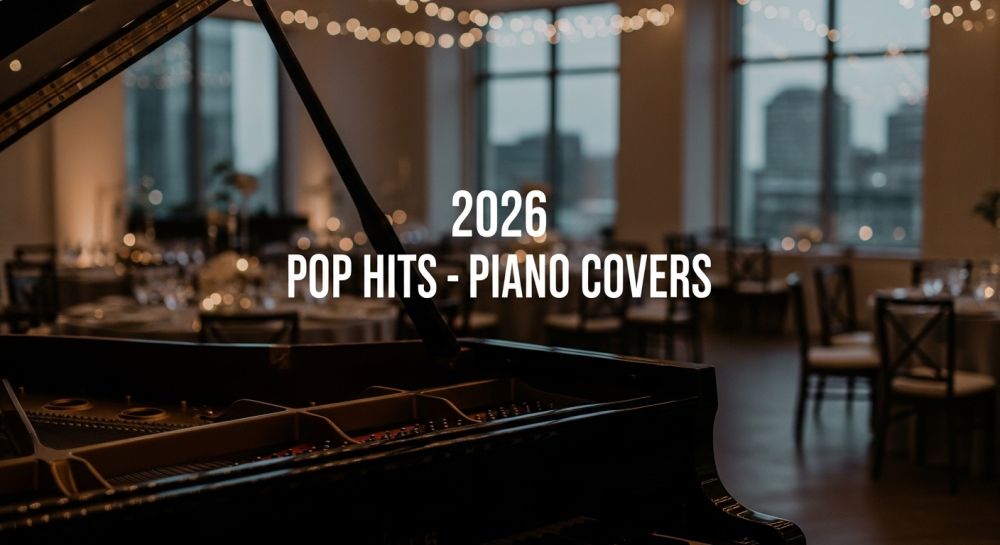
Your 2026 Wedding Music Update: Today’s Radio Hits, Reimagined for Solo Piano
Every year, the radio sounds different. New melodies stick in your head at the gym, in the car, and while scrolling through reels. But here is the question couples keep asking: Can those 2026 pop hits actually work at a wedding?
The answer is yes, and the trick is in the arrangement. A solo wedding pianist strips away the bass drops, auto-tune, and explicit lyrics. What is left is the recognizable melody, played on piano with warm dynamics, elegant pacing, and the kind of tone that fits a ceremony just as easily as a cocktail hour.
This post is your yearly wedding song update for 2026. It covers which current chart hits translate well to solo piano, where each song fits in a wedding timeline, how to filter for lyric risk (even on instrumentals), and how to hand your pianist a request list without causing chaos. Think of it as a translation guide: what today’s radio sounds like when it meets a piano bench at a black-tie reception.
Key Takeaways
- Melody-first arrangements turn 2026 radio hits into classy instrumental wedding piano covers without awkward lyrics
- Every pop song fits a specific wedding moment based on its tempo, emotional tone, and volume ceiling
- Instrumental covers solve the explicit lyric problem while keeping the recognition factor guests love
- Setlist pacing matters more than individual song picks; structure the energy arc from warm-up to cool-down
- Give your pianist a simple request framework: 5 must-plays, 5 no-plays, and 3 vibe words
- A live wedding pianist adjusts tempo, volume, and length in real time, something no playlist can do
What Makes a 2026 Pop Song Work on Piano
Not every chart hit belongs on a piano bench. Some songs rely so heavily on electronic production that the melody barely exists without the beat underneath. Others have a chorus so strong that a single piano can carry the entire room. Understanding the difference is what separates a polished piano cover arrangement from an awkward attempt that falls flat.
The Melody Has to Stand Alone
A melody-first piano cover works because listeners recognize the tune within the first few bars. Songs with a strong, singable chorus translate best. Think about it this way: if you can hum the hook in the shower without any backup music, it will probably sound beautiful on piano.
Taylor Swift’s “The Fate of Ophelia” is a perfect example. The melodic contour of that chorus is so distinct that even stripped down to a single instrument, the recognition is instant. The same goes for Olivia Dean’s “So Easy (To Fall in Love),” which has a warm, open melody that practically begs for a piano version.
On the other hand, songs built around a heavy beat, layered synth textures, or rapid-fire vocal effects lose most of their identity when you remove the production. A song like Bad Bunny’s Latin reggaeton tracks, for instance, relies on rhythmic drive and bass. Without those elements, you are left with very little to play.
Chord Simplicity vs. Clutter
The best modern pop piano arrangements use songs with clean chord progressions. Four or five chords cycling through a verse and chorus create a warm, flowing piano sound that is easy on the ears. When the original song has too many harmonic shifts, the piano arrangement can sound busy and lose its elegant tone.
Bruno Mars’ “I Just Might” has a classic pop structure with clear chord changes. That simplicity makes it an ideal candidate for a wedding-friendly piano arrangement. A pianist can add warm chord voicings, perhaps using add9 or maj7 chords, to give it sophistication without cluttering the sound.
Intro Length and Ending Control
For wedding ceremony piano songs, the intro matters more than you think. A processional needs a clear, recognizable opening that signals to the bridal party: “Start walking.” Songs with long, ambient intros create confusion. The pianist needs a tune where the recognizable intro hits within the first three to five seconds.
Equally important is the ending. A button ending technique (a clean, definitive final chord) works better for ceremony moments than a slow fade. For cocktail hour, a fade-out technique or smooth transition into the next song keeps the lounge-style wedding piano vibe flowing without awkward gaps.
I always listen for the hook first. If I can hear the melody once and play it back, that song is going to work beautifully on piano. If I need to hear it five times and still cannot find the melody without the beat, I skip it.
Arnie Abrams, Award-Winning Wedding Pianist
The Wedding-Moment Fit Map: Matching 2026 Hits to Your Timeline
Every song has a natural home in the wedding music timeline. The wrong tempo during the processional feels rushed. The wrong mood during dinner feels intrusive. Below is a quick mapping framework that helps couples and planners place 2026 pop songs for weddings in exactly the right spot.
What “Fit” Actually Means
Fit is a combination of four factors:
- Tempo: How fast or slow the song moves. A slow romantic tempo (60-75 BPM) suits the processional. A moderate elegant tempo (90-115 BPM) works for cocktail hour. A high-energy celebration tempo (120+ BPM) is for the reception.
- Volume ceiling: How loud should the music be? Ceremony and dinner music stays under conversation level. Cocktail hour sits at a not-too-loud background music level. The reception can push louder for featured moments.
- Emotional tone: Romantic, joyful, reflective, or celebratory. Each wedding moment has a natural emotional register.
- Attention level: During the ceremony, all eyes are forward and the music supports the moment. During cocktail hour, the piano is background. During featured dances, the music is the centerpiece.
| Wedding Moment | Ideal Tempo | Volume Level | Emotional Tone | 2026 Song Examples |
|---|---|---|---|---|
| Prelude / Guest Arrival | 70-100 BPM | Soft background | Warm, welcoming | Olivia Dean “A Couple Minutes,” Justin Bieber “Daisies” |
| Ceremony Seating | 70-90 BPM | Gentle underlayer | Calm, anticipatory | The Marías “Sienna,” Harry Styles “Aperture” (slowed) |
| Bridal Party Processional | 65-80 BPM | Moderate, clear | Elegant, emotional | Olivia Dean “So Easy (To Fall in Love),” Ella Langley “Choosin’ Texas” (piano ballad) |
| Bride Entrance | 55-75 BPM | Moderate, present | Deeply romantic | Taylor Swift “The Fate of Ophelia,” Sabrina Carpenter “Tears” |
| Recessional / Exit | 110-130 BPM | Bright, joyful | Celebration, relief | Bruno Mars “I Just Might,” RAYE “Where Is My Husband!” |
| Cocktail Hour | 90-120 BPM | Conversation-friendly | Upbeat, relaxed | Sabrina Carpenter “When Did You Get Hot?,” Benson Boone “Mr Electric Blue” |
| Dinner Background | 75-100 BPM | Soft, below conversation | Warm, sophisticated | Kehlani “Folded,” sombr “back to friends,” Leon Thomas “MUTT” |
| First Dance | 60-85 BPM | Featured, clear | Intimate, romantic | Taylor Swift “The Fate of Ophelia,” Olivia Dean “Man I Need” |
| Parent Dances | 65-90 BPM | Featured | Tender, nostalgic | Alex Warren “Ordinary,” Justin Bieber “Yukon” |
| Send-Off / Sparklers | 115-135 BPM | Bright, full | Joyful, triumphant | Bruno Mars “I Just Might,” Chappell Roan “Pink Pony Club” |
Notice the pattern. Slower, softer songs anchor the ceremony prelude and dinner background piano music. Faster, brighter arrangements take over for the recessional piano music and sparkler send-off music. That tempo flow is the backbone of setlist planning for weddings.
Pro Tip
Give your wedding coordinator a copy of the song list with moment labels. This helps with planner-friendly music cues and ensures the pianist, coordinator, and DJ are all working from the same timeline. Clear coordinator cue points prevent overlap and awkward silence.
2026 Chart Hits That Sound Beautiful on Solo Piano
Here is the wedding piano song list 2026 that couples and planners have been asking about. These are the current radio hits and streaming favorites that work well as instrumental wedding piano covers. Each one has a strong melody, clean emotional tone, and the right structure for a live wedding pianist to interpret with style.
Romantic and Slow Picks
Taylor Swift, “The Fate of Ophelia” is the biggest song of the year so far, spending nine weeks at number one on the Billboard Hot 100. The chorus has a wide, sweeping melodic arc that translates perfectly to a slow piano cover. Use it for the bride entrance piano moment or as a first dance piano version. The emotional weight carries beautifully even without lyrics.
Olivia Dean, “So Easy (To Fall in Love)” has a warm, open groove that feels like falling in love in slow motion. As a piano version of a pop song, it works well for the bridal party processional piano or as ceremony seating music. Dean won Best New Artist at the 2026 Grammys, so expect guests to recognize the melody instantly.
Sabrina Carpenter, “Tears” is a slower, more vulnerable side of Carpenter that lands well as a romantic piano cover. It has a singable melody line that a pianist can stretch with rubato moments for the ceremony. Best fit: processional piano music or quiet underscoring during a unity ceremony.
Justin Bieber, “Daisies” is a light, heartfelt track from his return to form. The melody is gentle and repetitive in the best way, making it ideal as wedding prelude piano or guest arrival music. The chord structure is clean and allows for broken chord patterns and arpeggios that fill a room warmly.
Justin Bieber, “Yukon” has a more introspective, winding melody. It works beautifully for a father daughter dance piano or mother son dance piano arrangement. The chorus has enough lift to keep it emotional without becoming heavy.
Mid-Tempo and Cocktail Hour Picks
Benson Boone, “Mr Electric Blue” has a bouncy, feel-good energy that sits right in the sweet spot for cocktail hour piano playlist material. The melody is catchy enough for a hook-forward piano arrangement and mid-tempo enough to keep things moving without overpowering conversation.
Harry Styles, “Aperture” is an interesting case. The original has a pulsing, electronic edge, but underneath is a solid pop melody. Slow it down slightly and you get an atmospheric mid-tempo piano cover that suits dinner background piano music or late-evening cocktail hour. It rewards a minimalist piano cover approach.
Olivia Dean, “Man I Need” has been climbing the charts all year. The song’s soulful, mid-tempo groove makes it one of the most versatile 2026 radio hits on piano. Use it for cocktail hour, the first dance, or even as a featured piano medley paired with another Dean track.
sombr, “back to friends” has a mellow, reflective quality that works as dinner set planning material. The melody is subtle but recognizable. Pair it with other gentle tracks for a soft dynamics for dinner set.
Kehlani, “Folded” is an R&B-leaning track with a smooth vocal melody. On piano, it becomes a warm piano sound that fills the conversation-friendly piano role during dinner beautifully.
Upbeat and Celebration Picks
Bruno Mars, “I Just Might” is Bruno at his most infectious. The melody is bright, the rhythm is crisp, and the energy screams celebration. As an upbeat piano cover, it is ideal for the recessional piano music or wedding exit song piano moment. Also strong as a grand entrance piano cue or sparkler send-off music.
RAYE, “Where Is My Husband!” is the kind of song that makes guests laugh and cheer. The chorus has a big, anthemic feel that translates to a uplifting piano cover for the recessional or reception entrance. It is cheeky and modern, which is exactly what couples looking for current but classy wedding music want.
Sabrina Carpenter, “When Did You Get Hot?” has a playful bounce that lights up a room. As a cocktail lounge piano vibe track, it adds fun without being loud. It works well in a piano medley for weddings paired with other Carpenter hits like “Espresso.”
Chappell Roan, “Pink Pony Club” continues to be a crowd favorite. The piano-friendly chord structure and soaring chorus make it a natural upbeat piano cover. Use it for the last song of the night piano or the send-off music piano moment.
for Piano
Covered
Wedding Experience
The Lyrics Risk Filter: Why It Still Matters for Instrumentals
One of the biggest reasons couples choose instrumental wedding songs is to avoid lyric problems. No one wants Grandma to hear explicit language during the cocktail hour. But here is the thing most people miss: even instrumental covers carry emotional associations.
If a guest recognizes the melody of a breakup song, they are going to think about the breakup lyrics. That is why clean wedding music choices go beyond just removing the words.
Themes to Screen Out (Even for Instrumentals)
Lyric Risk Checklist
- Breakup and goodbye themes: If the original lyrics are about leaving, ending things, or moving on, the melody still carries that weight for anyone who knows the song
- Explicit club energy: Songs built around nightclub themes or heavy party imagery can feel out of place, even as piano instrumentals, at a formal ceremony
- “Ex” songs: Tracks about ex-partners, revenge, or jealousy send the wrong message at a wedding, regardless of whether the words are playing
- Sad farewell ballads: Beautiful melodies about loss or goodbye belong elsewhere, not at a celebration of commitment
- Shock-value or provocative tracks: If the original song made headlines for being controversial, the association sticks even in an instrumental format
The instrumental workaround handles the literal words, but it does not erase the emotional fingerprint. A skilled live wedding pianist knows which songs carry positive, commitment themes and which ones carry baggage. That filtering happens during the planning stage, not at the event.
Safe Themes That Always Work
Songs about falling in love, building a life together, celebrating joy, and looking forward all carry the right emotional DNA for a wedding. The best 2026 pop hits for weddings lean into these themes:
- Modern love song themes: New beginnings, devotion, excitement about the future
- Celebration themes: Dancing, joy, being surrounded by people you love
- Commitment themes: Choosing someone, staying, and growing together
- Joyful wedding vibe: Songs that simply feel happy, with uplifting melodic energy
Setlist Pacing for Modern Hits: The Energy Arc
Picking great songs is only half the job. The order they are played matters just as much. Pacing a wedding set is about building an energy arc that keeps guests comfortable and engaged without any jarring shifts.
Imagine a graph. The energy starts low and warm, rises gently through the cocktail hour, plateaus during dinner at a comfortable level, and then builds again for featured moments like dances and toasts. That shape is the foundation of setlist planning for weddings.
The Four-Phase Energy Arc
Phase 1: Warm-Up (Prelude and Ceremony)
Start with soft piano covers at a slow tempo. These set the tone without demanding attention. Think of this as the hotel lobby style piano zone. Songs like Justin Bieber’s “Daisies” or Olivia Dean’s “A Couple Minutes” fit here. Keep dynamics gentle, use the soft pedal, and let the music breathe.
Phase 2: Mid-Set Lift (Cocktail Hour)
After the ceremony, the energy needs a slight bump. This is where mid-tempo piano covers shine. Benson Boone’s “Mr Electric Blue,” Sabrina Carpenter’s “When Did You Get Hot?,” and Olivia Dean’s “Man I Need” keep the room moving. The pianist should aim for a cocktail lounge piano vibe where the music is engaging but conversation-friendly.
A great technique here is the piano medley for weddings. Link two or three songs together with smooth key changes. A short medley moment might pair “Man I Need” into “So Easy (To Fall in Love)” using a half-step lift between them. That kind of smooth transition on piano keeps the set feeling alive.
Phase 3: Plateau (Dinner)
Dinner music needs to be the most invisible. This is not-too-loud background music territory. The piano should sit below conversation volume. Pick songs with flowing, gentle melodies: Kehlani’s “Folded,” sombr’s “back to friends,” or Harry Styles’ “Aperture” at a reduced tempo. Soft dynamics for dinner means the pianist uses lighter touch sensitivity and more half pedaling to control sustain.
Planning Your 2026 Wedding Music?
Arnie Abrams plays current pop hits, classics, jazz, and everything in between. Free consultations for all events.
Phase 4: Gentle Reset and Featured Moments (Reception Highlights)
After dinner, the energy picks back up for the first dance piano version, father daughter dance piano, mother son dance piano, and toasts background music. These are featured moments where the piano shifts from background to spotlight. The pianist increases volume, uses more dynamic shading, and applies crescendo for entrances and diminuendo when the moment calls for tenderness.
For the grand entrance piano cue or cake cutting piano music, a short burst of energy works perfectly. Bruno Mars’ “I Just Might” played with full chords and a bright octave melody in the right hand signals “this is a moment.”
Pacing is the part that separates a good pianist from a great one. Anyone can play the right notes. Knowing when to pull back to almost nothing and when to push forward with energy is what makes the whole night feel like one continuous, beautiful story.
Arnie Abrams, Arnie Abrams Entertainment
A Sample Energy Arc for a 2026 Wedding Set
| Phase | Duration | Energy Level | Sample 2026 Songs |
|---|---|---|---|
| Warm-Up | 20-30 min | Low and warm | “Daisies” (Bieber), “A Couple Minutes” (Dean), “Sienna” (The Marías) |
| Ceremony | 15-25 min | Moderate, focused | “The Fate of Ophelia” (Swift), “Tears” (Carpenter), “So Easy” (Dean) |
| Cocktail Hour | 45-60 min | Mid-energy, relaxed | “Man I Need” (Dean), “Mr Electric Blue” (Boone), “When Did You Get Hot?” (Carpenter) |
| Dinner | 45-75 min | Soft background | “Folded” (Kehlani), “back to friends” (sombr), “Aperture” (Styles, slowed) |
| Featured Moments | Varies | Spotlight peaks | “The Fate of Ophelia” (first dance), “Yukon” (parent dance), “I Just Might” (exit) |
How a Pianist Turns a Pop Hit Into a Wedding-Ready Cover
There is a craft behind modern pop piano arrangements that goes beyond simply playing the notes. A skilled solo pianist for events reshapes the original song to fit the moment, the room, and the couple’s style. Here is what that process looks like.
Melody-First Approach
The pianist isolates the most recognizable part of the song, usually the chorus hook, and builds the arrangement around it. The right hand carries the melodic motif while the left hand provides harmonic support. For a hook-forward piano arrangement, the melody stays front and center at all times.
Tasteful Reharmonization
This means changing some of the original chords to give the piano arrangement a richer, more sophisticated sound. A not-too-jazzy reharmonization might swap a basic major chord for a maj7 or add9 voicing. This keeps the song recognizable while adding an elegant piano tone that fits a formal event.
For example, Bruno Mars’ “I Just Might” uses a standard pop chord progression. A pianist might substitute open voicings and sus chords to give it a slightly more refined feel, perfect for a ballroom wedding piano vibe.
Dynamic Control
This is the single most important skill a live wedding pianist brings that a playlist never can. Dynamic control on piano means adjusting volume and intensity in real time. During vows underscoring, the pianist drops to barely a whisper. For the recessional cueing, the volume jumps to a bright, full celebration level.
A playlist plays at one volume. A live pianist reads the room and responds. That is the difference between reception background piano and a Spotify queue.
Medley Construction
A custom wedding piano medley connects two or three songs together without a break. The technique involves key matching between songs (or using a modulation to shift smoothly). A two-song mashup might pair Olivia Dean’s “Man I Need” with Taylor Swift’s “The Fate of Ophelia” by finding a shared chord progression and using smooth voice leading to transition between them.
For cocktail hour, a three-song medley of 2026 hits keeps things fresh. A theme-based medley built around romantic pop songs from this year gives the set a forward-looking wedding playlist feel that is unmistakably current.
Piano Arrangement Techniques at a Glance
- Arpeggios: Broken chord patterns that create flowing, water-like textures underneath the melody
- Octave melody: Playing the melody in both hands one octave apart for dramatic, featured moments
- Pedal control: Half pedaling and soft pedal use to manage sustain and keep the sound clean
- Rhythmic comping: A steady pulse in the left hand that gives the arrangement groove without overpowering
- Build and release: Gradually increasing volume and density for emotional peaks, then pulling back to quiet
Pop-to-Piano Covers in Context: What Others Are Doing
The idea of turning pop hits into instrumental wedding music is not new. Groups like Vitamin String Quartet and The Piano Guys have built entire catalogs of pop songs arranged for classical instruments. Midnite String Quartet offers similar playlists that many couples use as inspiration when planning their ceremony music.
The difference with a live wedding pianist is flexibility. A recorded cover from VSQ or Brooklyn Duo plays the same way every time. A live performer adjusts the tempo when the flower girl walks slowly, extends the ending when the couple lingers at the altar, or drops to near silence when the officiant begins speaking. Those real-time adjustments are what make piano music for ceremony feel truly personal.
These groups are great references, though. If you like how Vitamin String Quartet arranged a certain song, tell your pianist. It gives them a clear picture of the arrangement style and vibe you want.
Requests and Customization Without Chaos
Here is where many couples struggle. They want to give input on the wedding piano song list, but they are not sure how much direction is too much, or too little. The answer is a simple framework that gives the pianist clear guardrails without micromanaging every song.
The 5-5-3 Request Method
Your Request Framework
- 5 Must-Play Songs: These are your non-negotiables. Your “our song” on piano, the processional pick, the first dance, and any other song with deep personal meaning. The pianist will plan these into specific moments.
- 5 Do-Not-Play Songs: Your do-not-play list. Maybe an ex’s favorite song. Maybe a track with lyrics that hit wrong for a family member. This list prevents awkward surprises.
- 3 Vibe Words: Instead of listing 50 songs, give three words that describe the feel you want. Examples: “romantic, modern, fun” or “intimate, soft, classic” or “upbeat, chic, warm.” These vibe words guide the pianist’s song choices for the rest of the set.
This framework gives the pianist everything they need to build a full wedding piano song list 2026 that feels personal and cohesive. It also prevents the common mistake of handing over a 100-song playlist with no indication of what goes where.
How the Pianist Uses Your Input
An experienced solo wedding pianist takes those 13 inputs (5 + 5 + 3) and builds a complete ceremony music planning framework. The must-plays get placed at their designated moments. The vibe words guide song selection for the prelude, cocktail hour, and dinner. The no-play list gets flagged so nothing slips through.
The rest of the set? That is where the pianist’s experience fills in. A pro with 20+ years of playing weddings knows what works in each moment, what keeps the energy flowing, and how to read the room for guest arrival music versus toasts background music.
Guest Requests During the Event
Some couples love the idea of guest request cards at tables during cocktail hour. Others prefer to keep the set fully planned. Either way, a skilled pianist can handle live requests without derailing the pacing. The key is having a clear policy in advance. For more on how this works, Arnie has written about the etiquette of song requests from a professional perspective.
The 5-5-3 method works every time. Five songs you love, five songs to avoid, and three words that describe the mood. With that, I can build a full night of music that feels exactly like the couple’s personality. No guesswork, no stress.
Arnie Abrams, Professional Wedding Pianist
Venue and Setup Considerations for Piano Covers
The venue affects how your piano music for reception actually sounds. A ballroom wedding piano vibe is very different from a garden wedding piano vibe, and the pianist needs to plan accordingly.
Indoor Venues
Church wedding piano vibe: Churches often have excellent natural acoustics. An acoustic piano in a church sounds rich and full. The pianist can play with lighter dynamics because the room amplifies naturally. This is ideal for piano music for ceremony moments like the processional and recessional.
Ballroom acoustics: Large ballrooms can swallow sound. A digital piano setup or stage piano with a small speaker may be needed to fill the room. Sound check planning matters here. For a deeper look at how room size affects the music, check out how venue acoustics affect piano entertainment.
Small room acoustics: Intimate venues and private homes are where a solo piano shines brightest. The warm piano sound fills the space naturally. Volume stays low, and the intimate wedding vibe is effortless.
Outdoor Venues
Outdoor ceremony piano comes with practical challenges. Sound dissipates quickly in open air. A keyboard as backup (or primary instrument) is often the smartest choice, connected to a small PA system. The pianist also needs to consider power requirements for outdoor setups, extension cord planning, and weather protection.
For couples planning an outdoor wedding along the Jersey Shore, Arnie has specific experience with tent acoustics, wind considerations, and backup plans. A backup power plan is non-negotiable for outdoor events.
Equipment Essentials
Behind every polished performance is practical preparation. Here is what professional setup looks like:
- Sound check checklist: Test volume levels, monitor placement, and DI box connection at least 30 minutes before guests arrive
- Cable management: Gaffer tape secures all cables to prevent tripping hazards
- Load-in logistics: Confirm parking and access, elevator availability, and setup time planning with the venue coordinator
- Vendor arrival timing: The pianist should arrive at least 45 minutes before the first note to allow for full setup and sound check
Beyond the Wedding: 2026 Pop Piano Covers for Other Events
These modern pop piano arrangements are not just for weddings. The same songs and techniques work beautifully at other celebrations where current but classy music fits the mood.
- Engagement party piano: Play the couple’s favorite 2026 hits as cocktail hour live piano while friends celebrate the upcoming wedding
- Rehearsal dinner piano: A relaxed set of dinner background piano music using the same songs planned for the wedding creates a preview of the musical vibe
- Welcome party piano: For destination-style weekends, a lounge-style wedding piano set on Friday night sets the tone for the whole weekend
- Corporate event piano covers: Many of these 2026 hits work at corporate events and holiday parties where family-friendly wedding music standards apply
- Private party piano covers: Birthday parties, anniversaries, and cocktail parties all benefit from the recognizable melody on piano effect
- After party piano set: A late-night piano vibe with slower, moodier covers of the night’s biggest songs is a sophisticated way to wind down
- Next-day brunch piano: Light, acoustic-feeling piano versions of pop songs pair perfectly with mimosas and brunch conversation
Coordinating With Your Other Vendors
Great wedding music does not happen in isolation. The pianist needs to work in sync with the DJ, band (if applicable), coordinator, and venue staff. Here are the coordination points that matter most.
DJ Handoff Timing
If the pianist covers ceremony and cocktail hour while a DJ handles the reception, the DJ handoff timing needs to be planned precisely. The pianist plays through the end of cocktail hour and into the beginning of dinner, then hands off to the DJ during a natural break (such as when guests are seated and the couple is being introduced). A smooth handoff to DJ playlist prevents dead air.
Coordinator Communication
The wedding coordinator is the traffic director. They need a copy of the ceremony cue sheet that includes: which song plays for each moment, how long each piece runs, and what the visual or verbal cue is for transitions. Clear processional cueing and recessional cueing prevent the most common ceremony mishaps. For a full rundown of how this works, read about 19 wedding ceremony cue words that keep everyone in sync.
Band Coordination
If the event includes a band later in the evening, band handoff timing follows the same principle. The pianist wraps up during dinner, and the band takes over for dancing. Some couples prefer a shared set where the pianist plays alongside a string quartet or vocalist for certain moments. That is a piano plus vocalist combo or piano plus string quartet combo arrangement that adds layers to featured songs.
How to Keep Your Wedding Music Modern Without Losing Elegance
The fear couples have is this: “If we play current pop songs, will it feel cheap?” The answer is no, as long as the arrangement is right. A modern but elegant wedding music approach means choosing songs that are on the radio right now and trusting a skilled pianist to translate them into the elegant piano tone the venue and occasion deserve.
Here are three rules of thumb:
- Recognize, do not reproduce. The goal is for guests to recognize the melody and smile, not to replicate the radio version. A piano cover arrangement is a reinterpretation, not a copy.
- Mix eras, not just years. A set that blends 2026 hits with classic standards from Sinatra, Elton John, and Billy Joel creates a multi-generation friendly music experience. For more on this, explore creating multi-generational appeal with piano music.
- Trust the pianist’s ear. A professional who has been playing weddings for over two decades knows which current songs feel timeless and which ones will feel dated in six months. That instinct is worth more than any Spotify algorithm.
The fresh wedding music update approach works because it adds new flavor to a foundation of proven classics. You are not throwing out the standards. You are adding a layer of “right now” that makes the music feel personal and current.
Related Reading
Frequently Asked Questions
Can a pianist really play 2026 pop hits at a formal wedding without it sounding out of place?
Yes. A skilled pianist strips away the production, auto-tune, and beat-heavy elements, leaving just the melody and chords. The result is a modern but elegant wedding music arrangement that sounds sophisticated in any setting. The key is choosing songs with strong melodies and having an experienced solo wedding pianist handle the arrangement with proper dynamics and touch.
How many songs does a pianist need for a full wedding day?
A typical wedding with ceremony, cocktail hour, and dinner requires about 40 to 60 songs. The ceremony needs 4 to 6 pieces (prelude, processional, recessional). Cocktail hour runs 45 to 60 minutes (roughly 15 to 20 songs). Dinner adds another 15 to 25 songs depending on length. A pro pianist has hundreds of songs in their working repertoire and adjusts on the spot.
What if guests do not recognize the instrumental versions of current songs?
Many guests will recognize the melodies, especially for songs that have been on the charts for weeks. The recognition factor is strongest for chorus-driven hits like Taylor Swift’s “The Fate of Ophelia” or Bruno Mars’ “I Just Might.” Even guests who do not recognize a specific song will appreciate the warm, elegant piano tone that fills the room.
Should I give my pianist a Spotify playlist for reference?
A short playlist (10 to 15 songs) can be helpful as a vibe reference. But avoid handing over a 100-song playlist and expecting the pianist to learn every track. Instead, use the 5-5-3 request method: five must-plays, five do-not-plays, and three words that describe your desired mood. That gives the pianist clear direction with room to fill in the gaps.
How far in advance should I book a wedding pianist?
Book at least 6 to 9 months before your wedding date, especially during peak season (May through October). Popular pianists fill their calendars quickly. Early booking also gives you time for a free consultation to discuss song choices, timeline, and special requests in detail. For help evaluating vendors, review 23 questions to ask any wedding music vendor.
Can a pianist handle requests from guests during the cocktail hour?
Absolutely. Most experienced pianists welcome guest requests during cocktail hour and even dinner. With an ear-trained musician like Arnie Abrams, who can play songs by ear, guests can request almost anything and hear it played live within moments. Setting expectations with your pianist ahead of time ensures requests fit the overall vibe.
What is the difference between a piano cover and just playing the original song?
A piano cover arrangement reinterprets the song for a single instrument. The pianist may change the key, adjust the tempo, add richer chord voicings, and reshape the dynamics to fit the room and moment. It is a reinterpretation, not a karaoke track. The best covers add a layer of sophistication that the original pop recording never intended.
Does the pianist need a real piano or can they bring a keyboard?
Both work well depending on the venue. If the venue has an acoustic piano in good condition, that is ideal. If not, a high-quality digital piano or stage keyboard delivers excellent sound and offers portability. For outdoor events, a keyboard with a small PA system is the standard setup. Read more about grand piano vs. digital keyboard to decide what fits your venue.
Ready to Hear 2026 Hits on Piano at Your Wedding?
Arnie Abrams has been performing live piano music for weddings, cocktail hours, corporate events, and private celebrations across New Jersey, New York City, and Philadelphia for over 20 years. With perfect pitch, the ability to play by ear, and a repertoire that spans classical to today’s biggest pop hits, Arnie tailors every set to fit your style, your venue, and your moment.