
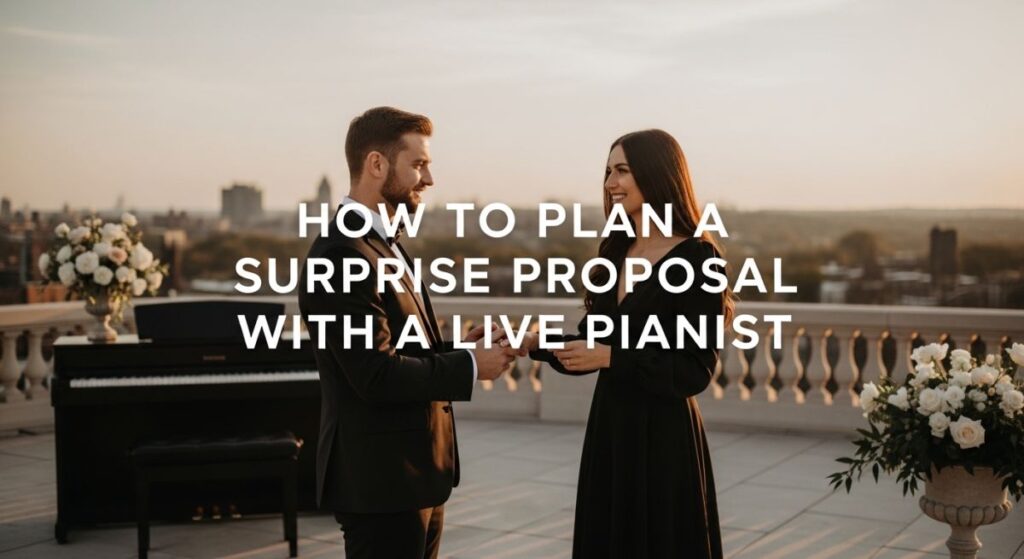
Practical Tips for a Smooth, Well-Timed Surprise Proposal
You have the ring. You have the plan. But you want the moment to feel right, not rushed, not awkward, and not like a scene from a movie that only works on screen.
Adding a live pianist to a surprise proposal is one of the most effective ways to set the tone for the moment. The music gives the scene a sense of intention. It signals to your partner that something is happening, but in a way that feels warm and natural rather than staged.
That said, live proposal music only works well when the logistics are planned in advance. The wrong location, a late cue, or a visible setup can ruin the surprise before you drop to one knee.
This guide walks through the real planning steps: choosing the right spot, timing the music, handling permits, hiding the setup, building a backup plan, and giving your pianist what they need to make it all feel easy. Whether you are thinking about a New Jersey surprise proposal, a New York City surprise proposal, or a Philadelphia surprise proposal, the core logistics are the same.
If you want broader inspiration on using live music during a proposal, the post on musical marriage proposals covers that angle. This article is about the planning side: what to do before the day arrives so the moment goes smoothly.
- Location determines everything. The spot you choose dictates what instrument works, how the pianist hides, and whether you need a permit.
- Timing the music cue is the single most important detail. A text signal, a nod, or a coordinator handoff keeps the moment feeling natural.
- Public and private proposals have very different logistics. A park setup in Manhattan requires permits and crowd management. A private dining room does not.
- You probably do not need an acoustic piano. A portable digital keyboard handles most proposal settings and keeps the setup footprint small.
- Backup plans matter. Weather, traffic, and timing shifts happen. Your pianist needs a plan for each one.
- Three details make planning fast: the exact location and access info, the timing and cue plan, and the song or style you prefer.
The Fast Answer: Is Live Piano a Good Fit for a Surprise Proposal?
Yes, in most cases. A live pianist for a surprise proposal adds a layer of emotion and presence that recorded music cannot match. It gives the moment a real, human feeling. Your partner hears the music building in real time, and the experience feels personal rather than prerecorded.
But live piano is only a good fit when three things line up:
- The location supports it. There needs to be space for a keyboard or piano, access to power (if using a digital instrument), and a way to position the musician so the surprise is not spoiled too early.
- The timing is controllable. If you are proposing in a setting where you control when you arrive and where you stand, live music can be timed precisely. If the setting is unpredictable (think a crowded street with no fixed arrival point), it becomes harder.
- The setup can stay hidden or discreet. The musician needs to be in position before your partner arrives. That means either arriving early, playing background music as part of the scene, or being tucked out of direct sightline.
If those three conditions are met, live piano is one of the strongest choices you can make for proposal music. If any of them are a stretch, there are simpler alternatives covered later in this guide.
Public vs. Private Surprise Proposals: A Side-by-Side Look
The biggest decision after choosing a proposal song is the setting itself. Public and private proposals have different strengths, risks, and logistics. Here is how they compare when a live pianist is involved.
| Factor | Public Proposal | Private Proposal | What to Think About |
|---|---|---|---|
| Privacy | Low. Strangers will watch, react, and possibly record. | High. Only the people you invite are present. | Consider your partner’s comfort with attention from strangers. |
| Noise Level | Unpredictable. Wind, traffic, crowd chatter. | Controlled. Indoor settings or private outdoor areas are quieter. | Amplification may be needed for public spots. |
| Timing Control | Limited. Crowds, weather, and access can shift your plan. | High. You control the arrival, setup, and moment. | Build a buffer of 15 to 20 minutes into any public plan. |
| Interruption Risk | Moderate to high. People may walk through the frame or talk loudly. | Very low. The space is yours. | A friend or coordinator can help manage crowd flow. |
| Permits Needed | Often yes, especially in NYC parks and public plazas. | Rarely. Venue or restaurant approval may be needed. | Check local rules at least 4 weeks in advance. |
| Photo/Video Coordination | Harder. The photographer needs to blend in with bystanders. | Easier. The photographer can be positioned in advance. | Brief the photographer and pianist together if possible. |
| Music Visibility | Pianist may be visible early unless placed behind a structure. | Pianist can be positioned in an adjacent room or behind a partition. | A digital keyboard is easier to hide than a grand piano. |
| Guest Involvement | Usually none, or hidden friends nearby. | Family and friends can be part of the scene. | Hidden guests add emotion but increase the chance of the surprise leaking. |
| Stress Level for Proposer | Higher. More variables to manage in real time. | Lower. The environment is controlled. | If you tend to get nervous, private settings are usually easier. |
Neither option is better across the board. A public proposal in a Manhattan park can be stunning with the right plan. A private proposal in a reserved restaurant dining room can feel just as significant. The difference is how much you need to manage on the day itself.
If you want the energy of a public setting with the control of a private one, consider semi-private locations: a reserved rooftop section, a rented garden patio, or a private room with a view. These give you the backdrop without the crowd risk.
Choosing the Right Location for Live Proposal Music
The location shapes every other decision: instrument type, volume, setup time, permits, and how the pianist stays hidden. Here is how common proposal location ideas break down when live piano is part of the plan.
Restaurants and Hotel Lounges
A restaurant proposal is one of the most manageable settings for live piano. Many upscale restaurants already have a piano on site or can accommodate a small keyboard setup near the dining area. The key is coordination with the restaurant manager.
Call ahead at least two to three weeks before the date. Confirm that the restaurant allows outside musicians if they do not have their own. Ask about a private or semi-private dining area where the pianist can play without disturbing other guests. Some restaurants prefer that the pianist play a short background set before the proposal cue, which actually helps mask the surprise.
Hotel lounges work similarly. Many hotels in New York City and Philadelphia have lobby pianos or lounge spaces that can be reserved for private events with advance notice.
Rooftops and City Views
A rooftop proposal with a skyline backdrop is visually dramatic. The challenge is logistics. Most rooftops have limited power outlets, restricted load-in access, and wind that affects sound. A portable battery-powered keyboard or a small amplified setup works best.
Ask the building or venue about elevator access for equipment, noise restrictions, and time limits. Some Manhattan and Brooklyn rooftop venues require liability agreements or certificates of insurance for outside vendors.
Parks and Gardens
A park proposal or garden proposal feels open and relaxed. The trade-off is noise control and power access. Digital keyboards need either a battery pack or access to a nearby outlet. Acoustic volume from a keyboard alone may be lost in an open space, so a small, battery-powered speaker helps.
In New York City, Central Park and many other city parks require a permit for amplified sound. In New Jersey, county and municipal parks have their own rules. Check with the parks department at least four weeks out. More on outdoor piano logistics for garden settings is available in a related guide.
Beach and Shore Proposals
A beach proposal along the Jersey Shore is a popular choice during warmer months. Sand, wind, and salt air create real equipment challenges. Keyboards need protection from sand and moisture. Sound carries unevenly near the water, so a small amplifier aimed toward the proposal spot is usually needed.
Timing matters here too. An early evening setup avoids peak beach crowds and gives you natural light for photos. Learn more about outdoor music at the Jersey Shore for additional logistical tips that also apply to proposals.
Private Homes or Estates
A private home gives you total control. You choose where the piano or keyboard goes, when the music starts, and who is there. There are no permits, no crowd issues, and no venue rules to navigate.
The main consideration is space. If the home does not have a piano, a portable keyboard fits in most living rooms, patios, and backyards. Keep the setup minimal so it does not signal the surprise before the moment.
Historic Venues and Event Spaces
Booking a short reservation at a historic venue or event space in New Jersey gives you the atmosphere of a public location with the privacy of a controlled environment. Many venues offer one-hour or two-hour rentals for private events, and some have house pianos.
Ask about acoustic characteristics, microphone use, and whether the venue has hosted proposals before. Experienced venue managers often have tips on setup placement and photographer positioning.
Timing the Music So the Moment Feels Natural
The most common concern people have about hiring a surprise proposal pianist is timing. When should the music start? What if you arrive late? What if you freeze up?
Here is how proposal music timing works in practice.
The Arrival Phase
If the pianist is already playing soft background music when you and your partner arrive, the presence of live music does not feel unusual. It just feels like part of the setting. This is the easiest way to build the scene without raising suspicion. Many restaurant and hotel proposals use this approach: the pianist plays a light set of standards, and your partner assumes it is part of the venue’s ambiance.
The Walk-In and Positioning
Once you are in the space and moving toward the spot where you plan to propose, the music should continue at the same volume and energy. Sudden changes in tempo or volume are a giveaway. The idea is to keep everything feeling normal until the cue.
The Proposal Cue
The cue is the signal from you (or your coordinator, photographer, or a trusted friend) that tells the pianist to transition into the proposal song. Common cue methods include:
- A text message: You send a pre-agreed word or emoji. The pianist keeps their phone visible on the music stand.
- A visual nod or gesture: You make eye contact with the pianist or raise a hand slightly.
- A coordinator relay: A friend or event coordinator, already positioned near the pianist, gives the go signal.
- A timing window: You tell the pianist to start the song at a specific time (e.g., 7:15 PM), and you position yourself accordingly.
The text message method is the most reliable in most settings because it does not require line-of-sight and works even if the pianist is in another room or behind a partition.
For a surprise proposal, timing matters just as much as the song choice. I tell every client: give me a clear cue method and a 10-minute buffer, and the music will land exactly where it needs to.
The Moment Right After “Yes”
After the proposal itself, the music should keep going. This is often the most emotional part, and silence right after a “yes” can feel abrupt. A good pianist will extend the song or transition into a second piece that keeps the mood warm while you celebrate together, take photos, and let the moment settle.
Common Timing Mistakes
Starting the song too early is the most frequent issue. If the proposal song plays for 90 seconds before you are in position, the moment loses its impact. On the other side, starting too late means you are already on one knee in silence, which feels incomplete.
The fix is simple: plan for the song to begin about 10 to 15 seconds before you intend to kneel or speak. That gives the melody time to register without dragging.
Do You Need a Piano on Site?
Most proposal settings do not have an acoustic piano available. That is fine. A digital keyboard is the standard tool for proposal setups, and in many cases it is the better choice. Here is a comparison of options.
| Option | Best For | Main Advantage | Main Limitation |
|---|---|---|---|
| Venue’s Acoustic Piano | Hotel lobbies, event halls, historic venues | Rich, natural sound with no setup needed | Not movable; location of the piano is fixed |
| Portable Digital Keyboard | Most proposal settings, indoors or outdoors | Small footprint, volume control, fits any space | Needs power (outlet or battery pack) |
| Keyboard + Small Amplifier | Outdoor parks, rooftops, beach proposals | Sound carries further; adjustable projection | Slightly larger setup; more equipment to hide |
| Weighted 88-Key Stage Piano | Indoor settings where tone quality matters most | Closest sound to a real piano in portable form | Heavier; needs a stand and possibly a bench |
For most surprise proposal music setups, a portable digital keyboard with built-in speakers or a small external speaker is the right call. It is easy to transport, quick to set up, and can be placed behind furniture, partitions, curtains, or even inside a nearby vehicle with the windows down for a park proposal.
For more on the differences between acoustic and digital instruments in event settings, see the guide on grand piano vs. digital keyboard.
Permits, Venue Rules, and Staff Coordination
This section covers the details that people often overlook until the last minute. Getting these right early makes everything else easier.
Park Permits
In New York City, any amplified music in a public park technically requires a permit from the NYC Department of Parks and Recreation. The same applies to many NJ county parks and municipal green spaces. Even if enforcement is inconsistent, having a permit protects you from being asked to stop during the proposal itself.
Apply at least three to four weeks ahead. Fees are typically modest (often under $50 for a short event), and the process is usually straightforward.
Venue and Restaurant Approval
If you are proposing at a restaurant, hotel, or private venue, speak directly with the manager or event coordinator. Explain the plan clearly: you are hiring an outside musician for a short performance, and you need a specific seating arrangement and timing.
Most venues are happy to help. Some will assign a staff liaison to coordinate on the day. Others may have restrictions on amplified sound, setup times, or where the musician can be placed. Ask these questions early:
- Is there a private or semi-private dining area available?
- Can an outside musician set up a keyboard near the table?
- Is there an outlet available, or should the pianist bring battery power?
- Does the venue charge a fee for hosting a private event within normal dining hours?
- Is there a separate entrance for the musician to arrive before the couple?
Rooftop Access Rules
Private rooftop venues and buildings often require advance approval for any outside vendor. Some need a certificate of insurance (COI) from the musician. Ask about load-in logistics: which elevator, what time, and whether the equipment needs to be carried up stairs. For Philadelphia-area logistics, the Philadelphia pianist logistics guide covers COI and load-in details that apply to proposals too.
Photography and Videography Rules
Some venues restrict professional photography or require approval for camera crews. If you are hiring a photographer to capture the proposal, confirm that the venue allows it and that the photographer knows where to position themselves without being obvious.
Weather Backup Plans
For any outdoor proposal, you need a backup plan. Rain, extreme heat, and high wind all affect live music outdoors. Discuss with your pianist what happens if conditions change: is there a covered area nearby? Can the setup move indoors? Will the timeline shift?
If your proposal plan involves any public space, do not assume the rules are the same as they were last year. Cities and parks update their event policies regularly. A quick phone call to the venue or parks office two weeks before your date can save you from a last-minute problem.
Planning a surprise proposal in NJ, NYC, or Philadelphia?
Arnie Abrams can help with location advice, timing, and music selection. Free consultations available.
Choosing the Right Song Without Overthinking It
Song choice matters, but it does not need to be complicated. The right proposal song is one that means something to you, or one that simply sounds beautiful as a piano instrumental. Both approaches work.
“Your Song” or a Shared Favorite
If you and your partner have a song that has been part of your relationship, that is usually the strongest choice. Hearing it played live on piano adds a layer of emotion that a recording cannot match. It does not matter whether it is a pop ballad, an R&B track, or an indie song. A skilled pianist can arrange almost any piece for solo piano.
Instrumental Love Songs
If you do not have a shared song, instrumental love songs and well-known romantic melodies work well. Think along the lines of Debussy’s “Clair de Lune,” Yiruma’s “River Flows in You,” or a gentle arrangement of “At Last.” These pieces are widely recognized and carry emotional weight without needing lyrics.
Classical Piano Pieces
Classical pieces like Chopin’s “Nocturne in E-flat Major” or Beethoven’s “Moonlight Sonata” (first movement) give the moment a formal, timeless quality. They work especially well in elegant indoor settings like historic venues, hotel lobbies, and estate gardens.
Modern Piano Covers
Current pop songs arranged for solo piano can sound striking. If your partner loves a specific artist or a recent hit, a piano cover of that song can surprise them in a way they do not expect. The key is confirming with your pianist that the arrangement works well as a solo instrument piece.
Songs for Quiet Entrances vs. the Reveal Moment
Some songs work best as background music while you walk into position. Others are better suited for the moment itself. A good approach is to choose two pieces: one for the lead-in (softer, slower, ambient) and one for the proposal cue (more recognizable, emotionally direct). Your pianist can transition between them naturally.
What If You Are Not Sure Which Song to Use?
Ask your pianist. An experienced proposal pianist has played dozens of these events and can suggest songs based on your setting, your partner’s taste, and the mood you want to create. Arnie Abrams, for example, regularly helps clients narrow down options during a free consultation. You do not need to have the answer before you reach out.
How to Keep the Surprise Intact
A surprise proposal only works if the surprise holds. Here is how to protect it when live music is part of the plan.
Positioning the Pianist
The pianist should be set up and playing (or silent and ready) before your partner arrives. For restaurant proposals, the pianist can be positioned in a nearby section, playing general background music. For private settings, the pianist can be in an adjacent room, behind a curtain, or on a patio just outside the main space.
In outdoor settings, a friend or coordinator can stand near the musician to make the setup look like a casual performance rather than a staged event.
Who Gives the Cue?
Decide this in advance and rehearse it once. The most reliable options are a text message or a relay from a designated person near the pianist. Avoid complex signals. A simple “now” text or a thumbs-up from across the room is enough.
Coordinating With a Photographer
Your photographer needs to know the pianist’s position, the cue method, and the approximate timing. Brief them together if possible, or share a written plan with both. The photographer and pianist should not be in each other’s shot, and both need to know where you will be standing or kneeling.
Should Friends or Family Be Hidden Nearby?
This depends on your partner. Some people love the moment of looking up and seeing their closest friends. Others want the proposal to be private, with celebrations afterward. If you include hidden guests, keep the group small (under 10) and give them strict instructions about where to stand, when to stay quiet, and when to step forward.
Be aware that hidden guests increase the risk of the surprise leaking through social media, accidental texts, or visible parking situations.
What Can Go Wrong and How to Prevent It
No plan is foolproof. But most proposal problems are preventable with a small amount of advance coordination. Here are the most common issues and how to handle each one.
Crowd Interference
In public settings, bystanders may walk through the scene, stand too close, or start recording on their phones. A friend positioned nearby can gently direct foot traffic or hold a small area clear. Do not rely on strangers to notice what is happening and step aside.
Bad Weather
For outdoor proposals, have a specific indoor backup location identified in advance. Share this with the pianist, photographer, and any guests. Make the weather call at least two hours before the event so everyone has time to adjust.
Delayed Arrival
Traffic, parking issues, or a slow dinner can push your arrival time past the planned cue. Build 15 to 20 minutes of buffer into the schedule. The pianist should be prepared to play background music for an extended period if needed. A text update to the pianist (“running 10 min late”) is all it takes.
Venue Staff Confusion
If the restaurant or hotel staff were not properly briefed, they may seat you at the wrong table, interrupt the moment with a menu, or ask the pianist to stop playing. Confirm your plan with the manager the day before, and ask for a specific staff member to be your point of contact on site.
The Proposer Gets Nervous and Moves Too Fast
This is more common than you might expect. Adrenaline kicks in, and you skip straight to the knee before the music starts. The fix: take a breath, wait for the first few notes of the song, and then move. Your pianist is watching for the cue, and those few extra seconds make a real difference in how the moment feels.
Music Starts at the Wrong Moment
A miscommunication on the cue can cause the song to start too early or too late. The best prevention is simplicity: one cue method, tested once in advance. If the music does start at the wrong time, keep going. The moment still belongs to you and your partner, and a skilled pianist can adjust on the fly.
The best proposal music setups usually feel effortless to the couple because the logistics were handled ahead of time. That is always the goal: smooth on the outside, planned on the inside.
When Live Piano Is the Better Choice
Live piano fits a surprise proposal especially well when:
- You want the music to feel personal. A pianist playing your song in real time, adjusting tempo to the moment, creates something a Bluetooth speaker cannot replicate.
- The setting supports it. Indoor venues, semi-private outdoor spaces, gardens, rooftops with power access, and private homes are all strong fits.
- You want the music to respond to the moment. If the proposal takes longer than expected (tears, laughter, a long embrace), a pianist extends naturally. A track just ends.
- You are involving family or friends. Live music elevates the atmosphere for everyone present, not just the couple.
- You care about the video and photos. A live pianist in the background of a proposal video looks and sounds better than a phone propped up playing a Spotify track.
For couples planning a New Jersey surprise proposal or an event anywhere in the tri-state area, Arnie Abrams serves all of New Jersey and can help assess whether live piano fits your specific setting.
When a Simpler Setup May Make More Sense
Live piano is not the right fit for every situation. Here are cases where a different approach may work better:
- Extremely remote outdoor locations. If the spot is deep in the woods, on a hiking trail, or on a beach far from any road, getting a keyboard there is impractical. A portable speaker with a pre-recorded piano track may be the better option.
- Very short timing windows. If the proposal is happening during a quick transition (say, a 30-second moment between activities), live music may not have time to register. A pre-timed recording can start and stop more precisely.
- Extreme noise environments. A busy public plaza during lunch hour, a crowded boardwalk, or a noisy sports venue may drown out live piano entirely unless you add heavy amplification, which increases the setup footprint.
- Budget constraints. If your budget is tight and you need to prioritize a photographer, a recorded piano piece played through a concealed speaker is a reasonable alternative.
- Partner strongly prefers privacy. If your partner would be uncomfortable with any visible setup or any stranger being part of the moment, a hidden Bluetooth speaker playing a pre-recorded track gives you music without a visible musician.
There is no shame in keeping it simple. The proposal is about the question and the answer, not the production. Live music makes a great moment better, but it is not a requirement.
Quick Decision Guide: Live Pianist vs. Recorded Music
Go With Live Piano
- Indoor venue, restaurant, or home
- Semi-private outdoor area with power
- You want the music to adapt in real time
- Family or friends will be present
- You want it in the video and photos
Go With Recorded Music
- Remote outdoor location with no power
- Extreme noise or crowd environment
- Very short timing window
- Partner prefers no visible setup
- Budget is focused on photography
Consider a Hybrid
- Pianist plays the proposal song live
- Recorded track plays during the walk-in
- Pianist arrives only for the 15-minute window
- Pre-recorded background, live feature moment
- Good for tight budgets with high-impact goals
The 3 Things Arnie Abrams Needs From You
When you reach out to Arnie Abrams about proposal music, three details help build the right plan quickly.
1. Exact Location and Setup Details
Where is the proposal happening? Indoor or outdoor? Is there a piano on site, or does the pianist need to bring a keyboard? What is the power situation? Is there a separate entrance for the musician to arrive without being seen?
The more specific you are, the faster Arnie can confirm whether the location works for live piano and what equipment is needed.
2. Proposal Timing and Cue Plan
What time will you arrive? How will you signal the pianist to start the song? Is a friend or coordinator involved? Will the pianist play background music before the cue, or stay silent until the signal?
Even a rough timeline helps. The cue method can be finalized closer to the date.
3. Preferred Music Style or Song Choice
Do you have a specific song in mind, or would you like suggestions? Is there a genre or mood your partner would respond to most? Classical? Jazz? Modern pop? A mix?
If you are unsure, that is perfectly fine. Arnie has played hundreds of events and can guide you toward the right fit based on your setting and your partner’s taste. Read more about what Arnie wishes clients knew for additional planning context.
Live piano works beautifully for proposals, but the location has to support the moment. Give me the where, the when, and the what, and I can handle the rest.
Event Experience
NJ • NYC • Philly
to Start Planning
Final Planning Guide for a Smooth Surprise Proposal
Here is a simple framework to follow once you have decided to include live piano in your proposal. Work through these steps in order, and you will have the logistics covered well before the day arrives.
- Lock in the location. Confirm the venue, park, restaurant, or private space. Make sure it supports live music in terms of space, power, and access.
- Contact your pianist early. Reach out at least three to four weeks before the planned date. Share the location, the approximate timing, and your initial song ideas.
- Handle permits and approvals. If the proposal is in a public park or a private venue, confirm what approvals are needed and submit them early.
- Choose the song and cue method. Work with your pianist to finalize the music. Agree on the cue method and test it once.
- Brief your team. Share the plan with the photographer, any friends or family involved, and the venue staff. Make sure everyone knows the timeline, cue, and backup plan.
- Do a final check two days before. Confirm the weather forecast, the arrival time, the cue method, and the pianist’s setup time. A short phone call covers everything.
- On the day: trust the plan. You have done the work. Breathe. Wait for the cue. The rest takes care of itself.
Frequently Asked Questions
How do you plan a surprise proposal with a pianist?
Start by choosing a location that supports live music, whether a restaurant, park, rooftop, or private home. Contact a pianist at least three to four weeks in advance with the location details, your preferred song, and the timing. Agree on a cue method (text message works best) and coordinate with your photographer and any involved friends. A brief final check two days before the proposal keeps everything aligned.
Is live piano a good fit for a surprise proposal?
Yes, in most settings. Live piano adds warmth and presence that recorded music cannot replicate. It works especially well in restaurants, hotel lounges, gardens, private homes, and semi-private outdoor spaces. The key is making sure the location has room for the setup and a reliable way to cue the musician at the right moment.
Do I need a piano at the location already?
No. Most proposal pianists bring a portable digital keyboard that fits in almost any space. The keyboard connects to a small speaker if extra volume is needed. If the venue has a house piano, the pianist can use it instead. Confirm the instrument situation with your pianist during the initial consultation.
Can a pianist play one specific song for the proposal?
Absolutely. Most pianists can learn or arrange a specific song for your proposal if given enough lead time. Share the song title during your consultation, and the pianist will confirm that it translates well to solo piano. Many clients also request a short set of background music before the featured proposal song.
What works better for a proposal: public or private?
It depends on your partner’s personality and your comfort level with managing variables. Private settings give you more control over timing, noise, and setup. Public settings offer dramatic backdrops but require more coordination, including crowd management and possibly a permit for amplified sound.
Do I need permission or a permit for a proposal with live music?
In many public parks and plazas, yes. New York City parks require a permit for amplified sound, and many NJ county parks have similar rules. Restaurants and hotels may need advance approval for outside musicians. Apply at least three to four weeks ahead to avoid last-minute issues.
What if the timing changes at the last minute?
A good pianist builds buffer time into the plan. If you are running late, a quick text keeps the musician informed. If the pianist is playing background music, they simply extend the set. If the cue timing shifts, the text-based cue system still works because the pianist starts only when you signal. Flexibility is built into the process.
Can Arnie Abrams help with proposal music in NJ, NYC, or Philadelphia?
Yes. Arnie Abrams provides proposal music services across New Jersey, New York City, and the Philadelphia area. A free consultation is available to discuss your location, timing, and music preferences before you commit.
Ready to Plan Your Proposal Music?
Arnie Abrams has over 20 years of experience playing live events across New Jersey, New York City, and Philadelphia. A free consultation is available to discuss your location, timing, and music preferences.
Request a Consultation