
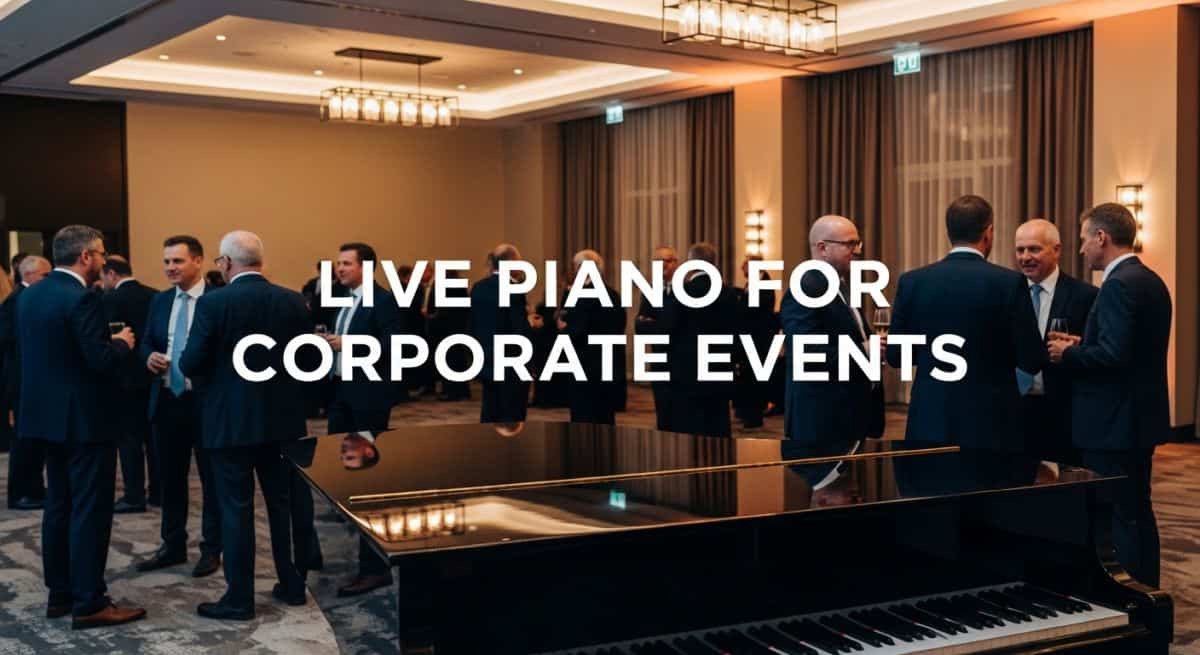
The Right Music Keeps Corporate Events Polished, Social, and Well-Timed
A corporate gala, award ceremony, or product launch is not just another event on the company calendar. It is the kind of evening where brand image, guest comfort, and professional atmosphere all matter at once. The right live piano entertainment for corporate galas sets the tone from the moment guests check in, and it keeps the room feeling polished through every speech, handoff, and networking break.
This guide covers practical planning advice for anyone booking a corporate event pianist for a gala, awards dinner, or launch. It is written for event planners, marketing teams, executive assistants, office managers, and business owners in New Jersey, New York City, and Philadelphia who want their next event to feel professional and welcoming without being stiff or forgettable.
- Live piano gives a corporate event real-time flexibility that playlists and DJ sets cannot match, especially during speeches, awards, and transitions.
- Music should support the brand tone of the company hosting the event, not distract from it.
- Volume, tempo, and cueing are often more important than the specific songs a pianist plays.
- Setup and logistics change depending on whether the event is in a hotel ballroom, rooftop, office space, or private dining room.
- A few key details from the planning team (timeline, cue points, tone) are all a professional pianist needs to shape the right music plan.
The Fast Answer: Why Live Piano Works for Corporate Galas, Awards, and Launches
Live piano works well for these events because it is polished enough for a formal room and flexible enough to shift in real time. A pianist can lower the volume when a speaker approaches the podium, raise the energy slightly when the cocktail portion begins, and pause cleanly when an emcee takes over. That kind of responsiveness is exactly what makes live piano music for corporate events a better fit than a static playlist.
The core appeal is not about entertainment in the way a wedding band entertains. It is about atmosphere, brand tone, networking support, and timing. When a room full of executives, clients, and sponsors hears well-chosen piano music at the right volume, the event immediately feels more put together. It signals attention to detail.
What Makes These Corporate Events Different From Other Business Gatherings
A quarterly team meeting, a lunch-and-learn, or a departmental happy hour can get by without any music plan at all. Corporate galas, award ceremonies, and product launches are different. These events are public-facing or high-visibility. The guest list usually mixes executives, board members, clients, sponsors, media contacts, and employees at various levels. The atmosphere needs to feel sharp and intentional from the start.
These gatherings typically include multiple phases: arrival and check-in, cocktails, a formal program (speeches, recognition, or a product reveal), and a post-program social window. Each phase has a different energy. The tempo and pacing of music must shift to match, and that requires planning.
The biggest difference between a gala and a typical office gathering is guest perception. At a gala or launch event, the company’s reputation is on display. Every detail, including the music, reflects on the brand. That is why event planners for these occasions tend to treat the music as a functional part of the program rather than background filler.
| Event Type | What the Music Needs to Do | Biggest Planning Risk |
|---|---|---|
| Corporate Gala | Set a polished tone for arrival and networking, then step back during speeches and awards | Music that stays at one volume all night and competes with conversation |
| Award Ceremony | Support podium walks, fill gaps between presenters, and pause cleanly during speeches | No cue coordination with the emcee, causing awkward silence or overlap |
| Product Launch | Build anticipation during the pre-reveal reception, then step aside for the announcement | Music that overshadows the reveal moment or feels mismatched with the brand |
Why Brand Tone Matters as Much as Entertainment
Every company has a personality. A financial services firm, a tech startup, a pharmaceutical company, and a family-owned real estate group all project different images. The music at a corporate gala should match that image, not fight it.
Live piano naturally carries an air of understated confidence. It fills a room without overwhelming it. Unlike a full band or a DJ setup, a pianist playing familiar instrumental music keeps the room active and inviting while letting conversations happen naturally. That is the balance most corporate events need: polished presence without noise.
Recognizable songs played on piano tend to work better than obscure deep cuts or high-energy tracks at business events. When a guest hears a familiar melody played as an instrumental, it creates a pleasant background feeling without pulling attention away from the people in the room. That kind of conversation-friendly live music is one of the main reasons planners choose piano over other formats for corporate galas.
A Typical Corporate Event Timeline and Where Music Fits
One of the most useful planning tools for corporate gala music is a simple timeline. Knowing where each phase starts and ends helps the pianist prepare the right material for each moment. Here is a typical breakdown for a gala or awards dinner:
| Event Phase | What Guests Are Doing | Best Music Approach | Why It Works |
|---|---|---|---|
| Check-in and arrival | Walking in, receiving name badges, scanning the room | Soft jazz standards or light classical at low volume | Signals that the event has started and feels welcoming |
| Cocktail reception | Mingling, networking, early conversations | Familiar instrumentals at moderate volume, slightly brighter tempo | Fills the room without forcing guests to raise their voices |
| Seating and transition | Moving from cocktails to the main room | Brief musical bridge, slightly quieter, as guests settle | Smooths the transition without an awkward silent gap |
| Program (speeches, awards, or reveal) | Listening, watching, applauding | Music stops or drops to near-silent; brief cues for walk-ups and exits | Keeps the focus on the speaker and avoids distraction |
| Post-program mingling | Dessert, drinks, open conversation | Resume music at moderate volume with familiar, crowd-friendly songs | Re-energizes the room and encourages guests to stay and connect |
| Close and farewell | Saying goodbyes, heading to the exit | Gentle wind-down with softer selections | Signals the evening is wrapping up gracefully |
The music can gradually become more familiar and slightly more upbeat as the evening progresses past the formal portion, but it should never tip into party-band territory at a corporate event. The goal is a controlled rise in energy that keeps the room feeling alive and social.
At a corporate event, the music should support the room, not compete with it. If people have to shout over the piano, something is wrong.
Live Piano vs. a Playlist for Corporate Events
This is a fair question, and the honest answer is that both can work depending on the event. But they serve different purposes, and the gap between them grows as the event becomes more visible.
A playlist is fine for a casual office party or an internal team gathering where music is truly just background noise. For a client-facing gala, a formal award ceremony, or a product launch with media present, a live pianist brings something a playlist cannot: real-time responsiveness.
A pianist can read the room. If the cocktail hour runs long, the music continues with no gap. If the CEO steps up to the mic five minutes early, the pianist stops cleanly. If the energy needs a small lift after a long speech, the next song can be brighter. None of that is possible with a pre-set playlist.
| Option | Best Fit | Main Advantage | Main Limitation |
|---|---|---|---|
| Live pianist | Client-facing galas, awards, launches, networking receptions | Adjusts in real time to speeches, timing changes, and room energy | Requires setup coordination and budget allocation |
| Pre-built playlist | Internal team events, low-key mixers, casual office gatherings | No coordination needed; runs on its own | Cannot react to the room; gaps and awkward timing during transitions |
For more on how the instrument setup itself affects your event, see this comparison of grand piano vs. digital keyboard options.
Choosing Music That Fits Executives, Clients, and Guests
One of the biggest questions planners ask is, “What should the pianist play?” The answer depends more on the event goals and guest mix than on any particular song list.
A room full of senior executives and clients from different industries does not need a playlist built around one genre. It needs a balanced approach that stays professional, recognizable, and easy to talk over. The music should feel familiar without demanding attention.
| Music Lane | Best Moment | Why It Fits |
|---|---|---|
| Recognizable contemporary songs (piano instrumentals) | Cocktail reception and post-program mingling | Guests notice the melody without it being loud or distracting |
| Polished classics (Sinatra, Nat King Cole era) | Arrival and check-in, early networking | Timeless quality that fits formal and semi-formal settings |
| Light jazz and standards | Dinner service and seated portions | Keeps the room warm without overpowering table conversation |
| Soft instrumental | Transition moments and seating changes | Smooths gaps between program segments |
| Slightly brighter, crowd-friendly songs | Post-awards or post-launch social time | Gives the room a natural lift when the formal program ends |
Start With the Event Goal, Not the Song List
Instead of handing your pianist a list of 40 songs, start by telling them the goal of each part of the evening. “We want the cocktail hour to feel relaxed and confident” is more useful than a genre label. “After the keynote, we want the energy to come back up gradually” gives the pianist a clear direction.
A pianist with decades of live performance experience already knows which songs fit each moment. What they need from you is the context around the event, not a track-by-track playlist.
Planning a corporate gala, awards dinner, or product launch in NJ, NYC, or Philadelphia?
Arnie Abrams can help you map the music to your event timeline, venue setup, and brand tone.
Ask About AvailabilityHotel Ballrooms, Private Rooms, Rooftops, Offices, and Launch-Space Logistics
Where the event takes place changes what the pianist needs to plan for. Here is a breakdown of the most common corporate venue types and what matters most at each one.
Hotel Ballrooms and Banquet Spaces
Most corporate galas in New Jersey, Manhattan, and Philadelphia take place in hotel ballrooms. These rooms are typically large, carpeted, and set up for seated dinners with a stage or podium area. The key logistics are power access near the piano position, load-in through service entrances, and AV coordination with the hotel’s in-house team. A digital keyboard is usually the best fit, since most ballrooms do not have a house grand piano available.
Private Dining Rooms and Restaurants
Smaller client appreciation dinners and executive gatherings often happen in private dining rooms. These spaces tend to have tighter floor plans, which means the keyboard footprint matters. The pianist should be positioned where the music fills the room evenly without being too close to any one table. Power access and a clear sightline to the host or emcee are the main setup concerns.
Corporate Offices and Atriums
Office-based events like company milestone celebrations or internal award ceremonies sometimes take place in lobbies, atriums, or large conference areas. Acoustics in these spaces can be tricky. Hard floors, glass walls, and high ceilings create echo and sound bounce. The pianist may need to adjust volume more carefully, and it helps to place the keyboard away from the hardest reflective surfaces.
Rooftops and Outdoor Terraces
Outdoor corporate events in the NYC metro area or Philadelphia are popular in spring and fall. The main concerns for a pianist on a rooftop are weather backup, power access, and wind noise. A digital keyboard with a small amplifier usually works best in open-air settings. If the venue is outdoors, always have an indoor rain plan for the equipment.
Product Launch Venues and Showrooms
Launch events sometimes happen in showrooms, galleries, or rented loft spaces. These venues may not have a built-in AV system, so the pianist may need to bring a self-contained setup. It is important to confirm electrical capacity, load-in access, and where the keyboard should sit relative to the product display or stage area.
Ask your venue contact these three questions before your pianist arrives: Where is the nearest power outlet to the performance area? Is there a freight elevator or ground-level load-in? Will the AV team be on site during setup? These answers save time on event day.
Volume, Tempo, and Cueing Matter More Than Most Teams Expect
If there is one section of this guide worth bookmarking, it is this one. The volume, tempo, and cueing of live piano music at a corporate event affect the guest experience more than the specific songs being played.
Volume: Guests should be able to hold a conversation at normal speaking volume during cocktails, dinner, and networking. If people are leaning in or raising their voices, the music is too loud. A professional NYC pianist knows how to read a room and adjust on the fly.
Tempo: During networking and dinner, mid-tempo music (roughly 90 to 110 BPM) keeps the room feeling active without creating urgency. After the formal program, the tempo can rise slightly to signal that the social part of the evening has arrived.
Cueing: This is where live piano really earns its place. The pianist can play a brief walk-up piece when an award recipient approaches the stage. They can hold a soft note under an emcee’s introduction. They can resume playing the moment applause begins to fade. These small cues make the program feel smooth and produced.
For a deeper look at how tempo shapes guest behavior and room energy, see this guide on music pacing and guest experience.
The best event sets have range. You want the energy to stay active, but you also want every conversation to feel easy.
Timing
Philadelphia
Awards & Launches
Common Corporate Event Music Mistakes
After two decades of performing at corporate events across North Jersey, Manhattan, Brooklyn, the Main Line, and Center City Philadelphia, there are a handful of mistakes that come up again and again. Avoiding these will make the music portion of any gala, award dinner, or launch event run much more smoothly.
- Making the music too loud during the first hour. When guests are still arriving and finding their footing, the music should be soft and welcoming. Starting too loud pushes people into corners to talk and makes the room feel chaotic before the event has even started.
- Using the same static playlist for the entire evening. A single playlist cannot account for the energy shift between cocktails, the formal program, and the post-program social period. The room needs different music at different moments.
- Not coordinating with the emcee or event lead. If the pianist does not know when speeches are happening, when award recipients will be called up, or when the product reveal is scheduled, the music will overlap or leave awkward gaps.
- Choosing music that clashes with the company’s image. Upbeat pop tracks might work for a startup launch, but they can feel out of place at a formal awards dinner for a law firm. The music style should match the host organization.
- Forgetting about transitions. The gaps between cocktails and seating, between speeches, and between the program and post-program mingling all need musical bridges. These are small moments, but they add polish.
- Assuming a house piano is available and in good condition. Most corporate venues do not have a quality acoustic piano on site. Always confirm whether the pianist should bring a digital keyboard.
- Leaving AV and setup questions until event day. Load-in routes, power access, and AV connections should be sorted at least a week before the event, not during setup.
Good corporate event music should make the room feel more polished the minute guests walk in. If you plan the music the same way you plan the lighting and the seating chart, you are already ahead of most events.
When Live Piano Makes the Biggest Difference
Live piano is not always necessary for every corporate gathering. But for certain events, it makes a clear and noticeable difference:
- Black-tie corporate galas where the room is formal and the guest list includes high-profile attendees. Live piano fits naturally without needing a stage or lighting rig.
- Annual award ceremonies where walk-up music, applause bridges, and emcee cues keep the program moving. A pianist handles these transitions more smoothly than any pre-programmed playlist.
- Product launches with clients, media, or leadership present. The pre-reveal reception needs energy and tone; live piano delivers both without competing with the announcement itself.
- Client appreciation dinners where the atmosphere should feel warm and personal, not corporate or generic.
- Company milestone celebrations (anniversaries, IPO events, expansion announcements) where the company wants to mark the occasion with something memorable.
- Upscale networking receptions where the entire point is conversation, and the music needs to enhance that instead of making it harder.
For more on how live piano shapes the feel of a professional event, read about the psychological impact of live piano at corporate events.
The 3 Things Arnie Abrams Needs From You
Planning the music for a corporate gala, awards dinner, or product launch does not have to be complicated. To build the right music plan quickly, Arnie needs three things from your team:
1. Event location, room setup, and AV details. Where is the event? Is it indoors or outdoors? Is there a house piano, or should the pianist bring a digital keyboard? Where is the nearest power outlet? Will the venue’s AV team be on site? These basics shape the setup plan.
2. Event timeline and cue points. When do cocktails start? When does the formal program begin? Are there specific moments (award presentations, a keynote, a product reveal) that need walk-up music or a clean stop? A timeline with cue points lets the pianist prepare transitions in advance.
3. Preferred tone, guest mix, and any must-play or do-not-play notes. Is the event formal or semi-formal? Are guests mostly executives, or is it a broader company-wide crowd? Are there any songs the host definitely wants included or excluded? These details fine-tune the music selection.
That is it. Three details. With those in hand, Arnie can build a music plan that fits the event from start to finish.
Quick Decision Guide: Is Live Piano the Right Fit for This Corporate Event?
Not sure if your event calls for a live pianist? Run through this checklist. If you check three or more, live piano is likely a strong fit.
Does This Event Need Live Piano?
- The guest list includes clients, sponsors, or senior leadership
- There will be speeches, awards, or a product reveal
- The event is formal or semi-formal in tone
- Networking and conversation are a major part of the evening
- The venue is a hotel ballroom, private dining room, or upscale space
- The company wants the atmosphere to reflect its brand image
- The event has multiple phases with different energy levels
- The timeline may shift on the night of the event
- The host wants music that can adjust in real time
- The event is in NJ, NYC, or the Philadelphia area
Final Planning Guide for a Corporate Event That Feels Polished, Not Stiff
Here is a short planning framework to keep your event music on track:
- Lock the venue and confirm the room layout before finalizing music logistics. Piano placement depends on the floor plan, guest flow, and podium or stage location.
- Share a written event timeline with the pianist at least two weeks out. Include cocktail start time, program start, award or keynote timing, and expected wrap time.
- Assign a point of contact who can communicate with the pianist on the day of the event. This person handles last-minute schedule changes and cue calls.
- Discuss brand tone and guest mix in a short call with the pianist. This is where you describe the feel of the event and mention any genre preferences or restrictions.
- Confirm AV coordination with both the venue and the pianist. If there is a sound system in the room, the keyboard should connect to it for even coverage.
- Plan for setup and load-in time. Budget 30 to 60 minutes for a keyboard setup, including sound check. Hotel and office venues may have specific load-in windows.
For a Philadelphia pianist or a pianist serving the tri-state area, these are routine steps. The planning does not need to be complex, but it should happen early enough to avoid day-of surprises.
Many corporate event planners assume the venue has a usable piano on site. In most cases, hotel ballrooms, restaurants, and office spaces do not. Always confirm whether the pianist should bring a digital keyboard, and check that the performance area has accessible power outlets.
Frequently Asked Questions
Is live piano a good fit for a corporate gala?
Yes. Live piano is one of the most common and well-suited music choices for corporate galas. It provides a polished, professional atmosphere that supports networking, speeches, and formal dining. A pianist can adjust volume and tempo in real time, which makes it easier to manage the energy of a multi-phase event.
Can a pianist play during an award ceremony without getting in the way?
A professional pianist can play walk-up music as recipients approach the stage, hold a soft note during introductions, and stop cleanly when a speaker begins. The key is coordinating cue points with the emcee before the event. This kind of live cueing is one of the main advantages over a playlist.
Does live piano work for a product launch?
It does. During the pre-launch reception, piano music sets a confident and professional tone. When the reveal moment arrives, the pianist can pause or play a brief lead-in piece. This kind of flexibility helps the announcement land without competing music in the background.
Is live piano better than a playlist for a corporate networking event?
For a formal networking event with clients, sponsors, or leadership present, live piano is usually the better choice. A pianist reads the room and adjusts volume and energy based on how guests are interacting. A playlist runs at one preset level regardless of what is happening in the room.
Do I need a piano at the venue already?
In most cases, no. Most corporate venues do not have an acoustic piano available. A professional pianist typically brings a high-quality digital keyboard that sounds excellent in any room size. Just confirm that the performance area has power access and enough floor space for the keyboard and bench.
What kind of music works best for executives, clients, and mixed corporate guests?
A blend of familiar instrumental covers, light jazz standards, and polished classics tends to work best. The goal is music that sounds recognizable and warm without demanding attention. The pianist selects songs that match the formality of the event and the demographics of the guest list.
How long should a pianist play at a corporate event?
Most corporate galas and award dinners book a pianist for two to four hours, covering cocktails through post-program mingling. Shorter events like a one-hour reception or a 90-minute launch may only need one to two hours. The exact duration depends on the event timeline.
Can Arnie Abrams play for corporate events in NJ, NYC, or Philadelphia?
Yes. Arnie Abrams performs at corporate galas, award ceremonies, product launches, and client events across New Jersey, New York City, and Philadelphia. He regularly plays at venues in Manhattan, Brooklyn, North Jersey, the Main Line, and Center City. Contact him at (732) 995-1082 to discuss your event.
Ready to Plan the Music for Your Corporate Event?
Whether it is a gala, an awards dinner, a product launch, or a client appreciation event in NJ, NYC, or Philadelphia, Arnie Abrams can help you choose the right music, plan the timeline, and handle the setup.
Request a Consultation- Corporate Galas
- Award Ceremonies
- Product Launches
- Client Dinners
- Networking Receptions