Low-Volume Live Piano that Supports Networking, Brand Presence, and Better Conversations
Most trade show booths, hospitality suites, and sponsor lounges are planned around everything except the music. The venue gets locked in, the catering gets sorted, the badges get printed, and the question of background sound ends up as a last-minute line on the checklist. That is usually where problems start.
Live piano can work well in these spaces, but only when it is treated as a practical piece of the event plan, not a decoration. The right setup supports conversations, helps guests settle in, and makes the room feel hosted. The wrong setup competes with the sales reps and annoys the neighbors. This guide walks through what separates the two.
Trade shows and hospitality suites live or die by the conversations that happen inside them. The right music supports those conversations. The wrong music fights them.
This guide explains how live piano actually fits a trade show booth, a sponsor lounge, a VIP suite, or a networking reception, and what planners, exhibitors, and office teams should think through before reaching out.
What to know before booking live piano for a trade show or suite
- The best fit for trade shows and hospitality suites is usually low-volume, instrumental live piano that supports conversations rather than competing with them.
- These events need a different music strategy than galas or parties. The goal is room tone, guest comfort, and networking flow, not a stage show.
- Placement matters as much as repertoire. A pianist in the wrong spot can make even good music feel intrusive.
- Setup details should be confirmed early. Power access, floor plan, load-in windows, and AV coordination all shape what is possible on event day.
- A digital keyboard is often the right choice when no house piano is available, especially inside convention centers, hotel suites, and sponsor lounges.
- The more a planner can share about the event goal, timing, and space, the faster Arnie Abrams can tell you if live piano is a good fit for the room.
- Arnie serves NJ, NYC, and Philadelphia, and planning considerations can shift based on venue type and location.
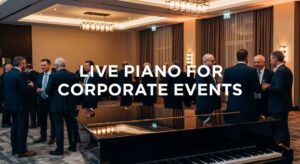
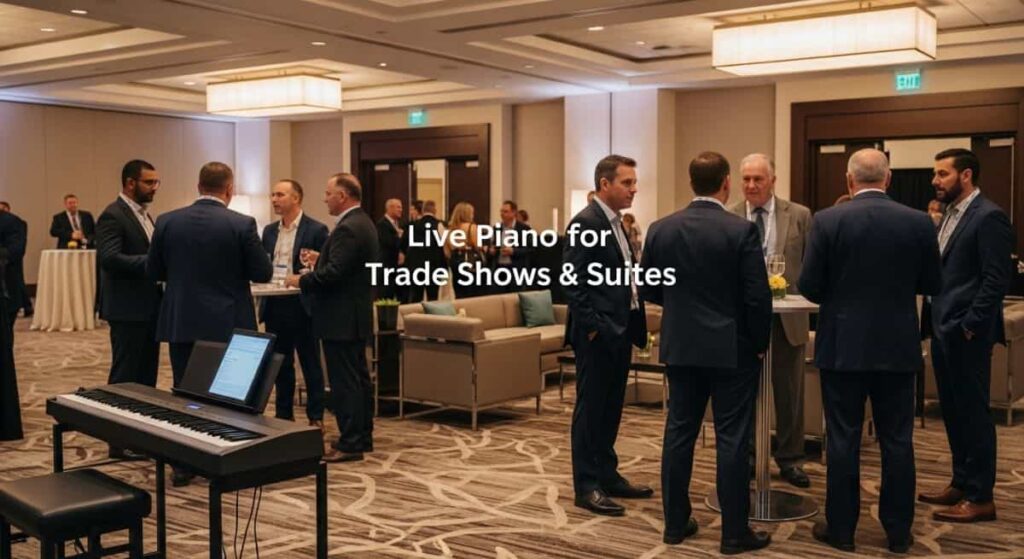
Live piano has a reputation for weddings and galas, but some of its best use cases are quieter, more practical corporate settings. A well-run trade show booth, a branded hospitality suite, or a networking reception is really about one thing: giving business conversations room to breathe. That is exactly where a capable pianist can help.
The challenge is that these events are often planned with music as an afterthought. A planner books the venue, locks in the catering, prints the badges, and then, a few weeks out, wonders if live music might be a nice touch. Sometimes it is. Sometimes the room cannot support it. This guide is meant to help you make that call clearly.
The Fast Answer: When Live Piano Works Best at Trade Shows and Hospitality Suites
If you are short on time and just want the honest answer, here it is.
Live piano works best at a trade show or hospitality suite when the music is treated as background support for the room, not as entertainment the guests are meant to stop and watch. The goal is a polished atmosphere that makes people want to stay a little longer, talk a little more, and feel good about the host or brand that invited them in.
That usually means:
- Low-volume instrumental piano that sits under the conversation level
- A flexible repertoire that can lean toward light jazz, standards, or modern instrumental covers
- Placement that supports guest flow without blocking booth traffic or meeting areas
- A pianist who reads the room and adjusts volume and tempo as the crowd changes
- Setup that matches the realities of the venue, whether that means a digital keyboard on a stand or a grand piano that is already in the space
Live piano is a strong fit when the host wants the room to feel welcoming, comfortable, and quietly premium. It is a weaker fit when the plan calls for loud music, hard dance energy, or an entertainment-first stage presence. For those, a different kind of event calls for a different kind of music, and Arnie will tell you so.
Why These Events Need a Different Music Strategy
A trade show is not a gala. A hospitality suite is not a wedding reception. A sponsor lounge is not a holiday party. These are conversation-first environments, and the music needs to serve that fact.
At a gala, guests sit, face forward, and expect a moment of entertainment between courses. At a wedding reception, people want to dance. At a trade show or hospitality suite, the entire point is meeting people, shaking hands, pitching ideas, and building relationships. Anything that gets in the way of those conversations works against the host.
This is why “more energy” is rarely the right answer at business events. More energy often means more volume, faster tempos, and a music presence that pulls focus. None of that helps a sales rep close a conversation with a prospect who walked up to the booth. What helps is a calm, polished backdrop that makes the space feel occupied and thoughtful without demanding attention.
Arnie has talked about this often when clients ask about live piano for corporate events. The approach that works for a trade show is closer to what a good hotel lobby pianist does than to what a concert performer does.
| Event Setting | Main Goal | Best Music Approach | Biggest Mistake |
|---|---|---|---|
| Trade show booth | Draw traffic, hold attention, support sales conversations | Low-volume instrumental piano that rewards stopping without demanding it | Volume that forces reps and guests to raise their voices |
| Hospitality suite | Make VIP guests feel hosted, relaxed, and willing to linger | Easy-listening repertoire at conversation volume, with flexible pacing | Treating the suite like a party stage instead of a living room |
| Sponsor lounge | Reinforce the sponsor’s brand tone and attract foot traffic | Polished background music that fits the brand’s feel, not the pianist’s ego | Music that has no relationship to the sponsor’s identity |
| Networking reception | Support introductions, small groups, and business exchanges | Instrumental piano under the chatter, with smooth transitions between pieces | Sets that build to a climax guests cannot talk over |
| VIP gathering | Deliver a premium feeling to a small, important audience | Warm, restrained repertoire that matches the room’s seriousness | Overplaying or over-performing in a space meant for quiet rapport |
Trade Shows, Booth Events, and Hospitality Suites Do Different Jobs
Even though these events all fall under “corporate gatherings,” they are structurally different. A planner who understands those differences makes better music decisions.
A show-floor activation lives or dies in ten-second windows, when someone walking past decides to slow down or keep moving. A hospitality suite runs on longer arcs, often hours of relaxed conversation. A sponsor lounge is part foot traffic, part brand theater. A VIP gathering is usually intimate, sometimes formal, and always attentive to tone. Music has a different job in each case.
| Event Type | What the Space Is For | What the Music Should Do | Main Planning Watchout |
|---|---|---|---|
| Show-floor activation | Attracting traffic and starting conversations | Add warmth and a sense that something is happening, without crowding the reps | Sound bleed into neighboring booths |
| Hospitality suite | Hosting invited guests in a controlled environment | Make the room feel welcoming and unhurried | Tight spaces with low ceilings that amplify everything |
| Sponsor lounge | Branded rest, refreshments, and casual meetings | Reinforce the sponsor’s tone and pull in foot traffic | Volume that clashes with video loops or sponsor audio |
| Networking reception | Structured time for guests to mingle | Keep the room lively enough to feel alive, quiet enough to talk | Speeches or toasts that compete with the music |
| VIP gathering | Quiet, premium time with important clients or partners | Signal care and attention without showing off | Over-performing and turning background music into a show |
| Private event tied to a conference | Relationship building outside the show floor | Support the host’s tone and make the space feel intentional | Rooms with bad acoustics or poor placement options |
When a planner can name which of these they are hosting, the conversation about music gets much clearer. A single “corporate event” label does not tell Arnie enough. Event type, audience, and room layout do.
How Live Piano Can Support Booth Traffic, Dwell Time, and Better Conversations
The practical value of live piano at a trade show or hospitality suite comes down to three things: drawing people in, helping them stay, and making the conversations they have while they are there feel more natural.
A quiet booth with no music can feel empty even when it is not. A booth with loud canned audio can feel pushy. A booth with a pianist playing at conversation volume tends to feel occupied, cared for, and worth approaching. Guests who might otherwise walk past slow down. Some stop. Some stay longer than they planned. None of that is magic. It is just what happens when a space feels welcoming.
The same effect shows up inside hospitality suites. A suite where music is running softly in the background almost always feels more hosted than one where the silence is broken only by HVAC noise. Guests unconsciously relax. Conversations last longer. The host gets more of what they invited people there for in the first place.
The right music for this kind of event should help people settle in and talk, not compete with the room.
Arnie Abrams
It is worth being careful about promises here. Nobody can guarantee that live piano will produce a specific increase in booth traffic or a specific number of extra conversations. What a thoughtful pianist can do is shape the atmosphere so that the business conversations your team is already trying to have get a better stage. That alone is usually worth the investment for planners who care about the quality of their environment.
If you want to go deeper on how atmosphere affects attendees, Arnie has written about the psychological impact of live piano at corporate events, which covers room tone, guest comfort, and why these choices are not just decorative.
The Best Sound for These Events Is Usually Low-Volume and Flexible
Volume is the single most important music decision at a trade show booth or hospitality suite, and it is the one most often gotten wrong. Too quiet, and the music disappears. Too loud, and it becomes a problem for reps, guests, and neighboring exhibitors.
The target zone is the band of volume where someone six feet away can hear the music clearly without raising their voice to be understood. That is not a setting you dial in once and walk away from. It shifts as the crowd grows, as the room warms up, as a presentation starts in the next space over. A good pianist adjusts throughout the event.
Instrumental music usually works best at these events for a simple reason: vocals pull attention. Guests start listening to the words instead of talking to each other. Instrumental piano, especially light jazz, standards, and modern instrumental covers, sits under the conversation without pulling focus.
Flexibility matters as much as volume. A room that feels sleepy at 4:00 may feel packed and buzzing by 5:30. A suite that starts with a small VIP group can swell when the keynote ends and the hallway spills in. The music should adjust to those moments. A prerecorded playlist cannot do that. A live pianist can.
Tell the pianist the goal, not the song list. Most planners do not actually care what is being played as long as the room feels right. If you tell a capable pianist “keep it warm, keep it under conversation level, lean modern but not aggressive,” you will get a better result than if you hand over a twenty-song set list and a stopwatch.
Placement, Floor Plans, and Guest Flow Matter More Than People Expect
You can hire the best pianist in New York and still have a music problem on event day if the placement is wrong. Placement is the part of the plan most hosts do not think about until they are standing in the room wondering why something feels off.
Good Placement Helps the Music Support the Room Instead of Fighting It
The pianist needs to be close enough to the crowd that the music registers, but far enough from active conversation areas, meeting tables, and demo stations that it does not interfere. A few practical guidelines:
- Keep pathways clear. The piano and stool should never sit in a traffic lane. Guests should be able to walk past without brushing the instrument or the performer.
- Stay out of bottlenecks. Doorways, bar lines, food stations, and registration tables are all places where sound gets trapped and crowds pile up. Music placed there becomes part of the congestion problem.
- Protect the meeting zones. If the suite has a corner where reps are holding one-on-one conversations, the piano should be far enough away that those conversations do not have to compete with it.
- Think about neighboring spaces. Inside a convention center, the booth next door is often a factor. A location against a shared wall is very different from a location in a corner or an open aisle.
- Consider sight lines. Guests rarely come for the piano, but seeing a live musician in the space adds visual warmth. A hidden pianist loses that benefit.
The floor plan conversation should happen before the event, not on the morning of load-in. A quick look at a venue map or sketch usually tells Arnie everything he needs to suggest a workable spot.
Setup, Power, Instrument Choice, and AV Coordination
Setup is where corporate event music plans quietly fall apart. Most planners assume the music side of an event is plug and play. It is not, especially inside convention centers and hotel properties with strict load-in rules.
Four questions usually drive the setup conversation:
- Is there a piano on site, or does one need to be brought in?
- Where is the power access, and is it reliable?
- When is the load-in window, and what are the venue rules?
- Is there any other AV in the space that needs to be coordinated?
Most trade show booths, hospitality suites, and sponsor lounges do not come with a grand piano. That usually means a digital keyboard on a stand, sometimes with a small powered speaker. This is a practical, reliable setup that travels well and fits into tight spaces. If you want a deeper comparison, Arnie has a post on grand piano vs digital keyboard that walks through when each makes sense.
| Planning Factor | Why It Matters | Common Problem | Best Early Step |
|---|---|---|---|
| Instrument choice | Determines sound quality, footprint, and setup time | Booking expecting a grand piano that the venue does not actually have | Confirm in writing whether there is a house piano, and if not, plan for a digital keyboard |
| Power access | Keyboards, speakers, and mixers all need dedicated power | Outlets shared with catering equipment that trip breakers mid-event | Ask the venue for a marked outlet and share its location with the pianist |
| Load-in window | Convention centers and hotels often have strict delivery rules | Arriving during a blocked freight window and losing setup time | Get the official load-in rules from the venue or exhibitor services early |
| Soundcheck | Balancing volume and tone before guests arrive | Guests walking in mid-soundcheck because doors opened too early | Build 30 minutes of protected soundcheck time into the schedule |
| AV coordination | Avoiding conflicts with mics, video loops, and sponsor audio | Two sound sources fighting in the same space | Share a copy of the AV plan so the pianist can work around it |
| Floor plan | Shapes placement, cable runs, and guest flow | Last-minute relocation to a spot that does not have power | Send a simple venue map or layout sketch with the inquiry |
None of this is complicated on its own. It only becomes a problem when nobody surfaces these questions until event day. A short planning email answers most of them in an afternoon.
What Planners, Exhibitors, and Office Teams Should Think Through Early
Success at a trade show booth or hospitality suite starts well before the music begins. The questions below are the ones Arnie asks planners and executive assistants during a first conversation. Thinking them through before you reach out saves everyone time.
- What is the event actually trying to accomplish? Lead generation, client hospitality, brand building, and internal engagement all shape the music choices.
- Who is the audience? A room full of executive buyers has a different feel than a room full of young engineers or hospitality guests at a resort.
- What time of day is the event? Morning coffee service, midday activation, cocktail-hour reception, and late-evening VIP gathering all have different energy levels.
- How busy will it be? A steady trickle is very different from a rush timed to a keynote ending.
- How formal or casual should the room feel? That tone should match the music choices.
- Are speeches or presentations happening? The music has to pause, soften, or end for these moments.
- Should music run the entire event, or only during key windows? Many hosts only want music during peak hours, not for the full day.
- Is there a brand vibe or reference the music should match? A modern tech company and a legacy financial firm often want different feels.
Office teams and executive assistants often run these events under tight timelines. The more of these you can answer in the initial inquiry, the faster the conversation moves. If you do not know the answers yet, that is fine. Arnie has helped plenty of planners think through them from scratch. The post on what Arnie Abrams wishes clients knew covers a lot of the same planning ground from the pianist’s side of the table.
Planning a trade show, sponsor lounge, or hospitality suite in NJ, NYC, or Philadelphia?
Arnie Abrams can help you figure out whether live piano fits your room, your timing, and your event goal, even if the details are still in flux.
Common Mistakes That Make Corporate Music Feel Wrong
Most corporate music problems are not caused by the musician. They are caused by planning choices made weeks earlier. Here are the ones that come up most often at trade shows, hospitality suites, and sponsor lounges.
- Choosing music that is too loud. The most common problem by far. If reps are raising their voices to be heard over the music, the music is already too loud.
- Placing the pianist too close to meeting areas. One-on-one conversations need their own acoustic space.
- Treating a booth like a party. A trade show booth is a sales environment, not a nightclub.
- Waiting too late to discuss setup and power. If the first time the pianist hears about power is at load-in, something is going to go wrong.
- Assuming every corporate event wants the same tone. A VIP lounge and a sponsor activation need different approaches.
- Not sharing the floor plan or event schedule. Timing gaps and placement surprises are almost always avoidable.
- Assuming a small hospitality suite needs no planning. Small rooms amplify bad choices faster than large ones.
- Overcomplicating the music brief. Hosts who try to script every song usually get worse results than hosts who describe the feel they want.
Once I know the layout, timing, and what the host wants the space to feel like, it gets much easier to shape the music around it.
Arnie Abrams
When Live Piano Makes the Biggest Difference
Live piano is not the right answer for every corporate event. But there are specific moments where it does more for the room than almost any other option.
- Early-evening networking receptions. Guests arrive, drinks are poured, conversations start. A pianist in the background gives the room a shape and a tone without taking over.
- Sponsor and VIP lounges. The whole point of the space is making guests feel taken care of. A live musician signals attention to detail in a way that piped-in music never will.
- Private suite hosting during a conference. A suite that feels planned with care for important clients is a suite that feels hosted, not rented.
- Corporate welcome events. The first evening of a multi-day conference or off-site sets the tone for everything that follows. Live piano makes it feel deliberate.
- Exhibitor gatherings with a hospitality focus. Events where the exhibitor wants guests to stick around and talk, not rush through.
- Branded environments where conversation matters. Any space where the host is trying to create a polished, quiet-premium feel for business conversations.
If you are in New Jersey, check the New Jersey pianist page for the full service area. Planning an event in the city or the boroughs? The New York City pianist page covers Manhattan and surrounding counties. For events around Center City or the Main Line, the Philadelphia pianist page has the details.
The 3 Things Arnie Abrams Needs From You
When a planner reaches out about a trade show or hospitality suite, the booking conversation moves fastest when three things are on the table right away. None of them require a finished plan. Rough answers are fine.
- Event type, venue, and basic floor-plan context. Is it a show-floor booth, a hospitality suite, a sponsor lounge, a VIP gathering, a networking reception? What venue or convention center? Any floor plan or rough sketch you already have?
- Timing, guest flow, and what the music should support. When does the event run? When are the peak windows? What kind of conversations is the music meant to support? Is there a keynote, a speech, or a presentation that has to happen cleanly?
- Setup details, power access, and preferred tone. Is there a house piano or is a digital keyboard needed? Is power confirmed? What feel do you want the room to have, and is there a brand reference worth mentioning?
These three answers let Arnie tell you quickly whether live piano is a good fit for what you are planning, and whether the setup will work inside the venue’s rules. They also help him flag problems early, before they become show-day problems.
Quick Decision Guide: Is Live Piano the Right Fit for This Event?
Answer these questions quickly
- Is the main goal of the room conversation rather than stage entertainment? If yes, live piano is likely a fit.
- Does the host want the space to feel polished, welcoming, and quietly premium? Strong fit.
- Is there a floor-plan spot where a pianist can sit without blocking traffic or meeting areas? Fit.
- Is power access available somewhere reasonable? Fit.
- Is the event primarily about loud music, dancing, or show-style entertainment? Live piano is probably not the right core choice.
- Is the space so small that a live performer would dominate it? Live piano may still work, but the brief matters.
- Are you unsure about any of the above? Reach out. A short conversation usually answers it.
At a trade show or hospitality suite, the best compliment is usually that the room felt comfortable and conversations flowed naturally.
Arnie Abrams
A Short Checklist Before You Send the Inquiry
What to gather before reaching out
- Event type (booth, suite, lounge, reception, VIP gathering)
- Venue name and location
- Event date and run time
- Peak-traffic windows if you know them
- Expected guest count (rough range is fine)
- Room feel you want (casual, polished, upscale, branded)
- House piano confirmed or not
- Power access confirmed or unknown
- Load-in window from the venue
- Any speeches or presentations during the event
- Brand references or tone examples
- Main contact on event day
Final Planning Guide for Trade Shows and Hospitality Suites
If you are planning a trade show booth, sponsor lounge, hospitality suite, or networking reception in New Jersey, New York City, or Philadelphia, here is the working framework.
Step one: Name the event clearly. A booth is not a suite. A sponsor lounge is not a VIP reception. The name shapes every music choice that follows.
Step two: Decide what the music is supposed to do for the room. Support conversations? Make a space feel occupied? Reinforce a brand tone? Write it down in one sentence.
Step three: Check the physical realities. Venue, floor plan, placement options, power access, load-in window, and any competing AV. Even rough answers help.
Step four: Share what you have with Arnie. Rough is fine. He will tell you whether the fit is strong, whether a different approach would serve the room better, and what setup will actually work on event day.
Step five: Protect the basics on event day. Soundcheck time, placement, power, and a clear main contact. Everything else usually takes care of itself.
A good event music plan should feel invisible by the time guests arrive. The room should just feel right. That is the job, and it is the job Arnie has been doing at NJ, NYC, and Philadelphia corporate events for years.
Frequently Asked Questions
Is live piano a good fit for a trade show?
Live piano can be a strong fit for a trade show when the goal is to draw foot traffic, support conversations, and create a polished booth atmosphere. It works best at conversation volume with instrumental repertoire. It is not the right choice if the plan calls for loud, show-driven entertainment or dance energy, which are better served by other formats.
Is live piano too quiet to help at a booth or hospitality suite?
A good pianist adjusts volume to the room and the crowd. At a trade show booth the target is usually conversation-level background, where guests notice the music but do not have to talk over it. In a larger hospitality suite or lounge, the pianist can project a bit more. The point is not maximum volume, it is the right volume for what is happening in the space.
What kind of music works best for a hospitality suite?
Hospitality suites usually call for warm, instrumental piano that sits under the conversation. Light jazz, standards, and modern instrumental covers tend to work well. The repertoire should match the host’s brand and the audience in the room. A capable pianist reads the space and shifts tempo, feel, and song choice as the energy in the suite changes.
Does a trade show booth need a full piano?
Almost never. Most trade show booths and hospitality suites use a digital keyboard on a stand because convention centers, hotels, and corporate venues rarely have a house piano in the space. A quality digital keyboard handles the job well, travels cleanly, and fits inside the footprint of a booth or suite without taking over.
What setup details should I confirm before booking a pianist?
Confirm whether there is a house piano or if a keyboard is needed, where the power outlet is, what the load-in window is, what other AV is running in the space, and where the pianist can physically sit inside the floor plan. Sharing these details early saves time and avoids last-minute problems. A short email with these answers usually gets you a clear reply.
Can live piano work for VIP events and networking receptions?
Yes. These are often the strongest use cases. VIP events and networking receptions are built around conversation, and live piano supports that perfectly when the volume and repertoire match the room. The host gets a polished feel, guests feel hosted, and the music never has to compete for attention the way it might at a high-energy party.
Does location in NJ, NYC, or Philadelphia affect planning?
Sometimes. Convention centers, hotel properties, and private venues each have their own load-in rules, power realities, and placement options. A trade show at a Manhattan venue may have different freight and timing rules than a corporate event at a New Jersey conference center. Sharing the venue name early lets Arnie flag anything specific to that location.
What information should I send when I inquire?
Send the event type, date, venue, run time, expected guest count, a rough sense of the feel you want, and any setup details you already know. If you have a floor plan or schedule, attach it. Even partial answers speed up the conversation. If details are still in flux, say so. Arnie works with planners at every stage of the process.
Can Arnie Abrams provide live piano for trade shows, hospitality suites, and corporate gatherings in NJ, NYC, or Philadelphia?
Yes. Arnie Abrams performs at corporate events, trade shows, hospitality suites, sponsor lounges, networking receptions, and VIP gatherings across New Jersey, New York City, and Philadelphia. Reach out with your event type, venue, and date to check availability and talk through whether live piano fits your room and your goals.
Related Planning Reads
Planning a Trade Show, Suite, or Corporate Gathering?
Arnie Abrams provides live piano for trade shows, hospitality suites, sponsor lounges, networking receptions, and VIP events across NJ, NYC, and Philadelphia. Share your event type, venue, and date, and he will walk you through whether live piano fits the room and the goals of the event.