Music That Keeps Every Age Group Comfortable, Engaged, and Celebrating Together
Your child just earned a diploma. Friends, family, aunts, uncles, grandparents, and a handful of the graduate’s closest friends are all coming to the same party. The food is planned. The backyard is cleaned up. The slideshow is loaded.
Now the question: what fills the room with the right energy while all of those different people are together?
A Bluetooth speaker and a Spotify playlist can handle some of the work. But when the crowd spans four decades of music taste, when guests are arriving in waves, and when the host wants the party to feel polished without being stiff, live piano music does something a playlist cannot. It adjusts. It reads the room. It gives the party a center of gravity without pulling attention away from the graduate.
This guide is built for parents, families, and hosts planning a high school or college graduation party in New Jersey, New York City, or Philadelphia. It covers why live piano works well for this kind of celebration, how to plan the music around party flow, what setup questions actually matter, and what to tell a pianist so the music fits your crowd.
- Live piano fits graduation parties because it adjusts to mixed ages, shifting energy, and open-house flow in real time
- Graduation celebrations are different from birthdays and weddings: they center on achievement, family, and flexible timing
- A pianist can stay in the background during mingling and step forward for toasts or recognition moments
- Backyard, home, restaurant, and banquet hall setups all work with a portable digital keyboard
- Arnie Abrams serves graduation parties across NJ, NYC, and Philadelphia with 20+ years of private event experience
The Fast Answer: Why Live Piano Works for Graduation Parties
A graduation party is a social event built around a personal milestone. Guests show up to congratulate someone, eat, talk, and catch up with people they may not have seen in months. The music needs to support that.
Live piano music works here because it is flexible, conversation-friendly, and wide-ranging. A pianist can play light jazz while guests are filling plates at the buffet, shift into recognizable pop covers when the graduate’s friends arrive, and pull back during a toast or slideshow without anyone touching a remote.
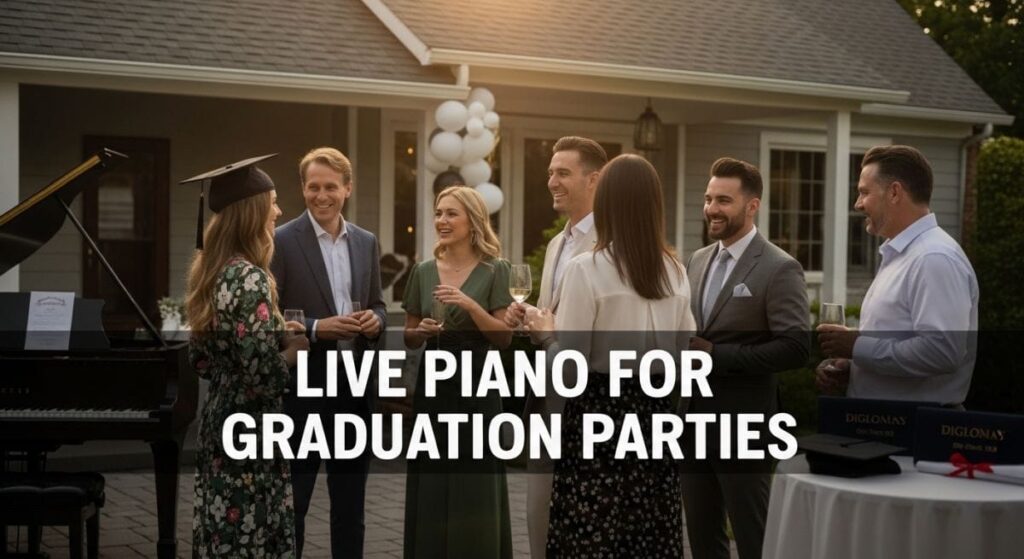
It is also a visual element. A pianist at a keyboard gives the room a focal point without dominating it. Guests naturally gravitate toward the music, which helps the party feel organized even when the schedule is loose.
For hosts who want the party to feel a step above casual but not overly formal, live piano hits that middle ground reliably. It works whether the celebration is in a backyard, a private restaurant room, a country club, or a finished basement with the furniture pushed aside.
There is also a practical side that often gets overlooked. A graduation party typically runs two to four hours, and during that time, the energy in the room changes. Early arrivals are usually the older relatives. The graduate’s friends often show up later. A pianist who has been performing at private events for years can read those shifts and adjust the music without being asked. That kind of responsiveness is what separates live music from a pre-built queue of songs.
What Makes Graduation Parties Different From Other Celebrations
Graduation parties are often grouped with birthdays and anniversaries, but they operate differently in several practical ways. Understanding those differences helps explain why the music plan matters.
The celebration is tied to an achievement
A birthday happens every year. A graduation marks the end of a specific chapter: four years of high school, a college degree, or a graduate program. The tone is proud and forward-looking. Guests are there to recognize the work the graduate put in and to wish them well for what comes next.
The host is usually a parent or family member
Most graduation parties are planned by someone other than the person being celebrated. A parent or a group of family members sets the budget, picks the location, handles the food, and coordinates the guest list. The music choice needs to satisfy the host’s vision for the event while also keeping the graduate happy.
The guest mix is wide
This is one of the defining features of a graduation party. The guest list often includes the graduate’s friends (ages 17 to 22), the parents’ friends (ages 40 to 60), siblings and cousins of various ages, and grandparents or older relatives in their 70s and 80s. That age spread is wider than what you see at most private parties.
High school graduation parties often have the widest range because the family network is fully present. College graduation parties sometimes skew slightly younger if the graduate invites more peers than relatives, but the age mix is still significant.
The schedule is loose
Many graduation celebrations run as open-house events. Guests arrive when they can, often after attending another ceremony or party that same day. There is no processional, no structured program, and no assigned seating in most cases. The party fills and empties naturally. Music that works at 2:00 PM when the first guests are arriving needs to work just as well at 5:00 PM when the crowd has thinned.
Conversation is the main activity
Dancing is rare at most graduation parties. Eating, talking, taking photos, and watching a slideshow or memory video are the main events. That means the music must support conversation, not compete with it.
Why Multi-Generational Music Matters So Much Here
The age range at a graduation party is one of its biggest planning challenges. Other events usually have a narrower audience. A birthday party is built around the birthday person’s taste. A cocktail party is often built for a single social group. A graduation party asks different generations to share the same space, the same food, and the same music for two to four hours.
Here is what that usually looks like:
- The graduate’s friends want to hear something current. They want to recognize the music, even if it is being played on piano rather than streamed through a speaker.
- Parents and their friends lean toward the music of the ’80s, ’90s, and early 2000s. They enjoy familiar crowd-pleasers they can hum along to.
- Siblings and younger cousins respond to anything upbeat or fun. They are less attached to specific songs and more responsive to energy and tempo.
- Grandparents and older relatives feel most comfortable with standards, classic pop, and jazz. They appreciate music that does not overwhelm the room.
A live pianist can move between these lanes without stopping the party. There is no need to switch playlists, adjust the algorithm, or argue over the aux cord. The multi-generational music approach happens in real time, guided by who is in the room and how they are responding.
A Typical Graduation Party Timeline and Where Music Fits
Every graduation celebration is different, but most follow a similar arc. Here is a breakdown of how the music can track with each phase of the party.
| Party Phase | What Guests Are Doing | Best Music Approach | Why It Works |
|---|---|---|---|
| Guest arrival / open house start | Walking in, greeting the host, finding the food | Soft jazz, light standards, instrumental versions of well-known songs at low volume | Sets a welcoming tone without overwhelming early conversations |
| Food and mingling | Filling plates at the buffet, catching up with relatives, standing around in groups | Familiar pop and classic covers at a moderate volume, comfortable for talking | Keeps energy steady; gives the room a sense of occasion while people eat and chat |
| Slideshow, toast, or recognition moment | Gathering around for a speech, video, or toast | Pianist pauses or drops to very soft background, then plays a brief recognition piece after | Clears space for the spoken moment and marks the transition back to the party |
| Second-wave mingling or dessert | New guests arriving, dessert table opens, photo station is active | Slightly more upbeat covers, recognizable crowd-pleasers, singalong-ready classics | The party is at its peak; the music can afford to be a bit bolder and more fun |
| Upbeat close or farewell | Saying goodbyes, final photos, cleaning up begins | Warm, familiar tunes at medium volume, feel-good energy without pushing too hard | Gives the final stretch a positive, relaxed feeling; no abrupt silence when people leave |
The key idea here is gradual movement. A good graduation party pianist does not jump from quiet jazz to loud pop in one song. The tempo and energy shift slowly, matching what the guests are actually doing.
Live Piano vs a Playlist for Graduation Parties
Live piano is not the right fit for every graduation celebration. A small, casual get-together with a few friends and a grill may not need it. But for medium to large celebrations with a mixed guest list, live music fills a gap that playlists leave open.
Here is a fair comparison:
| Option | Best Fit | Main Advantage | Main Limitation |
|---|---|---|---|
| Live pianist | Mixed-age celebrations with 30+ guests; events at home, in backyards, at country clubs, or private rooms | Reads the room and adjusts volume, tempo, and repertoire in real time | Requires a setup footprint (keyboard, bench, small speaker) and a power source |
| Pre-built playlist | Smaller gatherings under 20 guests; very casual parties; tight budgets | Zero setup and no coordination needed; plays consistently | Cannot adjust to the room; may feel flat or repetitive over 3 to 4 hours; no visual element |
| DJ | Dance-heavy parties, prom-style celebrations, teen-focused events | Can mix genres and control volume precisely; brings lighting and energy | Often too loud for conversation-heavy gatherings; more suited to reception-style events |
For a graduation party where the goal is atmosphere, not a dance floor, live piano gives the host more control over how the room feels without requiring constant attention.
At a graduation party, the music should help people connect, not compete with the room. Most guests are there to talk, congratulate the graduate, and catch up. The piano gives them a reason to feel like the party is something special.
— Arnie Abrams
Choosing Music That Teens, Parents, and Grandparents Can All Enjoy
The goal is not to make everyone love every song. That is not realistic at a party with a 60-year age spread. The goal is to keep the music feeling varied, familiar enough that no one feels lost, and pleasant enough that no group tunes it out.
A practical way to think about this is in “lanes.” A live pianist for a graduation party can rotate through several lanes across the event without the transitions feeling forced.
| Music Lane | Best Moment | Why It Connects |
|---|---|---|
| Current clean pop in piano form | When the graduate’s friends are most active in the room | Teens and young adults hear something they recognize, played in a way that fits the setting |
| Familiar singalong classics | Mid-party peak when the room is fullest | Songs like “Piano Man” or “Don’t Stop Believin'” cross generational lines easily |
| Light jazz and standards | Early arrival and food service | Sets an elegant tone and keeps grandparents and older guests comfortable |
| Movie and TV themes | Between other lanes, as a palette cleanser | Instantly recognizable across ages without being tied to a specific era |
| Calm dinner and mingling music | During food service or quieter stretches | Keeps the room from feeling empty without pulling attention away from conversation |
If You Are Stuck, Start With the Guest Mix, Not the Playlist
Instead of picking songs first, think about who will be at the party. Estimate the age ranges. Consider whether the crowd will lean older (more extended family) or younger (more of the graduate’s social circle). That balance shapes the repertoire more than any single song request.
A simple way to communicate this to a pianist: “The party is about 40% the graduate’s friends, 40% family, and 20% grandparents and older relatives.” That one sentence gives the musician a clear sense of how to weight the set.
If the graduate has a few songs they care about, share those early. A pianist can usually work three to five specific requests into the set naturally. But do not feel pressured to build a full playlist. That is the pianist’s job. You just need to describe the crowd and the mood you want.
Arnie Abrams has been performing at private events across New Jersey, New York City, and Philadelphia for over 20 years. Whether the party is in your backyard, a restaurant private room, or a banquet hall, Arnie can help plan the music to fit your guest list and timeline.
Backyard, Home, Restaurant, and Banquet Room Logistics
Setup questions are some of the most common concerns hosts raise. The good news: a portable digital keyboard works in almost any setting. It does not require a grand piano to already be on site. Here is what changes depending on the venue type.
Backyard graduation parties
Backyards are the most popular graduation party location, and they work well with a keyboard setup. The main considerations are:
- Power: The pianist needs a standard outdoor outlet or an extension cord rated for outdoor use. If the outlet is far from the setup spot, a 50-foot heavy-duty cord usually does the job.
- Weather: A tent or covered patio protects the keyboard. If the party is fully exposed, a backup plan for rain matters. Direct sun on a keyboard is also a factor on hot June days.
- Placement: Position the keyboard where guests can hear it across the yard but not directly next to the main conversation area. Near the food station or bar is often a good spot.
- Ground surface: A keyboard stand is stable on a patio, deck, or flat grass. Uneven ground can be managed with a small platform or leveling adjustment.
Home graduation parties
Indoor home parties give the pianist a controlled environment: no weather issues, consistent acoustics, and easy access to power. Space is the main constraint. A keyboard setup needs roughly a 4-by-6-foot footprint, including the bench.
If the home already has a piano, the pianist can play it directly. Otherwise, a portable keyboard fits in a living room, den, or even a wide hallway near the main gathering area.
Restaurant private rooms
Private rooms at restaurants are a popular choice for graduation dinners and smaller celebrations. Key questions to ask the restaurant:
- Is there room for a keyboard setup near the wall or in a corner?
- Can the pianist load in through a back entrance or side door?
- Are there power outlets along the walls?
- Does the restaurant allow outside entertainment?
Most restaurants in the NJ, NYC, and Philadelphia area are familiar with live musician setups. A quick call to the manager usually answers all four questions in under five minutes.
Banquet halls and country clubs
These venues are the easiest for live piano logistics. They typically have stage areas or designated entertainment corners, reliable power, and staff who are used to coordinating with musicians. The pianist usually just needs the load-in time, the contact name, and a sense of where the guests will be seated.
School and community spaces
Some families host graduation celebrations in a church hall, school cafeteria, VFW hall, or community center. These spaces tend to have larger rooms with harder surfaces, which means more echo. A pianist can manage this by adjusting the keyboard volume and using a small amplifier set to a moderate level. Power access and load-in doors are the two things to confirm in advance.
What about outdoor graduation parties with no cover?
Open-air setups without a tent or awning are possible, but they require a weather check within 24 hours of the event. Light overcast is fine. Rain or strong direct sun on the keyboard is not. If the forecast is uncertain, having a covered backup spot (a garage, porch, or inside the house) keeps the music going no matter what happens.
For hosts weighing location options, the behind-the-keys guide covers more of the practical details clients find helpful.
Volume, Tempo, and Conversation Matter More Than Hosts Expect
Many hosts spend most of their planning energy on food, decorations, and guest count. Music volume and tempo get less attention, but they shape how comfortable the party feels.
Volume is the most common issue
At a graduation party, guests need to be able to stand two feet from each other and carry a normal conversation. If the music makes that hard, people either cluster away from the speaker or leave earlier than planned. A live pianist controls this naturally by adjusting touch and keyboard volume in real time.
Tempo drives energy
Slow, mellow music during early arrivals sets a relaxed, welcoming pace. Mid-tempo covers during the food-and-mingling phase keep things social. Slightly faster, more recognizable songs toward the end give the party a lift. This progression happens organically with a live musician. With a playlist, it requires careful pre-planning and timed track changes.
Conversation is the priority
Unlike a reception or dance-heavy event, a graduation party puts talking first. Aunts catching up with nephews, grandparents chatting with the graduate’s friends, parents swapping stories with neighbors. The music’s job is to fill the silence between those conversations without stepping on them.
This is where live piano has a clear advantage over amplified speakers. A pianist playing at a moderate touch naturally produces a sound that supports the room rather than dominating it. With a speaker, even at a reasonable volume, the sound is constant and uniform. It does not breathe with the room the way live performance does. When a group near the keyboard laughs loudly, the pianist instinctively holds a note or softens the next phrase. A speaker does not react that way.
For graduation open houses in particular, where guests move freely between the food table, the card station, and clusters of conversation, this responsiveness matters. The music should feel like it belongs in the room, not like it was layered on top.
The best graduation party sets have range. You want the graduate’s generation to feel seen, but you also want grandparents to sit comfortably and enjoy the music without asking anyone to turn it down.
— Arnie Abrams
Common Graduation Party Music Mistakes
After years of performing at private celebrations in NJ and the surrounding area, certain patterns come up again and again. Here are the most common graduation party music mistakes and how to avoid them.
- Treating the party like a teen-only playlist event. The graduate’s friends are part of the guest list, not the entire guest list. Music should serve the full room.
- Starting the music too loud. Early guests are often grandparents and older relatives who arrive first. Loud music right away pushes them to the edges of the room.
- Choosing music with no range. Three hours of the same genre or the same era gets flat fast, even if every song is good. Variety keeps the room engaged.
- Forgetting about the arrival window. Open-house parties mean guests trickle in over an hour or more. The music during that first hour sets the tone for everyone who walks through the door.
- Skipping the toast or slideshow plan. If there is a speech or video, the music needs to know when to pull back. Without a quick plan, the pianist and the speaker end up stepping on each other.
- Assuming a real piano must be on site. A professional-grade digital keyboard sounds excellent and fits in any space. No grand piano is required.
- Leaving setup questions until the day before. Power, space, weather cover, and load-in access take five minutes to sort out, but they need to happen at least a week in advance.
Good party music should support conversation first and celebration all the way through. If guests are comfortable talking and eating while the music plays, you have the right balance.
— Arnie Abrams
When Live Piano Makes the Biggest Difference
Live piano is not a requirement for every graduation party. But certain types of celebrations benefit from it more than others. Here are the situations where it makes the most noticeable difference.
- Backyard celebrations where a speaker feels flat. Outdoor spaces absorb sound. A Bluetooth speaker can sound thin in a large yard. A keyboard with a small amplifier fills the space more evenly.
- Elegant family gatherings at home. If the party has a sit-down element or a more polished feel, live piano raises the atmosphere without extra decoration.
- Graduation parties with a large age range. The wider the generational spread, the harder it is for any single playlist to serve the room. A pianist can shift as the audience changes.
- Drop-in celebrations where the room fills gradually. Open-house format means the party sounds and feels different at 2:00 PM than at 4:30 PM. A live musician adapts to the size of the crowd naturally.
- Higher-end private rooms, country clubs, and banquet spaces. These venues expect a certain level of polish. Live music signals that the host thought about the details.
- Parties where hosts want atmosphere without shouting over the music. This is the most practical reason. A pianist adjusts volume by ear. A speaker requires someone to keep walking over and changing the dial.
Class of 2026 celebrations are already being planned across the tri-state area. Whether the party is a backyard open house in Monmouth County, a restaurant dinner in Manhattan, a Main Line brunch, or a catered event at a Jersey Shore venue, a live pianist fits into the setting and adds a layer of polish that guests notice and appreciate.
It is also worth noting that graduation parties tend to be photographed and recorded more than most family events. A pianist at a keyboard adds a visual element to those photos and videos that a Bluetooth speaker simply does not provide.
The 3 Things Arnie Abrams Needs From You
Booking a graduation party pianist does not require a long planning process. Arnie Abrams has performed at private events in New Jersey, New York City, and Philadelphia for over two decades. He can plan the music around your party quickly if you share three pieces of information.
1. Party location and setup
Where is the party? Is it inside or outside? Is there a covered area? Where are the power outlets? Will there be a piano on site, or does the pianist need to bring a keyboard? These details determine what equipment to bring and how early to arrive.
2. Guest mix and party timeline
How many guests are expected? What is the rough age breakdown? What time does the party start and end? Is there a toast, slideshow, or recognition moment planned? This information shapes how the music moves across the event.
3. Preferred style, favorite artists, and any must-play or do-not-play notes
Does the graduate have a few favorite artists? Does the family lean toward jazz, classic rock, pop, or standards? Are there any songs or genres to avoid? Even a short list of preferences gives the pianist a starting point.
That is it. Three details, and the music plan comes together quickly. Arnie handles the rest based on experience and what he learns about your party.
Frequently Asked Questions About Graduation Party Music
Is live piano good for a graduation party?
Yes. Live piano is a strong fit for graduation parties because it supports conversation, adjusts to the room, and works for a wide range of ages. A pianist can shift between genres and energy levels as the party moves through its natural phases, which is harder to do with a static playlist.
What kind of graduation parties work best with a pianist?
Parties with 30 or more guests, a mixed-age crowd, and a focus on mingling and conversation benefit the most. Backyard celebrations, home parties, restaurant private rooms, and country club events are all strong settings. Smaller, casual get-togethers may not need live music.
How is a graduation party different from a birthday party musically?
A graduation party centers on a milestone achievement and usually draws a wider age range. The music needs to move through multiple generational lanes rather than focus on one person’s taste. The schedule is also typically looser, with guests arriving and leaving at different times.
Can live piano work for a backyard graduation party?
Absolutely. A portable digital keyboard with a small amplifier is designed for outdoor settings. The main requirements are a power outlet (or a heavy-duty extension cord) and some form of shade or cover to protect the keyboard from direct sun or rain.
Do I need a piano at the venue already?
No. Most graduation party pianists bring a professional-grade digital keyboard that sounds excellent and fits in any space. A grand piano on site is a bonus but is not needed. The keyboard, stand, bench, and a small speaker make up the full setup.
What kind of music works best for a multi-generational graduation party?
A mix of light jazz and standards for older guests, familiar pop and classic rock covers for parents, and current clean pop played in piano form for younger guests. Movie and TV themes also cross generational lines well. The key is variety and smooth transitions between styles.
How long should a pianist play at a graduation party?
Most graduation parties benefit from two to three hours of live piano, with short breaks built in. For open-house events where guests come and go, three hours covers the main window comfortably. The pianist can adjust the timing based on the party’s energy.
Can Arnie Abrams play for graduation parties in NJ, NYC, or Philadelphia?
Yes. Arnie Abrams serves all of New Jersey, New York City (including Manhattan and Brooklyn), and the greater Philadelphia area (including the Main Line, Bucks County, and Montgomery County). He brings all equipment and handles setup independently.
Final Planning Guide for a Graduation Party That Feels Classy but Relaxed
Here is a simple framework to wrap up your music planning:
- Lock in the date and venue first. Everything else follows from where and when. If the party is outdoors, make a note about cover and power access.
- Describe the guest mix. Age range and crowd size matter more than a playlist. Tell the pianist the rough percentage of younger guests, parents, and older relatives.
- Share a few favorites. Three to five songs or artists from the graduate give the pianist a starting point. If the family has any do-not-play requests, mention those too.
- Confirm the logistics. Indoor or outdoor, power access, weather cover, and load-in timing. Five minutes of planning avoids day-of stress.
- Note any key moments. If there will be a toast, slideshow, or candle lighting, let the pianist know the approximate time. A quick heads-up is all that is needed to make the transition smooth.
- Let the pianist handle the flow. An experienced private event musician knows how to read the room and adjust. You do not need to manage the music once the party starts.
The goal is straightforward: a celebration that feels polished, comfortable, and fun for the graduate, the family, and every guest who walks through the door. Live piano music helps get there because it gives the party a sense of occasion without making anyone feel like they are at a formal event.
Graduation season in the NJ, NYC, and Philadelphia area runs from mid-May through July, with June being the busiest month. Pianists book up quickly during this window, so reaching out a few weeks early is a good idea. Most hosts find that a short phone call or email is enough to confirm the date, talk through the setup, and get the music plan started.
If you are hosting a graduation party in New Jersey, New York City, or Philadelphia this spring or summer, reach out to Arnie Abrams to talk through the details. A quick conversation is all it takes to put the music plan in place.
From backyard open houses to private restaurant dinners, Arnie Abrams brings 20+ years of live performance experience to graduation celebrations across New Jersey, New York City, and Philadelphia. Tell us about your party, and we will handle the music.