Why Live Piano Works So Well for Sweet 16 and Quinceañera Celebrations
A Sweet 16 or Quinceañera is one of those events where the room changes several times in a single evening. One hour, it is a formal presentation with family symbolism and quiet emotion. The next, it is a full dance party with a DJ and colored lights. The challenge for hosts, parents, and planners is making those shifts feel natural, polished, and timed well.
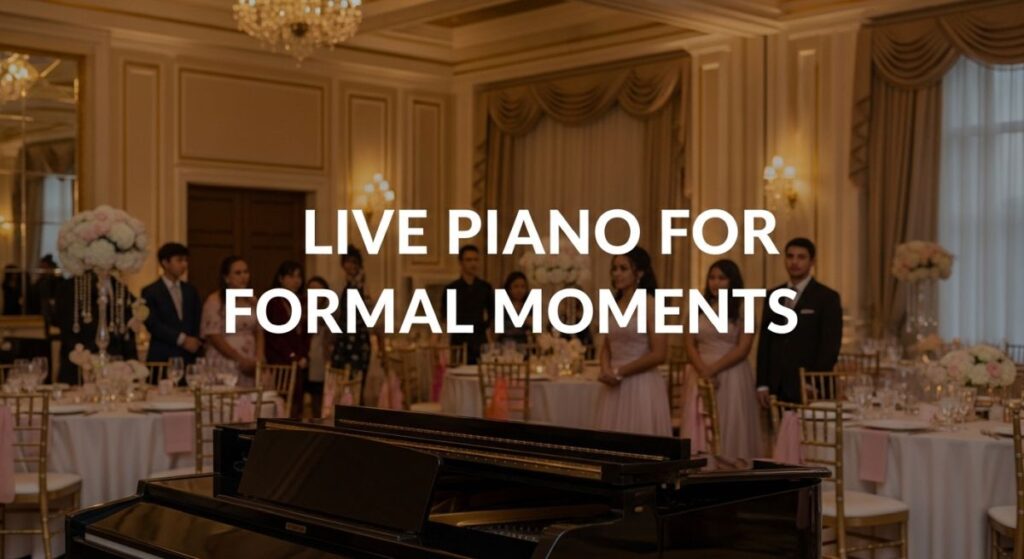
That is where live piano fits. Not as a replacement for the DJ. Not as background noise. Live piano is the instrument that gives the formal and ceremonial parts of a Sweet 16 or Quinceañera their shape. It supports the entrance, the father-daughter waltz, the candle-lighting, the changing of shoes, the crown or tiara moment, and the quieter family segments that matter most to the people in the room.
This guide covers how live piano works for these celebrations, where it fits in the timeline, how it works alongside a DJ, what setup looks like in different venue types, and how to plan music for the formal moments that deserve real attention. If you are planning a Sweet 16 or Quinceañera in New Jersey, New York City, or Philadelphia, this will help you understand what live piano adds and how to make it work. Families across North Jersey, Central Jersey, Manhattan, and the Main Line all run into similar planning questions, and the answers are more practical than most people expect.
What to Know About Live Piano for Sweet 16s and Quinceañeras
- Live piano works best for the formal and ceremonial segments of a Sweet 16 or Quinceañera, not the dance-floor portion
- The pianist-plus-DJ model is often the smartest setup, splitting the event between elegant live music and high-energy party time
- Sweet 16s and Quinceañeras are not identical celebrations, and the music plan should reflect each family’s actual timeline and traditions
- Formal entrances, candle-lighting, father-daughter dances, and symbolic moments all benefit from music that responds to the room in real time
- Volume, pacing, and transitions matter more than most families expect, and a live pianist can manage all three
- Arnie Abrams serves NJ, NYC, and Philadelphia with a portable digital keyboard setup that fits banquet halls, ballrooms, country clubs, and private rooms
The Fast Answer: Why Live Piano Fits Sweet 16s and Quinceañeras So Well
These events include formal moments that need music with timing, restraint, and flexibility. A playlist cannot pause when the emcee runs long. A house speaker setup cannot adjust naturally as a formal entrance or family presentation unfolds. A DJ focused on the dance floor is not always the best fit for a quiet candle-lighting or a symbolic shoe change.
Live piano handles all of that. It responds to the room in real time. It can slow down, speed up, hold a note, or fade out on cue. That kind of control is what makes the formal portions of a Sweet 16 or Quinceañera feel intentional, not rushed.
The formal segments of these events are built around family, tradition, and milestone recognition. Those moments are best supported by music that adjusts to what is actually happening, not music that plays on a fixed loop. That is the core reason live piano fits.
What Makes Sweet 16s and Quinceañeras Different From Weddings, Mitzvahs, and Standard Birthday Parties
A Sweet 16 or Quinceañera is not a smaller version of a wedding. It is not a mitzvah with different decorations. And it is not a regular birthday party with a fancier venue. These celebrations sit in their own category, and the music plan should reflect that.
Here is what sets them apart:
- Coming-of-age focus. The honoree is the center of the event, and the formal moments are about recognizing a transition from childhood into young adulthood.
- Formal presentation moments. These events often include a grand entrance, a father-daughter dance, candle-lighting, and other symbolic traditions that may follow a defined sequence. The specifics vary by family.
- Family symbolism. Parents, grandparents, godparents, and extended family may play specific roles during the formal segments, depending on the family’s traditions and preferences.
- Mixed-age guests. The room typically includes teenagers, parents, grandparents, aunts, uncles, and younger children. The music needs to work for all of them during the formal portions.
- A two-part event flow. Most Sweet 16s and Quinceañeras start with elegant, structured segments and shift into a more relaxed, high-energy party later. That shift is one of the hardest things to get right, and live piano makes the bridge smoother.
If you are interested in how pianist and DJ setups compare for other milestone celebrations, that post covers mitzvahs specifically. This article stays focused on Sweet 16s and Quinceañeras.
| Event Type | What the Event Emphasizes | Where Live Piano Fits Best | Biggest Planning Risk |
|---|---|---|---|
| Sweet 16 | Formal entrance, candle-lighting, father-daughter dance, dinner, speeches | Arrival through dinner, ceremonial moments, transitions | Treating the whole night as one nonstop party |
| Quinceañera | Symbolic traditions (shoes, last doll, crown), waltz, court presentation, family blessing | All formal traditions, waltz, dinner, transitions before DJ takes over | Assuming a generic template instead of following the family’s planned order |
| Wedding | Ceremony, vows, cocktail hour, reception, dances | Ceremony and cocktail hour primarily | Underplanning the cocktail hour or reception transitions |
| Bar/Bat Mitzvah | Service, candle-lighting, Horah, party games, dance floor | Candle-lighting, dinner, quieter segments | Overloading the formal portion with too much energy too soon |
| Standard Birthday Party | Casual gathering, cake, socializing, dancing | Background music, dinner, arrival | No formal structure to anchor the music around |
Sweet 16 and Quinceañera Are Similar, But Not Identical
Both celebrations mark a milestone. Both include formal moments, family involvement, and a party portion. But they are not interchangeable, and the music plan should not treat them as if they are.
Sweet 16 Celebrations
Sweet 16s often center on a formal entrance, a candle-lighting ceremony where the honoree recognizes important people in her life, a father-daughter dance, dinner, speeches, and then a shift into DJ-led dancing. In many cases, the mood moves from elegant and personal to fun and high-energy as the night goes on. Some families add their own touches, like a slideshow or a surprise performance, so the exact format varies.
Quinceañera Celebrations
Quinceañeras may include additional symbolic traditions. These can include the changing of shoes (from flats to heels, symbolizing the transition to adulthood), the last doll (a final childhood symbol), a crown or tiara moment, the waltz with the father or with a court of honor (damas and chambelanes), and a family blessing. Not every family follows the same format. Some include all of these, and some choose only a few.
The most important thing a musician can do is follow the family’s actual plan, not assume a standard order. Every family brings their own traditions, and the music should reflect what that specific family wants.
| Celebration Type | What Usually Matters Most | Best Music Approach | Planning Watchout |
|---|---|---|---|
| Sweet 16 | Candle-lighting, father-daughter dance, formal entrance | Soft piano for ceremony-like moments, light pop piano for dinner | Skipping the candle-lighting music or making it feel rushed |
| Quinceañera | Waltz, symbolic traditions, court presentation, family blessing | Waltz-friendly piano for the formal dance, restrained and respectful piano for symbolic moments | Using a one-size-fits-all timeline instead of the family’s actual order of events |
A Typical Event Timeline and Where Piano Fits Best
Most Sweet 16s and Quinceañeras follow a general arc: guests arrive, formal moments happen, dinner is served, speeches or toasts are given, and then the DJ takes over for the dance portion. The details vary, but this is the most common flow.
Here is where live piano fits into each phase:
| Event Phase | What Is Happening | Best Music Approach | Why It Works |
|---|---|---|---|
| Guest Arrival | Guests enter, find seats, greet family | Soft background piano at low volume | Sets an elegant tone without competing with conversation |
| Formal Entrance | Honoree enters, often with an escort or court | A clear, recognizable piece that builds slightly as the honoree appears | Live piano can start soft and grow with the moment |
| Candle-Lighting | Honoree calls forward important people, lights candles, shares words | Gentle piano underneath each dedication, adjusting to the speaker’s pace | Pianist can respond to pauses, laughter, and emotion in real time |
| Father-Daughter Dance or Waltz | The traditional dance or waltz, often the emotional centerpiece | A single featured piece, played with care and attention to timing | Live piano gives the dance room to breathe and land naturally |
| Changing of Shoes / Last Doll / Crown or Tiara | Symbolic moments (more common in Quinceañeras) | Quiet, restrained piano that stays in the background | Music supports the symbolism without drawing focus away from the moment |
| Dinner | Guests eat, talk, and relax | Light instrumental piano: jazz standards, clean pop covers, familiar melodies | Keeps the room warm without interrupting conversation |
| Speeches and Toasts | Family members and friends speak | Pianist pauses or plays very softly between speakers | Avoids the awkward silence between toasts |
| Transition to DJ | The mood shifts from formal to party | Pianist plays slightly brighter, more upbeat pieces, then hands off cleanly | A smooth transition keeps the energy rising without a jarring jump |
For more on how tempo and pacing shape guest experience, that article goes deeper into the mechanics of how music speed affects the room.
One thing that often gets overlooked is how the emcee’s timing affects the music. If the emcee introduces each candle-lighting honoree with a short story, the pianist needs to know that in advance so the music can hold softly underneath. If photographers plan to pause the formal entrance for posed shots at the doorway, the pianist needs a signal for when to hold and when to resume. And the DJ handoff should have a specific cue, whether it is a nod, a song ending, or a verbal signal from the emcee. These small coordination details are the difference between a smooth event and one where people are unsure what is happening next.
The Pianist-Plus-DJ Model Is Often the Smartest Fit
One of the most common questions families ask is whether to hire a pianist or a DJ. For Sweet 16s and Quinceañeras, the best answer is usually both.
Here is why: these events have two very different moods. The first half is formal, family-focused, and built around presentation. The second half is a party. A pianist handles the first mood extremely well. A DJ handles the second. Trying to make one do the other’s job usually creates problems.
- Live piano covers: arrivals, formal entrances, candle-lighting, the father-daughter dance or waltz, symbolic traditions, dinner, speeches, and the transition into the party portion.
- The DJ covers: announcements, dance-floor energy, lighting effects, high-volume party music, and keeping the teens on their feet for the rest of the night.
This split creates a more polished event because each part gets the right kind of music. The formal moments feel intentional and grounded. The party feels like a real release of energy. And the transition between them is smooth instead of abrupt.
A lot of these celebrations work best when piano handles the elegant parts and the DJ takes over for the party. The two sides of the event get the attention they each deserve.
Arnie Abrams| Setup Option | Best Fit | Main Advantage | Main Limitation |
|---|---|---|---|
| Pianist + DJ | Events with formal moments and a dance party | Each segment gets the right kind of music and energy | Requires coordination between pianist and DJ on timing |
| DJ Only | Events focused primarily on dancing and party energy | One provider handles the full night | Formal moments may feel less personal or rushed |
| Pianist Only | Small or intimate celebrations without a major dance segment | Consistent elegant tone throughout | Cannot deliver the high-volume dance energy teens expect later |
| Playlist Only | Very small or casual gatherings | Low cost, easy to set up | No real-time control over timing, volume, or transitions |
Live Piano vs a Playlist or House Speaker Setup
A playlist or built-in venue speaker system can work for casual parties, but Sweet 16s and Quinceañeras with formal segments are a different situation. Here is a balanced look at when each option makes more sense.
Live piano is the stronger fit when:
- The event includes a formal entrance, candle-lighting, father-daughter dance, or other structured traditions
- The host wants the formal portions to feel polished, not rushed
- Mixed-age guests (grandparents through teenagers) will share the room during dinner and formal moments
- The venue is a banquet hall, ballroom, or country club where the atmosphere matters
- The family wants the music to adjust to the real timing of each moment
A playlist may be enough when:
- There are no formal traditions or structured moments to support
- The event is small, casual, and mostly about hanging out
- The budget does not allow for both a pianist and a DJ
- The venue already has a built-in sound system and the host is comfortable managing it
Most families planning a formal Sweet 16 or Quinceañera find that the investment in live piano for the earlier parts of the evening is worth it. The formal moments are the ones that get remembered, photographed, and talked about. Getting the music right for those moments shapes the way the whole event feels.
Choosing Music for Candle-Lighting, Formal Entrances, Waltzes, and Family Moments
The right approach to music selection for these events is not about building a long playlist. It is about matching the right style of music to the right moment. Each segment of the event calls for a slightly different tone.
| Music Lane | Best Moment | Why It Fits |
|---|---|---|
| Soft classical or neo-classical piano | Guest arrival, symbolic traditions | Quiet elegance that fills the room without competing for attention |
| Familiar ballads in piano form | Candle-lighting, father-daughter dance | Recognizable melodies carry emotional weight without lyrics pulling focus |
| Light instrumental pop piano | Dinner, mingling | Keeps the room warm and relaxed at conversational volume |
| Waltz-style piano | Formal waltz or father-daughter dance | Gives the dance structure and a gentle sense of movement |
| Warm dinner and mingling piano | Between speeches, during the meal | Fills gaps without dominating the room |
| Slightly brighter transition pieces | The shift from formal to DJ-led dancing | Lifts the energy gradually so the DJ handoff feels natural |
A few brief examples of what this might sound like in practice: a soft piano rendition of “Clair de Lune” for the guest arrival, an instrumental version of “My Girl” or “Isn’t She Lovely” for the father-daughter dance, a gentle modern ballad arrangement during candle-lighting, and light jazz standards or clean pop instrumentals during dinner. The pianist selects and adjusts based on the family’s preferences and the flow of the evening.
The key is that the music should support the moment, not compete with it. During candle-lighting, for example, the piano should sit underneath the speaker’s words, not on top of them. During the waltz, the tempo should match the dancers, not force them to keep up.
Planning a Sweet 16 or Quinceañera?
Ask Arnie about live piano for the formal moments of your celebrationQuinceañera Traditions Need Respectful Music Planning
If you are planning a Quinceañera, the music for the symbolic traditions should feel purposeful and calm. These moments carry real meaning for the family, and the music should reflect that.
A few things to keep in mind:
- Not every family follows the same format. Some families include the changing of shoes, the last doll, and the crown ceremony. Others skip some of these and add their own customs. The pianist should never assume.
- Some moments are symbolic and should feel intentional. The changing of shoes, for example, represents a transition. The music during that moment should be restrained and supportive, not flashy.
- Timing and restraint matter more than showing off. The pianist’s job during these traditions is to stay in the background, follow the pace of the moment, and let the symbolism carry the weight.
- Bilingual family celebrations may call for awareness of Spanish-language favorites. If the family has preferences for specific songs or styles rooted in their cultural tradition, the pianist should know that well ahead of time.
Start With the Family’s Timeline, Not a Generic Template
The most reliable way to plan music for a Quinceañera is to get the family’s exact order of events before selecting a single song. Ask which traditions they are including, what order they want them in, whether there are pauses between moments, and whether the emcee or DJ will be announcing transitions. That timeline is the foundation of the music plan.
Arnie Abrams works from the family’s schedule, not from a stock template. That approach means the music matches what is actually happening in the room instead of following a generic outline that may not fit.
Banquet Halls, Private Rooms, Ballrooms, Country Clubs, and Family Venues
Venue type affects setup, sound, and placement. Here is what to consider for the most common Sweet 16 and Quinceañera venue types.
Banquet Halls and Ballrooms
These are the most common settings for formal Sweet 16s and Quinceañeras. They usually have good power access, enough room for a keyboard setup, and decent acoustics. Banquet halls across New Jersey and the Philadelphia suburbs are popular for these events because they handle large guest counts and have built-in catering. The main concern is placement: the keyboard should be positioned where it can be heard during formal moments but does not block foot traffic, photographer sight lines, or the DJ setup. In larger rooms, a small amplifier may be needed to fill the space during guest arrival and dinner.
Country Clubs and Formal Event Spaces
These venues often have a house piano or a designated music area. If a house piano is available, the pianist may be able to use it, but it is always smart to confirm condition and tuning ahead of time. If you are unsure about what setup works best, the post on grand pianos vs digital keyboards covers the key differences. Country clubs tend to have good acoustics, which means the pianist can play at a lower volume and still fill the room.
Restaurant Private Rooms
Smaller private rooms are common for more intimate celebrations, especially in Manhattan restaurants and smaller venues along the Main Line. The main challenges are space and noise bleed. A compact digital keyboard setup works well here. The pianist should keep volume low enough to avoid bouncing off close walls. These rooms are often best suited for dinner music, background piano, and a few key moments like a candle-lighting or a toast.
Family Venues and Multi-Use Spaces
Community halls, VFW halls, church halls, and rented multi-purpose rooms are common for family-run celebrations. Power access can be inconsistent, so confirming outlet locations matters. Acoustics vary widely, and some of these rooms have hard floors and bare walls that amplify sound. The pianist should do a quick sound check on arrival and adjust volume accordingly.
Ask the venue coordinator about power outlet locations, stage or riser availability, and where the DJ will set up before the event. Knowing these details early avoids last-minute scrambling and helps the pianist and DJ stay out of each other’s way.
Acoustics play a bigger role than most families realize. In a large ballroom with high ceilings, sound spreads out quickly, and a small amplifier helps the piano carry during guest arrival and dinner without the pianist having to press harder on the keys. In a smaller private room with low ceilings and hard surfaces, the opposite happens: sound bounces off the walls and can feel louder than intended. In those rooms, the pianist needs to dial back and rely on touch and volume control to keep the music at a comfortable level. Knowing the room size ahead of time lets the pianist plan for both situations.
Volume, Pacing, and Transitions Matter More Than Most Families Expect
One of the most overlooked parts of planning music for a Sweet 16 or Quinceañera is how the music moves through the event, not just what songs are played.
- Formal moments should feel clear and calm. If the music is too loud during candle-lighting, guests cannot hear the dedications. If it is too fast during the father-daughter dance, the moment feels rushed.
- Guests should be able to hear the symbolism in the room. When a father is placing a crown on his daughter’s head, or a mother is changing her daughter’s shoes, the room should be quiet enough for the moment to land.
- Dinner music should support conversation. Piano at conversational volume keeps the room warm without forcing people to talk over it. This matters especially when grandparents, parents, and younger guests are sharing the same table.
- Piano can bridge one segment to the next. Between candle-lighting and dinner, or between speeches and the DJ handoff, a few minutes of well-chosen piano fills the gap and keeps the room from going quiet.
- Too much volume too early can flatten the impact of later moments. If the formal entrance is as loud as the dance party, the shift loses its punch. Starting soft and building gradually gives the event shape.
For a broader look at how piano music connects across age groups, that article covers the dynamics of mixed-age guest lists in more detail.
The formal moments need room to breathe. The music should support them, not crowd them. When families give me the timeline ahead of time, we can shape the whole evening so it feels natural.
Arnie AbramsCommon Music Mistakes at Sweet 16s and Quinceañeras
These are the mistakes that come up most often at coming-of-age celebrations. Most of them are easy to avoid with a little planning.
- Treating the full event like one nonstop party. The formal and ceremonial portions need a different energy than the dance floor. Running everything at the same volume and pace makes the event feel flat.
- Making the music too loud too early. If the arrival music is at party volume, guests cannot talk, and the formal entrance loses its impact.
- Failing to separate ceremonial moments from dance-floor moments. The candle-lighting and the father-daughter dance are not hype moments. They need quiet, focused music.
- Assuming Sweet 16 and Quinceañera use the same music plan. They share some similarities, but the traditions, symbolism, and pacing can be very different depending on the family.
- Leaving the timeline vague. If the pianist and DJ do not have a clear order of events, transitions get messy and moments overlap.
- Not coordinating the pianist and DJ. These two should know exactly when the handoff happens and what cue to use.
- Assuming there is a usable piano on site. Most banquet halls and event spaces do not have one. A portable digital keyboard is the standard setup for events like these.
- Choosing songs before confirming the event order. The music should follow the timeline, not the other way around.
- Forgetting that grandparents, parents, teens, and younger guests all share the room. The music during formal and dinner segments should work for everyone, not just the teens.
Here is what it looks like when the pianist and DJ are not aligned: the candle-lighting ends, but the DJ does not realize it is time for dinner music. There is a gap of silence, or worse, the DJ starts a high-energy track while guests are still seated and emotional. On the other side, if the pianist does not know the DJ plans to make an announcement right after the waltz, the piano may keep playing over the microphone. These are small problems that feel big in the room. A shared timeline with clear cues prevents all of them.
When the timeline is clear, the music feels natural. That is what makes the whole event feel more polished. I have seen families get stressed because no one told the DJ and the pianist the same plan.
Arnie AbramsMany families book a DJ and a pianist separately but never connect them before the event. Both providers should have the same timeline, the same order of events, and a clear cue for the handoff. A five-minute phone call or group text a few days before the event can prevent the most common coordination problems.
When Live Piano Makes the Biggest Difference
Not every part of a Sweet 16 or Quinceañera needs live piano. But some moments are shaped by it. Here are the situations where live piano adds the most:
- Formal entrances. The pianist can time the music to the honoree’s walk, pausing or building as needed.
- Candle-lighting ceremonies. Each dedication gets its own musical texture, and the pianist can match the mood of each one.
- Father-daughter dances and waltzes. Live piano gives the dance room to breathe. The tempo adjusts to the dancers, not the other way around.
- Changing of shoes. A quiet, respectful piece played underneath the moment adds weight without drawing focus.
- Last doll presentation. This is a symbolic farewell to childhood, and the music should reflect that gently.
- Dinner in a ballroom or banquet hall. Soft piano fills a large space elegantly during the meal.
- Transitions before the DJ starts. A few minutes of gradually brighter piano helps the room shift moods smoothly.
- Events where families want the early portion to feel personal and polished. Live piano signals that the formal part of the evening has been planned with care.
These are the moments that get photographed, recorded, and remembered. The right music makes them feel grounded and intentional. For more on what Arnie Abrams wishes clients knew before booking, that article covers the practical side of working with a live pianist.
The 3 Things Arnie Abrams Needs From You
When families reach out about a Sweet 16 or Quinceañera, Arnie Abrams needs three pieces of information to put together a strong music plan quickly:
- Event location and room setup. Where is the event? Is it a banquet hall, country club, restaurant, or private space? Is there a house piano, or will a digital keyboard be needed? Where will the DJ set up? Knowing the venue and layout helps with placement, volume, and equipment planning.
- Event timeline, including all formal moments and the DJ handoff. What is the order of events? Which traditions are included? When does the DJ take over? A clear timeline is the single most important thing a family can provide. It shapes every music decision.
- Preferred tone, guest mix, and any must-play or do-not-play notes. What is the overall mood the family wants for the formal portion? Are there specific songs they want played during the father-daughter dance or candle-lighting? Are there songs they want avoided? Is the guest list mostly adults, mostly teens, or a wide mix? These details help the pianist match the room.
Those three details are usually enough to build a plan that fits the event. Families who provide them early give the pianist more time to prepare and coordinate with the DJ.
Arnie Abrams serves New Jersey, New York City, and Philadelphia, including North Jersey, South Jersey, Manhattan, and the Main Line.
Quick Decision Guide: Is Live Piano the Right Fit for This Event?
Use this checklist to decide whether live piano makes sense for your Sweet 16 or Quinceañera.
Does Your Event Fit the Live Piano Profile?
- The event includes a formal entrance
- There will be a candle-lighting ceremony
- A father-daughter dance or waltz is planned
- Symbolic traditions like changing of shoes, last doll, or crown are included
- The guest list includes mixed ages (grandparents through teens)
- The venue is a banquet hall, ballroom, or country club
- You want the formal portion to feel polished and well-timed
- A DJ will handle the dance party later in the evening
- You want dinner music that supports conversation
- The family values smooth transitions between segments
If you checked four or more of those items, live piano is likely a strong fit for the formal half of your event. If you checked two or fewer, a DJ-only setup or a well-planned playlist might cover your needs.
Frequently Asked Questions
Is live piano a good fit for a Sweet 16?
Yes. Live piano works especially well for the formal parts of a Sweet 16, including the entrance, candle-lighting, father-daughter dance, dinner, and transitions. It adds a polished, personal touch that a playlist cannot match. Most hosts pair the pianist with a DJ who handles the dance-floor portion later in the evening.
Is live piano a good fit for a Quinceañera?
Absolutely. Quinceañeras include symbolic traditions like the waltz, the changing of shoes, the last doll, and the crown moment. These traditions are best supported by music that responds in real time. A live pianist can adjust tempo, volume, and mood to match each moment without rushing or overwhelming the room.
Can a pianist play only for the formal parts while the DJ handles the dancing?
Yes, and this is one of the most common setups. The pianist covers arrivals, formal traditions, the father-daughter dance, dinner, and the transition. The DJ takes over for announcements, lighting, and high-energy dancing. The two coordinate a clean handoff so the shift feels natural.
What kind of music works best for a father-daughter dance or waltz?
Familiar ballads and waltz-style pieces work well. Some families choose a specific song with personal meaning. Others leave it to the pianist’s judgment. The music should be gentle enough to let the moment feel emotional without pushing it. Live piano gives the dance room to move at its own pace.
Do we need a piano at the venue already?
No. Arnie Abrams brings a professional digital keyboard that fits most venue types, including banquet halls, private rooms, country clubs, and family spaces. If the venue has a well-maintained house piano, that can be used instead, but it is not required.
Can live piano work for candle-lighting, changing of shoes, or the last doll moment?
Yes. These moments benefit from music that stays in the background and supports the symbolism. A live pianist can play softly underneath the speaker, pause when needed, and match the pace of each tradition. That level of real-time control is what separates live music from a preset playlist.
Can Arnie Abrams play for Sweet 16s and Quinceañeras in NJ, NYC, or Philadelphia?
Yes. Arnie Abrams performs at Sweet 16s and Quinceañeras across New Jersey, New York City, and Philadelphia. He also covers North Jersey, South Jersey, Manhattan, and the Main Line. His portable keyboard setup is designed to work in a wide range of venues.
Can live piano work well for mixed-age family celebrations?
It can. Live piano is naturally suited for events where grandparents, parents, teens, and younger children share the room. The volume stays conversational during dinner and formal moments, so no one is overwhelmed. The pianist can also shift styles across the evening to connect with different age groups.
Final Planning Guide for a Sweet 16 or Quinceañera That Feels Polished, Warm, and Well-Timed
If you are planning a Sweet 16 or Quinceañera and want the formal portions to feel intentional, here is a simple planning framework to follow:
- Build the timeline first. List every formal moment in order: arrival, entrance, candle-lighting, waltz or father-daughter dance, symbolic traditions, dinner, speeches, and the handoff to the DJ. This is the foundation of the music plan.
- Decide which moments need live piano. Most families use live piano for arrivals through the DJ handoff. Some only need it for a few key moments. Either approach works.
- Confirm the venue setup. Check power outlets, available space, whether a house piano exists, and where the DJ will set up. Share these details with both the pianist and the DJ.
- Connect the pianist and the DJ. Make sure both have the same timeline and the same transition cue. A quick group text or phone call a few days before the event prevents the most common problems.
- Share your preferences. Tell the pianist about any must-play or do-not-play songs, the guest mix, and the overall tone you want for the formal portion. These details shape the music more than anything else.
- Reach out early. Popular dates fill up, especially in spring and fall. Contacting the pianist a few months ahead gives everyone more time to plan well.
For a full look at Arnie Abrams’ background, experience, and approach, that page covers how he works with families and event planners. To explore all the services and resources available, the full site map is a good starting point.
Planning a Sweet 16 or Quinceañera in NJ, NYC, or Philadelphia?
Arnie Abrams can help you plan live piano music for the formal moments, symbolic traditions, and transitions that matter most. Share your timeline and venue details to get started.
Request a Consultation