The Night Before Sets The Mood: Warm, Conversation-Level Piano That Helps Everyone Connect
Most couples spend months planning the ceremony and reception. The welcome party? It gets a text thread and a restaurant reservation.
That is a mistake, and a big one. Your wedding welcome party is the first time your entire guest list comes together. It is the moment your out-of-town guests stop feeling like travelers and start feeling like family. Done right, it sets the energy for the whole weekend. Done wrong, it is an awkward hour of people staring at their phones waiting for someone to make the first move.
Wedding Weekend Planning
Your Wedding Weekend Starts Before the Ceremony
Live piano at your welcome party sets the tone for the entire weekend. First impressions happen the night before. Make yours unforgettable.
60–120
Min. Typical Set
20+
Years Experience
3
Major Markets Served
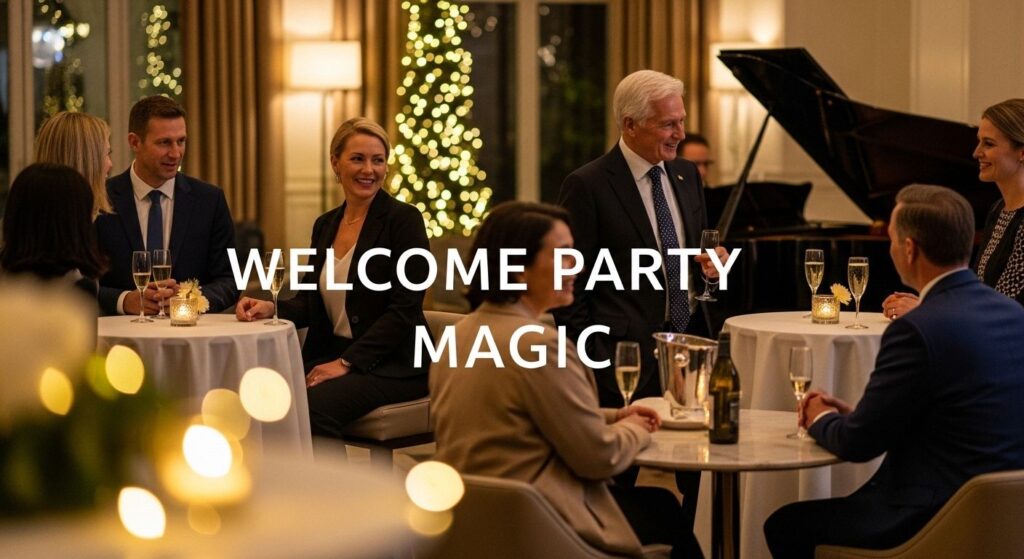
Live piano music changes that dynamic immediately. The moment guests walk into a room with a pianist playing, the conversation starts. The silence disappears. People relax. The weekend begins on the right note. Literally.
Arnie Abrams has performed at welcome parties, rehearsal dinners, cocktail hours, and receptions across New Jersey, New York City, and Philadelphia for more than 20 years. This guide covers everything you need to know about live music for your wedding welcome party: from venue logistics to song choices, from timeline planning to what happens when there is no piano on site.
▶ Key Takeaways
- ✓ The welcome party is its own event with its own music goals, separate from the cocktail hour and rehearsal dinner.
- ✓ The goal is conversation-level warmth: not dancing, not background noise, but music that fills silence and sparks connection.
- ✓ Mixed-age, mixed-familiarity guest groups are the norm. Music choices need to work for everyone from the groom’s college friends to the bride’s grandparents.
- ✓ Volume matters more at a welcome party than almost any other event. Guests need to hear each other.
- ✓ Live piano works in hotel lounges, rooftops, restaurant private rooms, backyards, wineries, and more, with or without a house piano.
What Is a Wedding Welcome Party (and Why Do So Many Couples Skip It)?
A wedding welcome party is an informal gathering held the evening before the wedding, sometimes called a welcome reception, welcome gathering, or wedding kickoff event. It is not a rehearsal dinner. The rehearsal dinner is typically a sit-down meal for the wedding party and immediate family. The welcome party is broader: it includes out-of-town guests, close friends, extended family, and anyone else the couple wants to see before the big day.
The settings vary widely. Some couples rent out a hotel lounge near the room block. Others book a brewery welcome party, a winery welcome party, or a private room at a restaurant. Backyard welcome parties and rooftop welcome parties are popular in warmer months, especially for Jersey Shore wedding weekends and destination-style events in the tristate area.
So why do couples skip it? Usually one of two reasons: budget, or the belief that guests will “just figure it out” the night before. Both underestimate what is actually at stake.
Guests who travel for a wedding, especially those flying in or driving hours, arrive with no social footing. They do not know where to go, who to talk to, or how to connect with people they have never met. Without a structured welcome moment, the night-before energy stays flat. People retreat to their rooms. The first real gathering becomes the ceremony the next day, a high-pressure moment that was supposed to be joyful, not the first time everyone met.
“I have played hundreds of welcome parties over the years,” says Arnie Abrams, NJ pianist and founder of Arnie Abrams Entertainment. “Every single time, the music is what breaks the ice. Guests walk in, hear the piano, and immediately relax. The conversations start on their own. You do not have to force anything.”
Welcome Party vs. Cocktail Hour vs. Rehearsal Dinner: What Makes This Different
These three events get confused in planning conversations all the time. Each one has a different purpose, a different audience, and different music needs.
The rehearsal dinner is intimate and structured. It follows the ceremony rehearsal, includes speeches and toasts, and centers on the wedding party and close family. The music for a rehearsal dinner needs to support a seated dinner with moments of silence for speakers.
The cocktail hour is a 45- to 75-minute window between ceremony and reception. It has a time constraint, a defined end point (guests moving into the reception room), and a specific job: keep energy up while the couple takes photos. The cocktail hour music can afford to be slightly more upbeat because the reception is right around the corner.
The welcome party is different on every count. It is a multi-day wedding weekend opener. It has a wider and more diverse audience. It often runs longer. And its primary job is not to entertain. It is to connect people who do not know each other yet.
▶ Event Music Comparison
| Event | Music Goal | Audience | Typical Length |
|---|---|---|---|
| Welcome Party | Connect strangers, warm atmosphere, low pressure | All guests, wide age range | 90–120 min |
| Rehearsal Dinner | Elegant background, support toasts and speeches | Wedding party, close family | 2–3 hours |
| Cocktail Hour | Energize, mingling, transition to reception | All guests post-ceremony | 45–75 min |
The Psychology Behind the Welcome Party: Why First Impressions Matter So Much
Psychologists call it the “primacy effect”: the tendency for first impressions to anchor how we feel about everything that follows. Your guests’ first experience of your wedding weekend shapes how they experience the ceremony, the reception, and the weekend as a whole.
If the welcome party feels awkward and disconnected, guests carry that energy forward. If it feels warm, alive, and welcoming, they show up to the ceremony already in a celebratory mood. They are already connected to other guests. They already feel like part of something.
Live piano music addresses the primacy effect directly. It fills the silence that creates awkwardness. It gives guests something to respond to: a comment, a question, a shared experience. “Oh, is that Billy Joel?” becomes a conversation starter. A well-known jazz standard becomes common ground between a college friend and a great-aunt who have never met.
This is why couples who book a pianist for their welcome party music consistently report that the whole weekend felt more connected. Not because of anything they planned. The music created the conditions the music created the conditions for connection to happen on its own.
Venue Scenarios: Where Welcome Parties Happen and What Each One Needs
The venue shapes everything about how live piano works at a welcome party. Here is what to expect in the most common settings.
▶ Common Welcome Party Venues
🏢
Hotel Lounge
Most common setting. Often has a house piano. Confirm piano availability, access hours, and noise limits with the coordinator before booking.
🍆
Winery / Brewery
Relaxed, social vibe. Rarely has a house piano. Keyboard setup required. Confirm power access, floor surface, and load-in path.
🏔
Backyard / Rooftop
Beautiful setting, weather-dependent. Need a rain plan, shade for the keyboard, wind considerations, and nearby power source or extension cord.
🍽
Restaurant Private Room
Tight on space. Footprint planning matters. Confirm placement away from kitchen noise and server lanes. Discuss volume expectations with the manager.
Hotel Lounge and Hotel Lobby Piano
The hotel lounge pianist setup is the most straightforward welcome party scenario. Many full-service hotels in New Jersey, New York City, and Philadelphia have a house piano. That eliminates equipment concerns entirely. The challenge is logistics: hotel coordinators often have strict timelines, noise ordinances in public spaces, and check-in hours that limit how early a musician can set up.
Always confirm with the venue coordinator whether the piano is tuned, whether a bench is available, whether the space has been reserved exclusively for your party or will be open to other hotel guests, and what the curfew time is.
Rooftop and Outdoor Setups
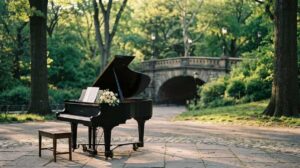
A rooftop welcome party with string lights and a pianist is one of the most memorable setups possible for a New York City wedding weekend or a summer event in New Jersey. The visual alone creates an atmosphere that no DJ or playlist can match.
Outdoor setups require more planning. Rooftop wind affects sound projection. Beach humidity and salt air near the Jersey Shore can affect digital piano performance. Direct sun creates glare on the keyboard. Every outdoor setup needs a rain plan and a confirmed indoor backup location. Power access needs to be confirmed before the event date, not the day of.
Restaurant Private Rooms and Buyouts
A restaurant welcome party in a private room is intimate and efficient. The kitchen handles food service, staff is already in place, and the couple does not have to manage logistics from scratch. The challenge for a pianist is footprint. Most restaurant private rooms have limited floor space. A digital piano setup needs roughly 6 feet by 4 feet, plus clearance to avoid blocking server lanes or emergency exits.
Discuss placement options with the restaurant manager before the event. Placing the pianist near the entrance creates an immediate greeting experience as guests arrive. Placement near a patio or window works well when the interior is small. Avoid corners that face the kitchen. The noise competition is significant.
Winery, Brewery, and Country Club Settings
A winery welcome party or brewery welcome party has a built-in relaxed energy. Guests expect an informal, social atmosphere. That actually makes a pianist’s job easier. There is no pressure to perform, just to support the vibe and keep it going. These venues almost never have a house piano, so a digital piano setup is standard. Confirm power availability, bring extension cords, and have a backup power strip.
Country club welcome parties and resort welcome parties often have excellent infrastructure for live music: existing sound systems, dedicated event rooms, and experienced coordinators. These tend to be the smoothest setups of any welcome party venue type.
The Music Goal: Warm, Social, and Conversation-Level
This is the most important concept in this entire guide. Read it once and remember it every time you think about your welcome party music.
The goal is not to entertain. The goal is to connect.
Welcome party music should sit at conversation-level volume. Guests need to hear each other. The music fills silence. It does not replace conversation. It creates warmth. It makes the room feel alive. But it should never be so loud that a grandmother is leaning toward a groomsman and asking “What did you say?”
This distinction matters because many couples default to thinking about their welcome party the same way they think about their reception. They imagine upbeat sets, crowd-pleasers, high energy. That is the wrong frame. The welcome party is not a dance event. It is a meet-and-greet vibe, a reunion atmosphere, a “welcome, we are so glad you made the trip” moment.
“The number one mistake I see at welcome parties is volume,” says Arnie. “Someone thinks louder means more fun. But guests cannot talk to each other, they stop trying, and the energy actually drops. Keep it conversational, keep it elegant, and the room comes alive on its own.”
The best background piano music for a welcome party does three things simultaneously: it fills silence so no moment feels awkward, it gives guests a shared sensory experience, and it stays low enough that people can hear each other speak at normal volume from three feet apart.
What Music Works: Genres and Styles for Welcome Party Sets
The welcome party is one of the most musically flexible events in the entire wedding weekend. Here is what works, organized by style and why.
Light Jazz Piano
Classic jazz standards are the gold standard for welcome party music. Jazz is sophisticated without being stuffy. It is recognizable without demanding attention. Standards like “Fly Me to the Moon,” “The Way You Look Tonight,” and Nat King Cole favorites create an immediate warmth that works across every age group. Jazz says: this is a special evening, you are in good hands, relax.
A welcome party jazz set also handles mixed crowds exceptionally well. College friends and grandparents rarely share the same musical taste. But almost everyone responds positively to well-played jazz. It transcends generational preference.
Classic Standards Piano
Frank Sinatra. Nat King Cole. Ella Fitzgerald. These artists defined American popular music for decades, and their songs still work in every social setting. A welcome party standards set built around this repertoire is virtually fail-proof. Guests recognize the songs, feel comfortable, and often find themselves softly singing along. That is exactly the kind of low-pressure social warm-up you want the night before a wedding.
Modern Pop Piano Covers
Blending in modern pop piano covers keeps younger guests engaged. Elton John, Billy Joel, Ed Sheeran, Taylor Swift piano arrangements all work at welcome parties when played at the right tempo and volume. The key is the arrangement. A pop song played at full performance volume becomes a spectacle. The same song played as a soft, elegant piano arrangement becomes a pleasant background presence that guests appreciate without having to stop their conversations to focus on.
Arnie’s ear-playing ability means he can take a couple’s favorite song and work it into a welcome party set naturally, at the right energy level for the room, without making it feel like a performance moment. For deeper insight on how live piano adapts to any event format, see this related guide.
Bossa Nova and Soft Swing
A welcome party bossa nova piano set is particularly effective for outdoor summer events, garden welcome parties, and winery welcome parties. The style is light, rhythmic, and effortlessly social. It does not demand attention but rewards it. Guests who notice it feel rewarded. Guests who do not are still surrounded by a warm, pleasant sonic atmosphere.
♫ Welcome Party Music Style Guide
| Style | Best For | Example Artists | Energy Level |
|---|---|---|---|
| Light Jazz | All guests, all ages | Sinatra, Nat King Cole | Low – Medium |
| Classic Standards | Multigenerational groups | Sinatra, Ella, Tony Bennett | Low |
| Pop Piano Covers | Younger guests, casual setting | Ed Sheeran, Elton John, Billy Joel | Medium |
| Bossa Nova | Outdoor, winery, summer events | Jobim, Getz/Gilberto | Low |
| Motown / R&B Piano | Social, upbeat closer | Stevie Wonder, Marvin Gaye | Medium – Higher |
Handling Mixed Ages and Mixed Friend Groups
One of the most unique challenges of the welcome party is the guest mix. Unlike the rehearsal dinner (mostly wedding party and family) or the reception (everyone, but with a DJ anchoring things), the welcome party puts friends reconnecting and family mingling in the same room without a structured program to guide them.
Music choice becomes a social equalizer. Here is how to think about it.
Do not over-index on any one group. If the set leans entirely toward classic standards, the groom’s 28-year-old college friends may feel like they are at a dinner party their parents threw. If it leans entirely toward modern pop, grandparents may feel out of place. A well-built welcome party set moves between styles: jazz standards anchor the first half, pop favorites filter in during the second hour as the room warms up and guests loosen.
Clean, instrumental versions serve everyone. Instrumental piano arrangements remove the lyric problem entirely. A song with explicit or adult themes becomes completely neutral when played as a tasteful piano arrangement. Guests who know the song appreciate it. Guests who do not still enjoy the melody. Multi-generational music planning is something Arnie brings to every event as a matter of course.
Read the room as it fills. The early arrivals at a welcome party tend to be older family members. The crowd shifts as the evening progresses and more friends arrive. A live pianist adjusts to that shift in real time. A playlist does not.
♫
“A welcome party playlist can fill silence. But it can’t read a room. It can’t shift energy when a group of college friends walk in at 7:30 and the vibe needs to adjust. That’s what a live pianist does.”
ARNIE ABRAMS | NJ Wedding Pianist, 20+ Years
Volume Rules: The Most Overlooked Factor at Welcome Parties
Volume at a welcome party is not a matter of personal preference. It is a functional requirement. Guests need to hear each other. Full stop.
Here is the practical rule: if guests at a table have to lean in to hear each other at normal conversation volume from three feet away, the music is too loud. A live pianist trained in welcome party and cocktail-style settings knows this intuitively. They watch the room. They pull back when guests are clearly straining to talk. They lift slightly during quieter moments when the room energy needs support.
There are also external volume constraints to consider:
- Hotel noise limits: most hotels have explicit decibel limits for lobby and lounge events, especially after 9 PM.
- Restaurant noise limits: private rooms in restaurants are often adjacent to the main dining room. Sound bleeds through walls.
- Outdoor noise ordinances: cities and townships across NJ and the tristate area have curfew times and decibel rules for outdoor events. Know yours before the event date.
The solution in almost every case is a small PA system with a dedicated speaker that the pianist can adjust independently. This gives the musician direct control over volume without relying on venue equipment that may not be calibrated for the space.
Welcome Party Timeline Templates
Here are three practical timeline options based on the length of your event. Each one accounts for arrival window music, guest mingling, welcome remarks, and a closing set.
▶ Sample Welcome Party Timelines
60-Minute Set
0:00 – Opening arrival set (jazz / standards)
0:20 – Welcome toast / remarks (music under or paused)
0:30 – Continued mingling set
0:55 – Soft closing set, guests begin to transition
90-Minute Set
0:00 – Arrival window / check-in music (light jazz)
0:25 – Welcome toast
0:35 – Full mingling set (standards into pop covers)
1:05 – Optional short break
1:15 – Closing set and wrap-up
120-Minute Set
0:00 – Arrival + greeting music
0:30 – Welcome toast / family introductions
0:45 – Peak mingling set (shift to pop, Motown)
1:20 – Short break (5–10 min)
1:35 – Closing set, final remarks, goodbye music
Song Requests at Welcome Parties: How to Handle Them Well
Song requests at a welcome party are almost guaranteed. Guests are relaxed, drinks are flowing, and the piano is right there. Someone will walk up and ask for something.
The best approach is a light request policy communicated to the pianist before the event. Here is what works well:
- Have a must-play list of 5 to 8 songs you definitely want included. This gives the pianist anchor points throughout the set.
- Have a do-not-play list for anything that feels wrong for the evening tone, particularly overly sentimental songs that might overshadow the wedding day, for example.
- Let the pianist use judgment on live requests. A skilled pianist can work almost any request into a set gracefully. If a guest asks for something that does not fit, a professional redirects warmly without making anyone feel turned down.
One thing to avoid: turning the welcome party into a request show. When a pianist takes every request immediately and pivots constantly between styles, the set loses cohesion. Guests get a catalog experience rather than a musical atmosphere. The etiquette around requests is something Arnie covers in his guide on song request etiquette for live events.
A special request song, like the couple’s favorite or a song that means something to an out-of-town guest, is a different matter entirely. These should be shared with the pianist in advance. Arnie plays by ear and can learn most songs given a few days’ notice. A familiar song played live for someone who traveled from across the country is one of the most memorable moments a welcome party can produce.
Logistics: Setup, Sound, and What Happens When There Is No Piano On Site
Most couples are surprised to learn how much setup planning goes into a live piano performance at a welcome party. This is especially true when the venue does not have a house piano. Here is what to plan for.
Keyboard Setup at Venues Without a Piano
A professional digital piano setup for a welcome party includes the keyboard, a stand, a bench, sustain pedal, and a small sound system. The total footprint is roughly 6 by 4 feet in most configurations. This fits in almost every venue type, including restaurant private rooms, hotel suites, and outdoor patios.
Power requirements are modest but specific. A standard wall outlet within 25 feet of the setup location is ideal. Extension cord needs should be discussed during venue walkthrough, never the day of the event. Cords should be taped down or covered for safety.
Load-In and Setup Time
Allow at least 60 minutes for setup before the first guests arrive. This includes load-in, equipment check, sound check, and a short buffer for any unexpected issues with the venue (locked freight elevator, unavailable service entrance, tight hallways). Many welcome party venues, especially hotels, have specific vendor check-in procedures and service entrance requirements. Confirm these in advance.
Outdoor Setup Plan and Rain Protection
Outdoor welcome parties need two plans: the plan for good weather and the rain plan. The backup indoor spot should be confirmed and available before the event date, not negotiated the evening of. Digital pianos can handle light humidity, but direct rain exposure is damaging. A tent or covered patio setup is ideal for outdoor events in areas prone to evening showers, particularly Jersey Shore wedding weekends in late summer.
For outdoor piano logistics, Arnie has covered the full picture in his guide on outdoor wedding live piano setup and weather planning.
Coordinating With the Venue and Planner
Every successful welcome party performance depends on planner coordination and clear communication with the venue coordinator. Share a timeline cue sheet covering what the pianist should watch for as signals to shift from arrival music to mingling music, when to soften the set for welcome remarks, and when to begin the closing sequence. These cues can be simple: a nod from the planner, the host stepping to the microphone, or the arrival of the couple themselves.
✓ Welcome Party Pianist Checklist
Before the Event
☐ Confirm venue has piano or keyboard needed
☐ Verify power access and extension cord distance
☐ Confirm load-in time, parking, service entrance
☐ Share must-play list and do-not-play list
☐ Confirm rain plan if outdoor
☐ Share cue sheet with planner and pianist
Day of Event
☐ Arrive 60 min before guests for setup
☐ Sound check at arrival volume (not performance volume)
☐ Confirm placement does not block servers
☐ Brief venue coordinator on cue words
☐ Tape all cords down for safety
☐ Confirm break timing and overtime rate if applicable
Welcome Party Music Across NJ, NYC, and Philadelphia
Arnie Abrams serves the full tristate region, and welcome party setups look a little different in each market.
New Jersey Wedding Weekends
New Jersey has one of the most active destination wedding markets in the country. Couples from Manhattan, Philadelphia, and beyond choose NJ venues for their accessibility and venue variety. The Jersey Shore is particularly popular for summer wedding weekends, with welcome parties at beach town venues, hotel lounges in Asbury Park, Spring Lake, Cape May, and Long Branch are common booking requests.
Arnie is based in Freehold, NJ, and serves all of Central Jersey, North Jersey, and South Jersey. He is familiar with most major venue regions in the state and handles venue logistics independently so couples do not have to manage them.
New York City Welcome Parties
The New York City wedding weekend welcome party often takes place in a Manhattan hotel lounge, a Brooklyn rooftop, or a restaurant buyout in neighborhoods like Hoboken or the West Village. NYC venues are operationally complex. Freight elevators,, vendor check-in procedures, noise ordinances, and building management rules all come into play. Arnie’s NYC pianist experience includes regular performance across all five boroughs and surrounding counties.
Philadelphia Welcome Parties
Philadelphia couples often host welcome parties in Center City hotel lounges, Rittenhouse Square area restaurants, or Main Line venues with outdoor access. The Philly market has a strong tradition of multi-day wedding weekends, particularly for destination guests arriving from out of state. Arnie’s experience as a Philadelphia wedding pianist includes familiarity with venue logistics, COI requirements, and load-in procedures specific to the Philly market. For a full breakdown of Philadelphia venue planning, see the dedicated Philadelphia pianist logistics guide.
Why Live Piano Outperforms a Playlist at a Welcome Party
This question comes up every time. The answer is not about audio quality. It is about what music actually does at a social event.
A playlist plays songs. A live pianist plays the room.
Playlists cannot respond when a shy group of out-of-towners walks in and the energy needs a lift. They cannot soften the set when a toast is about to happen. They cannot read that the crowd has gotten louder and needs the music to come up slightly to maintain the ambient warmth. They cannot take a request from the couple’s mother and make her feel like the evening was made for her.
Live music creates human moments. The pianist pausing to acknowledge a request, the slight improvisation on a recognizable melody, the moment a guest realizes the song playing is one they chose for their own wedding 30 years ago. None of that happens with a playlist.
For a full breakdown of how live piano compares to recorded music across event types, Arnie covers this topic in depth.
Booking Your Welcome Party Pianist
Ready to Book Arnie for Your Wedding Weekend?
Serving NJ, NYC, and Philadelphia. Free consultation. 20+ years of wedding weekend experience.
Small Details That Make a Big Difference
The difference between a good welcome party and a great one often comes down to a handful of details that couples do not think about until the night of the event.
Music During Guest Arrivals and Check-In
The first 20 to 30 minutes of any welcome party are the most socially fragile. Guests are arriving in waves. Early arrivals do not know where to stand. Conversations have not started yet. This is the highest-value window for live music. Arrival window music, soft, warm, and continuous, turns the awkward waiting period into a comfortable ambient experience. Guests stop worrying about what to do and start simply being in the moment.
Music Under Welcome Remarks and Toasts
The welcome toast at a kickoff event is usually informal. The host, often a parent, the couple, or a close friend, says a few words, thanks everyone for making the trip, and raises a glass. Music under this moment should be handled carefully. Most pianists have two options: pause entirely during remarks, or play at a very soft level underneath. Discuss this preference in advance. Some couples love soft piano under a toast. Others want full silence so every word is clear.
Timing the Closing Set
A welcome party should end on a positive note, not a fade. The closing set gives guests a clear cue that the evening is wrapping up without anyone having to announce it. Music that softens gradually over the last 10 to 15 minutes signals the transition naturally. Guests finish their conversations, say their goodnights, and leave feeling satisfied rather than abruptly dismissed.
Bridal Party Arrival Moment
If the couple arrives at the welcome party after some guests are already there (which is common when there is a rehearsal dinner for closer family earlier in the evening), coordinate a musical moment for their arrival. It does not have to be dramatic. Even a brief melodic flourish or the beginning of a favorite song as they walk in creates a warm, memorable welcome that tells guests: the weekend has officially begun.
Frequently Asked Questions
What is the difference between a wedding welcome party and a rehearsal dinner?
A rehearsal dinner follows the ceremony walkthrough and typically includes only the wedding party and immediate family. It is structured around a sit-down meal with toasts and speeches. A welcome party is broader in scope. It includes out-of-town guests, close friends, and extended family, and it focuses on informal mingling rather than a formal dinner program. The music goals for each event are different: rehearsal dinners need background elegance; welcome parties need warmth and social energy.
How long should a welcome party pianist perform?
Most welcome party sets run between 90 minutes and two hours. Sixty-minute sets work for smaller, more intimate gatherings. For large groups with guests arriving from out of state, two hours gives the event room to breathe and ensures that guests who arrive slightly late still experience the full atmosphere. Breaks are typically built into longer sets to give the pianist a rest while keeping the event flowing.
What if my welcome party venue does not have a piano?
Most welcome party venues do not have a house piano, and that is completely fine. Arnie brings a professional digital piano setup to any venue that needs one. The footprint is compact, the sound quality is excellent for the room size, and the setup process is handled independently. The only requirements are a standard power outlet within reach and a clear path for load-in. This is confirmed during venue coordination before the event date.
Can the pianist learn a specific song for our welcome party?
Yes. Arnie plays by ear and can learn most song requests given a few days’ notice before the event. Share the song title and artist in advance, and he will work it into the set at the right moment. Special request songs, a couple’s song, a family favorite, a meaningful piece for an out-of-town guest, create some of the most memorable moments a welcome party can produce.
How do we handle volume at an outdoor welcome party?
Outdoor volume management involves three factors: natural sound dispersion (sound travels differently outdoors than indoors), wind and ambient noise, and any local noise ordinances with curfew times. Arnie uses a small PA system with independent volume control, which allows him to adjust in real time as conditions change. For outdoor events near the Jersey Shore or in townships with noise ordinances, confirm the curfew time with your venue coordinator well before the event date.
Does the welcome party pianist need to coordinate with the wedding venue the next day?
Not necessarily, but it is worth mentioning the full weekend picture during your initial booking conversation. If there are overlapping musicians, for example a string quartet at the ceremony and Arnie at the welcome party, having one coordinator who has confirmed all vendor timelines avoids scheduling conflicts. Many couples book Arnie for both the welcome party and the live wedding music the following day, which simplifies coordination significantly.
How far in advance should we book a welcome party pianist?
For popular wedding weekends, including June, September, holiday weekends, and Jersey Shore summer dates, booking four to six months in advance is strongly recommended. Fridays and Saturdays in peak season fill quickly, and welcome parties typically fall the Thursday or Friday before a Saturday wedding. The earlier you confirm, the more time you have to plan the set, share song preferences, and handle any venue logistics that require advance coordination.
What is a typical welcome party set for mixed-age guests?
A well-built welcome party set for mixed ages typically starts with jazz standards and classic American songbook material to welcome early-arriving older guests. As the room fills and younger guests arrive, the set shifts toward recognizable pop piano covers: Billy Joel, Elton John, Ed Sheeran arrangements, and may include light Motown or Stevie Wonder toward the end of the evening. The transition happens naturally and is guided by reading the room in real time, which is something a live pianist does that a playlist cannot.
Can Arnie provide additional musicians for a larger welcome party?
Yes. Arnie Abrams Entertainment includes a roster of additional musicians: guitarists, saxophonists, violinists, and vocalists. A jazz duo or trio creates a fuller sound for larger venues or couples who want a slightly more elevated atmosphere. For smaller, more intimate welcome parties, a solo piano is often the perfect choice. Discuss your guest count and venue size during the free consultation and Arnie will recommend the right configuration. See the full musician roster at Hire a Musician New Jersey.
The Right Start for Your Wedding Weekend
Your wedding day will have a ceremony, a cocktail hour, a reception. Every one of those moments has been planned, rehearsed, and anticipated for months. But the night before? That first gathering, that first moment your people come together? That sets the tone for everything.
Live piano music at your welcome party makes that first moment count. It removes the awkwardness before it starts. It gives guests a shared experience before the formal events begin. It tells everyone in the room: this weekend is going to be something special.
“I have watched welcome parties go from flat to alive in the time it takes to play the first eight bars of a standard,” says Arnie. “The guests do not even realize what changed. They just feel comfortable. They start talking. And that energy carries all the way through to the ceremony the next day.”
Arnie Abrams serves couples across New Jersey, New York City, and Philadelphia for welcome parties, rehearsal dinners, ceremonies, cocktail hours, and receptions. Every booking includes a free consultation to discuss your event, your guests, and exactly the right music for your wedding weekend.
Learn more about Arnie’s live wedding music services, read client testimonials, or check the top 25 wedding music moments couples forget to plan to make sure your entire weekend is covered.
Your welcome party is the beginning of your story. Make it one worth telling.
Arnie Abrams Entertainment
Book Live Piano for Your Wedding Welcome Party
Serving New Jersey • New York City • Philadelphia
Free consultation • 20+ years of experience • Perfect for multi-day wedding weekends
“Arnie is great! Absolutely amazing and so talented!” Patricia, NJ Bride