
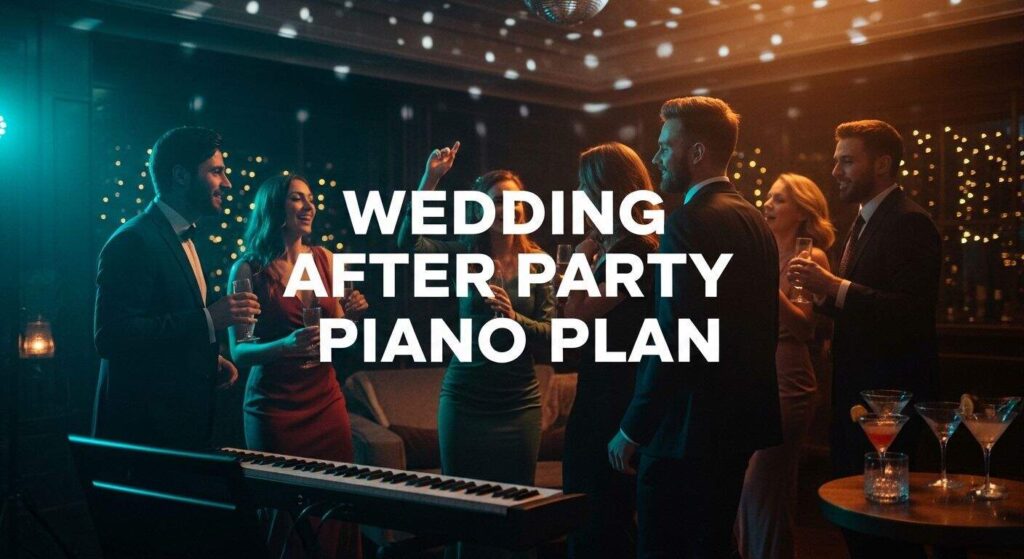
Late-Night Piano That Keeps Your After-Party Moving From Warm-Up to Finale
Your wedding reception ends at 10 PM. But for your closest friends and wedding party, the night is far from over. The after party is its own event. It has different energy, a different crowd, and very different needs from everything that came before it.
Most couples spend months planning ceremony music, cocktail hour, and the reception playlist. The post-reception after party gets about 20 minutes of thought the week before the wedding. That gap shows when the after party feels flat, awkward, or just like a quieter version of the reception.
This guide covers what actually makes live piano music for a wedding after party work. Not ceremony basics. Not first dance tips. Just the practical, specific side of planning late-night live music that keeps people engaged, keeps the energy where it needs to be, and wraps up cleanly when the time comes.
Key Takeaways
- The after party is a second event with its own energy curve, logistics, and audience expectations.
- Live piano works differently after 10 PM because the crowd is smaller, the vibe is more personal, and the music can be more flexible.
- Venue type determines everything: volume limits, setup space, curfew, and whether a portable piano or on-site piano is needed.
- The transition from elegant to upbeat needs a plan, not just a vibe. An experienced pianist executes it without making it feel forced.
- Logistics that seem minor (load-in, power, breaks, overtime) are the most common reasons after parties fall apart.
- Guest communication matters: people who know what to expect actually show up and stay longer.
Why the After Party Needs Its Own Music Plan
A wedding after party is not a smaller version of the reception. The crowd is different. The energy expectation is different. The space is almost always different. And the goal of the music shifts entirely.
During the reception, live wedding music serves many people with many different preferences. It covers dinner, toasts, the first dance, the parent dances, and open dancing. The setlist has to work for grandparents and college friends alike.
After the reception, the guest list shrinks to the people who actually want to keep going. That is usually the wedding party, close family, and college friends. The median age drops. The tolerance for slow songs drops. The appetite for making noise and making memories goes up.
A live pianist for the after party has a chance to do something the reception did not allow: play directly to the room. Fewer people means faster feedback. A skilled pianist reads the crowd in real time, adjusts the setlist mid-song if needed, and takes requests without derailing the energy. That kind of responsiveness is what separates live music from a playlist on shuffle.
Who is typically at the after party?
- Bridesmaids and groomsmen
- Close college or childhood friends
- Siblings and younger family members
- Anyone who told the newlyweds they were “not ready to stop”
- Often: the bride and groom themselves, finally free from the formal obligations
The After-Party Energy Curve
Every successful after party follows an energy arc. Ignore the arc and the night either peaks too early or never gets off the ground. Understanding it is the single most useful thing you can do when working with an after-party pianist.
♪ After-Party Energy Timeline
The exact timing above is flexible. If the after party starts at midnight, everything shifts by 90 minutes. What stays constant is the arc itself: warm up, build to high energy, then a controlled cooldown. Without that structure, the night either peaks too fast or never quite gets there.
Venue Reality Check: Not All Spaces Work the Same Way
Before you book an after-party pianist, you need to know what the venue actually allows. This is the step most couples skip, and it is the most common reason after parties run into problems. The after-party space may be completely different from your reception venue, with its own rules about volume, setup, and curfew.
Here are the four most common after-party venue types and what each one means for live piano:
Usually the most restrictive. Volume limits are real and enforced. A digital piano with a monitor speaker at conversation-level is the standard setup. Load-in logistics depend on elevator access and whether the hotel event manager approves the gear list in advance.
More volume flexibility than a private room, but often a venue curfew of 1 or 2 AM. The lounge area typically has a PA system already. Confirm whether the pianist can plug in or needs their own speaker setup.
The most flexible option. Typically allows a PA system, higher volume, and later curfews. Confirm noise ordinance rules for the building and whether there is a sound level plan the venue requires in writing.
Great energy because the room already has a nightlife feel. The bar’s own sound system may be available. Confirm whether the venue allows outside musicians to plug in. Overtime and breakdown logistics are often more flexible at bar buyouts than at hotel venues.
Questions to Ask Your Venue Before Booking Live Music
- What is the venue curfew and what happens if we go over?
- Are there noise limits or decibel caps we need to meet?
- Is there a piano on site, or does the pianist need to bring a portable piano or keyboard setup?
- What is the load-in process and where does equipment enter the building?
- Is there a dedicated power outlet for musician equipment?
- Does the venue require a certificate of insurance from the musician?
Pro tip on piano setup: Most after-party venues do not have a grand piano on site. A professional wedding pianist brings a quality digital piano with a sustain pedal, proper bench height, and a monitor speaker positioned so the sound fills the room without hitting the walls. Speaker placement matters more in a small space than in a ballroom.
How to Shift From Elegant to Upbeat Without It Feeling Awkward
This is the transition most couples do not think about until it is happening live. The reception ends with a certain level of formality. A live pianist walks into the after party space, and suddenly the same musician who played your first dance is supposed to be playing Bruno Mars piano covers while people jump around.
The elegant to upbeat transition does not happen all at once. It happens in steps. Here is how a skilled pianist manages it:
- Start slightly above the reception’s ending energy. If the last hour of the reception was high-energy dancing, the first after-party song can pick up right there. If the reception ended with dinner music and a slow last dance, give the room a few minutes with familiar mid-tempo songs before pushing the pace.
- Use genre bridges. Moving from jazz to pop is easier when you go through a shared territory first. Motown piano works well here. So does classic rock piano, which sits between the “sophisticated” and “party” worlds without landing too firmly in either.
- Watch for physical cues. Live musicians read the room by watching what people do with their bodies. Standing near the piano is a different signal than turning toward the dance floor. A good pianist sees these cues and adjusts the tempo accordingly.
- Make the shift intentional with one anchor song. A recognizable, high-energy song played with obvious purpose signals to the room that the vibe has changed. Think Billy Joel singalong or Elton John singalong. These are songs people know and want to participate in, and participation resets the room’s energy faster than any other technique.
Live Piano Formats That Work After 10 PM
Not all piano sets are built the same way. The format you choose for the after party should match the crowd size, venue type, and how long the night is expected to run. Below are the formats that tend to work best for late-night wedding music.
Singalong Piano
This is the format with the highest guest engagement ceiling. The pianist plays the melody loudly, clearly, and at a singalong pace, while guests fill in the vocals themselves. It works best with songs people know cold: Billy Joel, Elton John, Bon Jovi, Queen, classic rock, and certain Motown standards.
What makes it work is not just song selection. It is tempo control. Songs played slightly slower than the recorded version are easier to sing along to. A good after-party pianist knows which tracks pull a crowd in and which ones lose them halfway through.
Pop Piano Medleys
Instead of playing songs from start to finish, the pianist moves through abbreviated versions of multiple popular songs, connecting them by key or feel. A well-executed pop piano medley keeps energy high because there is always a new song just around the corner. It also handles requests efficiently, since a guest who asks for a specific song can hear a verse and chorus without the full four-minute commitment.
This format works well during the peak phase (11:15 PM to 12:15 AM) and is especially effective when the crowd is mixed in age or musical taste.
Lounge-to-Party Progression
This is the warm-up format. The pianist starts with cocktail jazz piano, light bossa nova, or soft pop piano during the first 30 to 45 minutes of the after party while guests filter in and settle. As the room fills, the tempo rises and the song choices shift toward more recognizable pop. By the time everyone is there and drinks are in hand, the room is already at a medium energy that is easy to push higher.
Request-Driven Sets
A request system is one of the strongest after-party tools available. The after-party crowd is small enough that requests feel personal. Getting your specific song played in front of 30 people feels very different from requesting something at a reception of 200.
Set it up simply: let guests know they can walk up to the pianist and request a song. No app, no paper slips. Just a direct conversation. The pianist handles it live, either playing the request immediately or folding it into the next natural transition point.
A good rule: maintain a do-not-play list for the after party just as you would for the reception. If there are songs connected to specific people or memories you want to avoid, tell the pianist before the night starts.
After-party music format by venue type:
- Hotel suite / private room: Lounge-to-party progression, request-driven set
- Hotel lobby lounge: Pop piano medleys, singalong piano
- Private room rental: Any format; best for full energy curve
- Bar buyout: Singalong piano, pop medleys, high-energy request-driven
Setlist Pacing: How to Build the Night Song by Song
A dynamic setlist is not a random playlist. It is a structured progression where each song sets up the one after it. Understanding setlist pacing helps you communicate with your pianist before the event and gives them the context they need to execute well.
The After-Party Opener
The after-party kickoff song matters more than most couples realize. It is the first signal to the room about what kind of night this is going to be. A strong opener is recognizable within the first four beats, has a steady singalong rhythm, and lands at a medium-high energy. It should not be the highest-energy song of the night. That comes later. The opener sets a tone and invites people in.
Song Progression Through the Peak
During the 11:15 PM to 12:15 AM peak window, the setlist should climb in energy, with occasional brief dips to give the crowd a chance to breathe and re-engage. Think of it as wave motion rather than a straight climb. A high-energy medley, then a slightly slower crowd-favorite, then back up again. This pattern keeps people engaged longer than continuous high-energy playing, which can exhaust a room.
The Finale Song
The last song of the after party is the moment people remember. It should feel earned. Not arbitrary. Some couples choose a reprise of their first dance song, played with more energy and a singalong feel. Some choose the highest-energy crowd favorite of the night as the closer. Either approach works, as long as the pianist knows it is the finale and plays it with intention.
Consider using a wireless mic for a brief newlywed announcement before the final song. Thirty seconds to thank the room and introduce the last song turns a simple music moment into a signature after-party memory.
Logistics That Actually Break After Parties
Most after-party problems are not music problems. They are logistics problems that affect the music. The following are the most common issues, and what to do about each one before the event.
Load-In and Setup Time
A pianist needs time to set up a digital piano, connect a PA system, run a sound check, and adjust the monitor before guests arrive. For an after party starting at 10:30 PM, that setup should be complete by 10:15 PM at the latest.
Setup time is typically 30 to 45 minutes for a keyboard and speaker rig. If the after-party venue is in a different location from the reception venue, the pianist needs travel time factored into their contract. Confirm this detail when booking, not the week of the wedding.
Power
A keyboard setup with a monitor speaker draws roughly 200 to 400 watts. Most hotel rooms and private lounges can handle this without issue. The problem comes when the room has limited accessible outlets or a power strip is needed that the venue did not anticipate.
Ask your venue coordinator to confirm there is a dedicated outlet within 25 feet of the planned piano position. If there is not, an extension cord and power strip resolve it easily. Do not assume the room is set up for live music just because it is a nice venue.
Sound Limits and Venue Curfew
Volume control is a real constraint in many after-party spaces, especially hotel properties. The pianist should be briefed on the sound level plan before arriving. If the room has a strict noise ordinance or a neighbor-friendly policy, a good pianist can adjust their playing dynamics and speaker output without sacrificing the energy feel.
Know your venue curfew before the night starts. If the music must stop at 1 AM, the pianist needs to know that at 12:30 AM so they can manage the cooldown and final song properly rather than being cut off mid-set.
Breaks
A live musician performing from 10:30 PM to 1:00 AM typically takes one 15-minute break, usually around midnight. Plan the break during a natural low-energy moment, such as when late-night snacks are being served or when the bar has its peak rush. A break during a high-energy set kills momentum. A break timed to a room-wide pause feels invisible.
Overtime
After parties run long. Build this into the contract. Discuss the overtime rate and the process for extending in increments before the event. Having a clear overtime planning agreement means the couple or a designated person in the wedding party can extend the night with a simple yes, rather than a mid-event negotiation.
Contract language to confirm before signing:
- Start time, end time, and what constitutes overtime
- Overtime rate per 30-minute increment
- Break policy (number, length, timing flexibility)
- Load-in window and setup expectations
- Whether a different-location after party requires additional travel compensation
Guest Communication: Tell People What to Expect
One of the most overlooked parts of after-party planning is the simplest: telling your wedding guests that the after party exists and what it will be like.
Guests who know what to expect actually show up. Guests who are vague on the details filter out during the reception and go back to their hotel rooms. If you want the after party to have energy, communicate it clearly.
What to Tell Guests in Advance
- Where the after party is happening (address or hotel location, room number or floor if applicable)
- What time it starts
- Whether it is open to all guests or invitation-only
- That there will be live piano music (this is a selling point, not a throwaway detail)
- Whether there is a dress code change (some couples encourage people to “dress down” for the after party)
- Late-night transportation options, including any rideshare pickup zones or shuttle routes
A group text or a dedicated section on the wedding website works well. Some couples add an after-party insert to the ceremony program. The simpler and more direct the communication, the better the attendance.
Same Venue vs. Different Location
A same-venue after party held in a secondary room or the same reception venue is logistically easier for guests but may feel too similar to the reception to create a distinct energy shift. A different-location after party at a nearby hotel or bar requires more guest coordination but creates a clean psychological break from the formal wedding events.
If you go with a different location, consider directional signage, a venue coordinator to manage arrivals, and a clear late-night transportation plan so no one is confused about how to get there.
After-Party Atmosphere: The Details That Amplify the Music
Live piano sets the tone. Everything else in the room either reinforces that tone or fights against it. A few small details make a significant difference in how the music lands.
Lighting
Dance lighting does not require a full light show. A few strategic uplighting fixtures shifted to a warmer or more saturated color from the reception’s palette signals that something different is happening. Some couples rent a small disco ball for the after party. It is low-cost, visually striking, and immediately tells the room the vibe has changed.
Avoid keeping the same full-brightness white reception lighting. Dimmer, warmer light encourages people to relax and move. Bright white light keeps people in “event mode” rather than “party mode.”
Late-Night Snacks and Hydration
The snack table timing matters more than the food itself. Bringing out late-night snacks during the warm-up phase gives guests a reason to stay and settle in. A water station is not optional. After several hours of dancing and drinking, guests need hydration readily available, and the pianist appreciates it too.
Time the snack service during a natural energy pause, not during a peak moment. Interrupting the highest-energy point of the night to serve sliders kills momentum faster than almost anything else.
Space Planning
A small after-party room that is slightly overcrowded feels exciting and alive. A large after-party room with 30 people spread out feels empty and dead. If your after-party space is too big for your expected headcount, use furniture and lighting to define a smaller zone around the piano. Crowd flow toward the piano creates energy. Guests scattered far apart drain it.
After-Party Pianist Logistics Checklist
Use this before your after party to confirm every logistical detail with your pianist and venue coordinator.
♪ Before the Event
- Confirm start time, end time, and overtime rate in writing
- Verify venue load-in window (allow 45 minutes minimum)
- Confirm whether a piano is on site or a keyboard setup is needed
- Get the venue’s noise limit or sound level policy in writing
- Identify the power outlet nearest the piano position
- Share the after-party energy arc timeline with your pianist
- Provide a must-play list and do-not-play list
- Confirm break policy and preferred break timing
- Communicate after-party details to all expected guests
- Coordinate late-night transportation and rideshare pickup zones
♪ Day-of Details
- Designate one person in the wedding party to communicate with the pianist during the event
- Confirm the finale song and who will announce it
- Set up the water station near the piano position
- Plan snack service timing around natural energy lulls
- Brief the bar manager on when the peak phase starts so they are staffed accordingly
- Confirm that venue staff know not to interrupt the final song
After-Party Budget and Cost Drivers
The after-party cost for live piano music is driven by three main factors: performance duration, location logistics, and overtime.
Performance Duration
Most after-party bookings run two to three hours. A two-set format with one break is standard. Longer bookings cost more, and some musicians offer package rates for full-night bookings that include the reception and after party together. If you are booking the same pianist for both, ask about combined pricing.
Location Logistics
A different-location after party in NJ, NYC, or Philadelphia may involve additional travel time, parking costs, or load-in complexity compared to a same-venue arrangement. Be transparent about the after-party location when getting quotes so the estimate is accurate.
Equipment Needs
If the venue has a piano on site, the cost is typically lower because the musician is not transporting equipment. If a full keyboard setup with a monitor speaker is needed, factor in the additional setup time and gear. Ask specifically about what equipment is included in the quoted rate.
| Factor | Lower Cost Option | Higher Cost Option |
|---|---|---|
| Duration | 2-hour set, same location as reception | 3+ hour set, different location |
| Equipment | Piano on site at venue | Full keyboard and PA rig required |
| Overtime | Clean end at agreed time | Multiple overtime extensions |
| Booking timing | Booked several months in advance | Last-minute or peak-season booking |
Connecting the After Party to the Rest of Your Wedding Day
The after party works best when it feels like a natural extension of the night, not a separate event awkwardly attached at the end. A few small music choices can create continuity between the reception and the after party without repeating anything.
Consider having the pianist open the after party with a more energetic version of a song from the cocktail hour. Guests who remember the cocktail hour version will notice the shift and feel the arc of the whole evening. It is a small touch with a disproportionately large effect on how the night feels in memory.
For couples who want a fully planned wedding day music plan, reviewing how all music moments connect is worth doing early in the planning process. The blog post on live piano music for every wedding moment covers the full arc from ceremony to reception, which serves as a useful reference when planning what the after party needs to accomplish differently.
The impact of tempo and music pacing on guest experience is also directly relevant to after-party planning, since the energy curve described above is fundamentally a tempo and pacing question.
Frequently Asked Questions About Live Piano at Wedding After Parties
What time should the after party typically start?
Most wedding after parties begin between 10 PM and 11 PM, depending on when the reception ends. If you are hosting an indoor after party at a hotel or private room, plan for guests to arrive over a 20 to 30 minute window after the reception ends. Building in that buffer gives the pianist time to finish setup and lets the room fill naturally before the music pushes into higher energy.
Can a live pianist take requests at an after party?
Yes, and it is one of the best reasons to book live piano music for an after party rather than using a playlist. A skilled after-party pianist handles song requests in real time, either playing them immediately or folding them into the next natural transition. The smaller crowd at an after party makes requests feel personal and interactive rather than getting lost in the shuffle. Share a must-play list ahead of time, and let the rest happen organically.
How long should live piano music run at a wedding after party?
Two to three hours covers most after-party timelines well. A two-hour set from 10:30 PM to 12:30 AM allows a proper energy curve from warm-up through peak and into cooldown. If you expect guests to stay later, build a three-set format or confirm the pianist’s overtime rate so extensions can happen easily without a mid-event negotiation. Most after parties wind down naturally between 1 and 1:30 AM.
What type of piano is used at an after party when there is no grand piano?
A professional wedding pianist brings a high-quality digital piano with weighted keys, a sustain pedal, and a monitor speaker calibrated to the room size. For smaller after-party spaces, this setup is often better than a grand piano because the volume is fully adjustable, load-in is simpler, and the sound can be directed precisely. The key question is whether the venue has a power outlet within range and enough floor space for the piano setup.
Do I need a separate contract for after-party live music?
If the same pianist is performing at your reception and your after party, confirm in writing whether the after party is included in the reception contract or priced separately. Most musicians treat the after party as a separate booking with its own start time, end time, and overtime rate. Get the contract language clear before the event so there is no ambiguity about when the booking ends or what additional hours cost.
How is an after-party setlist different from a reception setlist?
A reception setlist covers a wide range of guests across different ages, musical tastes, and comfort levels with dancing. An after-party setlist is built for a smaller, self-selected group that chose to stay. The average energy level is higher, the song choices skew more toward crowd-favorite singalongs and modern pop, and the pacing moves faster. The pianist also has much more flexibility to take requests and respond to the specific crowd in real time rather than adhering to a formal event timeline.
What should I tell guests to make sure they come to the after party?
Guest communication is one of the most effective tools for a well-attended after party. Let guests know the location, start time, and that live music will continue. Include this in the ceremony program, on the wedding website, or in a group text to the wedding party. Guests who are told in advance and reminded before the reception ends are significantly more likely to attend than those who hear about it informally. A walkable after party location or a shuttle to the venue removes a major barrier to attendance.
Is live piano music better than a DJ for a small wedding after party?
For a small, intimate after party of 20 to 60 guests, live piano music offers something a pre-recorded DJ set cannot: real-time adaptability. A live pianist reads the room, adjusts the tempo, takes requests on the spot, and creates moments that feel personal to that specific group of people. The interactivity and the human element of live performance tend to generate more memorable moments in a small-group setting than a curated playlist.
Ready to Plan Your Wedding After Party?
Planning live piano music for your wedding after party is a specific job that requires a specific skill set. The energy curve, the venue logistics, the setlist pacing, the transition from elegant to upbeat: these are all manageable when you work with a pianist who has done it before and knows what each phase of the night requires.
Arnie Abrams has been performing live wedding music across New Jersey, New York City, and Philadelphia for over 20 years. He has performed cocktail hour sets, late-night after parties, and everything in between. His ability to read the room and build a night from warm-up to finale is exactly what an after party requires.
Explore his entertainment venue experience, listen to music demos, and review his FAQ page for common booking questions.
Book Your After-Party Pianist
Talk with Arnie about your after party vision. He offers free consultations and will help you plan the energy curve, setlist, and logistics from start to finish.
Call (732) 995-1082 Request a Free Quote