The Permit Rules, the Acoustic-Only Rule, and How to Get the Live Piano Feel You Want Without a Parks Officer Stopping the Ceremony
Central Park is one of the most photographed wedding backdrops on the planet, and for good reason. The Bethesda Terrace arches, the Bow Bridge railings, the Wagner Cove gazebo tucked into the trees, the Conservatory Garden in full spring bloom: each spot looks like a postcard before anyone even shows up. Couples picture their ceremony there months before they pick a date.
Then the planning starts, and the questions land in a different order than most people expect. Do you need a permit? What about a microphone for the officiant? Can a pianist actually play in the park? What happens if it rains? The answers are not always what couples assume, and a few of them shape the entire music plan for the day.
This guide walks through the rules NYC Parks actually enforces, the spots where ceremonies happen, the live music options that fit those rules, and how to keep the music part of the day from becoming a problem the morning of. If you are planning a Central Park ceremony, or thinking about one, the details below will save you some surprises.
Key Takeaways
What every couple should know before booking a Central Park ceremony
- A permit is required for 20 or more guests, costs $25, and must be submitted at least 21 days in advance through NYC Parks.
- Amplified sound is prohibited in Central Park. The rule appears three times on the permit itself. Acoustic instruments only.
- Conservatory Garden has its own rules: a separate permit is always required regardless of guest count, and it is designated a Quiet Zone.
- No chairs, tents, decorations, or alcohol are allowed at any standard ceremony location, with very limited exceptions.
- Permits do not reschedule for rain. If the weather turns, the slot is gone unless you apply for a new date.
- There are no pianos at any park ceremony location. A live piano option means a battery-powered keyboard at conversational volume, an acoustic substitute (violin, cello, harp, classical guitar), or moving the music to a venue near the park.
The Permit Basics That Shape Every Other Decision
Most couples start by picking a spot. The Parks Department starts with a different question: how many people are coming? That number decides whether you need a permit at all, and the answer shapes everything else.
NYC Parks requires a Special Events Permit for any gathering of 20 or more people in any city park, or any time you want to reserve a specific location regardless of group size. For Central Park, the application fee is $25, paid online at the time of submission. Permits must be filed at least 21 days before the ceremony date, and processing typically takes 21 to 30 days. Applications submitted inside the 21-day window are not accepted.
If your group is smaller than 20 people, you do not technically need a permit. You can show up at most spots in the park, hold a brief ceremony, and leave. There is one major catch: you cannot reserve the location, which means another wedding party with a permit (or a tour group, or a film shoot, or a few hundred tourists with cameras) might be in your spot when you arrive. For popular locations like Wagner Cove, Ladies Pavilion, and Bow Bridge, a $25 permit is cheap insurance even if your guest count is below the threshold.
Permits cover a two-hour window. Within that window, you set up, hold the ceremony, take photos, and clear the area. There is no buffer for late arrivals, traffic from across town, or a weather delay.
Important: No Rain Reschedules
NYC Parks does not reschedule wedding permits due to weather. Once you book your two-hour window, that window is yours whether it is sunny, raining sideways, or snowing. If you want a different date, you have to apply for a brand new permit, which means another $25 and another 21 to 30 day processing window. Couples planning a Central Park wedding need a real backup plan, not a hopeful one.
What the Permit Application Asks
The online form asks for the date and time, the requested location, the expected guest count, the names and contact info for the couple, and a few yes/no questions about what you plan to bring. This is also where you would request amplified sound, which we will get to in a minute. The Parks Department reviews each application and may offer alternate dates, times, or locations if your first choice is unavailable. You do not need to file a new application if they offer an alternate.
One detail couples often miss: NYC Parks no longer issues wedding permits on major holidays like Memorial Day, July 4, Labor Day, or Thanksgiving. If your group is under 20 people, you can still hold a ceremony on those days without a permit. The Conservatory Garden, which operates under a separate system through the Central Park Conservancy, does still issue permits on holidays.
The Acoustic Music Rule (And Why It Matters More Than You Think)
Here is the rule that quietly reshapes every Central Park music plan: no amplified sound is permitted in Central Park. Acoustic music is allowed. The line appears in the smoking and alcohol notice at the top of every permit, in the body of the permit itself, and on the NYC Parks weddings page. It is the most-stated rule on the entire document.
That means no PA system. No powered speakers. No microphone for the officiant. No Bluetooth speaker playing a recorded processional. And in practice, no traditional digital keyboard with built-in amps either.
People walk into the park picturing a string quartet at Bethesda Terrace and a microphone on the officiant. Half of that picture is fine. The other half breaks the rule, and a Parks officer can stop the ceremony to enforce it. That is not a story you want from your wedding day.
~ Arnie AbramsThere is a theoretical workaround. You can apply separately to the local NYPD precinct for a Sound Device Permit, which costs $45 and must be filed at least five days before the event. Before you can apply, NYC Parks has to grant amplified sound permission on your Special Events Permit, which Parks rarely does for weddings. The sound permit also caps the maximum allowed volume and cannot be issued within 500 feet of a school, courthouse, or house of worship during operating hours. For a Central Park wedding, the safer assumption is that amplification is not happening.
The acoustic rule is not arbitrary. Central Park is a public space. Tourists, joggers, picnickers, kids on field trips, and other wedding parties all share the same paths and lawns at the same time. A PA system at one ceremony would carry across the lake into someone else’s quiet picnic. The rule keeps the park usable for everyone, and it has been enforced consistently for decades.
What Counts as Acoustic
Acoustic instruments make sound on their own without electrical amplification. Violin, viola, cello, harp, classical guitar, flute, clarinet, trumpet (played softly), saxophone (acoustic, not amplified), bagpipes, and the human voice all qualify. These are the instruments you see at Central Park ceremonies week after week.
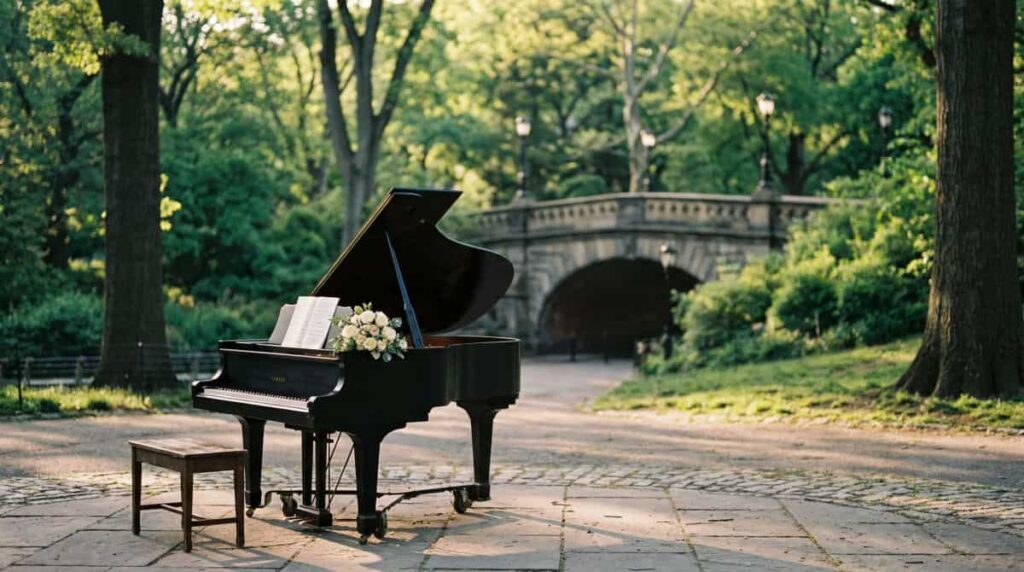
Acoustic pianos do not appear on that list, and the reason is simple: there are no acoustic pianos at any Central Park ceremony location. Bethesda Terrace does not have one. Wagner Cove does not have one. The Conservatory Garden does not have one. A grand piano weighs around 800 pounds and cannot be carried across a footbridge to a gazebo on the lake. This creates a real puzzle for couples who specifically want piano music at their ceremony.
The Live Piano Question: Three Real Options
If you walk into a Central Park ceremony wanting live piano music, the answer is not “no.” It is “here are your three real options, and you need to pick one before the permit goes in.”
Option 1: A Battery-Powered Keyboard at Conversational Volume
Modern stage keyboards like the Roland GO:PIANO, Yamaha CK-61, and Korg KROSS 2 run on AA batteries with built-in speakers. They are light, they sound good, and they do not need an outlet. A skilled player can use one at conversational volume, no louder than a violin, and the music carries to a small ceremony group standing nearby.
This option lives in a gray area of the rules. The keyboard is technically electronic, and any sound that comes out of a built-in speaker is technically amplified. Park enforcement of this gray zone is inconsistent. Some couples have used a small battery keyboard at Wagner Cove or Cop Cot without issue. Others have been asked to stop. The risk depends on how loud the keyboard is, whether a Parks officer is in the area, and whether other park users complain. If you want zero risk, this is not the option to pick.
Option 2: An Acoustic Substitute Instrument
The most reliable path is to choose a different acoustic instrument that achieves the feel you wanted from the piano. A solo violin or cello handles ceremony music beautifully and works in every Central Park location. A harp adds the same elegance most couples are picturing when they think “piano in a garden.” A classical guitar fits the more relaxed cocktail-style ceremonies couples plan at Cop Cot or Cherry Hill.
Arnie Abrams Entertainment books all of these instruments alongside piano, and the network includes string players, harpists, classical guitarists, and acoustic vocalists who regularly perform at Central Park ceremonies. The advantage of this route: no rule-bending, no risk of interruption, and no surprises on the day. You can hire a musician directly through Arnie’s office and have one point of contact for booking, timing, and song selection.
Option 3: Move the Piano to the Reception Venue
The third option is the one couples often arrive at after thinking it through: have the ceremony in the park with an acoustic instrument that fits the rules, then move to a reception venue right outside the park where a real piano (or a fully powered keyboard with a PA) can carry the rest of the day. Tavern on the Green, The Loeb Boathouse, the Plaza Hotel, the Mandarin Oriental, and several other Central Park-adjacent venues have grand pianos on site or can accommodate a brought-in keyboard with full power.
This routing gives you the live piano music you wanted without forcing the park rule into a corner. Arnie has played both sides of this setup many times: a violin or harp colleague handles the ceremony in the park, and Arnie meets the wedding party at the reception venue for cocktail hour and dinner. One booking covers both pieces of the day.
Planning a Central Park Ceremony
Get the music details handled before you submit your permit. Talk through your options.Where Couples Actually Get Married in Central Park
Central Park has dozens of spots that work for ceremonies, but a handful of locations get the vast majority of bookings. Each one has its own character, capacity, and music considerations. The table below covers the most popular permitted spots and what to know about each.
| Location | Max Guests | Character & Music Notes |
|---|---|---|
| Bethesda Terrace / Fountain | 25 | Iconic arcade with mosaic ceiling. Heavy foot traffic. The arches under the terrace shelter from rain and have been hosting acoustic musicians for decades. Excellent acoustics for solo violin, cello, or harp. |
| Cop Cot | 50 | Largest wooden rustic shelter in the park, near the Central Park South entrance. Good shade in summer, partial rain cover. Holds the largest group of any non-Conservatory location. Works for solo or duo acoustic. |
| Wagner Cove | 20-25 | Hidden wooden gazebo on the lake. The most private spot in the park. Quiet enough that a single acoustic instrument carries the entire ceremony. |
| Ladies Pavilion | 20-25 | Cast-iron Victorian gazebo near Strawberry Fields. Lake views, partial rain shelter, two built-in benches. Popular and busy on weekends. |
| Bow Bridge | 20-25 | Classic NYC backdrop. Almost no privacy: it is a working footbridge with constant pedestrian traffic. Best for very brief ceremonies. |
| Shakespeare Garden | 20-25 | Floral surroundings, intimate path layout. Quiet morning ceremonies work best. Strong setting for harp or solo voice. |
| Belvedere Plaza | 20-25 | Castle backdrop with sweeping views over Turtle Pond. No interior castle access. Some wind exposure on the terrace. |
| Cherry Hill | 60-100 | Open area near the 72nd Street Transverse, just east of West Drive. Larger groups, fewer rain options. |
| Conservatory Garden | up to 100 | Separate permit system through Central Park Conservancy. Three sub-gardens (Italian, French, English). Designated Quiet Zone, so amplification rules are even stricter than the rest of the park. |
For the smaller permitted spots (Wagner Cove, Ladies Pavilion, Shakespeare Garden, Bow Bridge, Gapstow Bridge), 20 to 25 people is the hard maximum. Cop Cot, Cedar Hill, Summit Rock, Great Hill, and the Pool Lawn all accommodate larger groups in the 50 to 60 range. Conservatory Garden goes up to 100 depending on the sub-garden you book.
Picking the Right Spot for Your Music
The permitted spots fall into two music categories. The intimate gazebos and bridges (Wagner Cove, Ladies Pavilion, Bow Bridge, Gapstow) work beautifully with a single acoustic instrument played at conversational volume. Twenty guests standing within ten feet of the musician will hear everything. The larger open areas (Cop Cot, Cherry Hill, Cedar Hill, Summit Rock) are harder for a single acoustic instrument to fill, and the lack of walls or rain shelter means weather can interfere. For larger groups, a string duo or trio carries better than a solo player.
Bethesda Terrace is the exception in both directions. The arcade under the terrace has wonderful acoustics from the tile ceiling, and acoustic musicians have used that spot as a natural amphitheater for years. The same arcade gets a steady stream of tourists, so any ceremony there shares the space with passersby.
Conservatory Garden: A Different Permit, Different Rules
Conservatory Garden operates as a separate world inside Central Park. The Central Park Conservancy manages it directly, not NYC Parks, and the permit system is entirely different. If your ceremony is here, almost everything you read above changes.
A permit is required for every ceremony in the Conservatory Garden, regardless of guest count. There is no 20-person threshold. The application goes through the Central Park Conservancy, not the NYC Parks Special Events portal. Recent permit fees have ranged from $400 to $1,000 depending on the year and the package, and couples should verify current pricing directly with the Conservancy. The reservation covers 90 minutes (longer than the standard NYC Parks two-hour window arithmetic might suggest, because the 90 minutes here is exclusive use rather than a setup window).
Conservatory Garden is officially designated a “Quiet Zone.” Amplification of musical instruments, sound systems, or any other electronic sound device is explicitly prohibited. The rule is stricter than the rest of the park. The garden is divided into three sub-gardens, each with its own character: the Italian-style North Garden with the Wisteria Pergola, the French-style center garden, and the English-style South Garden. Couples select which sub-garden they want when applying.
The garden remains open to the public during ceremonies. Visitors may be asked to stay clear of the immediate area, but there are no closures, no roped-off zones, and no exclusive privacy. Wedding receptions are not permitted in the Conservatory Garden at all.
Pro Tip
If you are choosing between Conservatory Garden and a standard Central Park location, weigh the higher permit fee against the more controlled environment. Conservatory Garden permits are more expensive but easier to schedule on holidays and weekends, and the three sub-gardens give a more enclosed feel than open ceremony spots like Cherry Hill or Cop Cot. The Quiet Zone rule means even the small acoustic options are limited to truly soft instruments: solo harp, solo flute, and acoustic guitar all work well; bagpipes do not.
What You Cannot Bring (And What You Can)
The Central Park ceremony rules are restrictive in ways that catch most couples off guard. Knowing the list ahead of time prevents the day-of scramble.
Central Park Ceremony Rules at a Glance
- No setup of chairs, tables, or tents. 1-2 chairs allowed for guests with mobility needs (couple brings them).
- No alcohol. Sparkling cider for toasts is fine.
- No decorations. No balloons, no signs affixed to trees, no rope or banner attachments.
- No flower petals, rice, birdseed, or confetti. Bubbles allowed at Conservatory Garden only.
- No vehicles in the park. No limo or car drop-off at the ceremony site.
- Chuppahs may be hand-carried in and out with prior permission from Parks.
- The public always has access to the ceremony area. Tourists may walk through.
- Cleanup is the couple’s responsibility. Everything brought in must be carried out.
- No amplified sound at any standard location, no exceptions without a separate NYPD permit.
- No drones without special permission from NYC Parks.
- Smoking is prohibited in all NYC parks and beaches.
- The ceremony location is not exclusive. A permit reserves the spot for your party but does not block public access.
Most of these rules surprise couples because they sound restrictive in isolation. In practice, ceremonies happen at Central Park every weekend and most of them go smoothly. The rules exist to keep the park functioning for the millions of people who use it each year. The couples who get into trouble are usually the ones who tried to bring a PA system, set up a row of rental chairs, or assumed amplified music would be fine “just for our small ceremony.”
The Marriage License Is a Separate Step
The Parks permit reserves the location. It does not make you legally married. For that you need a New York State or New York City marriage license, obtained at least 24 hours before the ceremony from the City Clerk’s office. The license fee is $35, both parties must apply in person with photo ID, and the license is valid for 60 days from the date of issue. You also need an officiant who is registered with the city and at least one witness who is 18 or older (two are allowed).
This is one of the easiest things to forget when planning, especially for couples coming in from out of state. The 24-hour waiting period is enforced. A couple who arrives in NYC on a Saturday morning for a Saturday afternoon ceremony does not have a legal wedding unless they handled the license earlier in the week.
The Officiant Voice Problem (And How to Solve It Without a Microphone)
Without amplification, your officiant has to project. For a 10-person elopement at Wagner Cove, this is not a problem. Everyone is close enough to hear a normal speaking voice. For a 50-person ceremony at Cop Cot or a 100-person ceremony at Cherry Hill, the math gets harder.
A few practical workarounds:
- Choose an officiant who has done outdoor ceremonies before. Experienced wedding officiants know how to project without shouting and adjust their pace to outdoor acoustics. Ask before you book.
- Arrange your guests in a tight semicircle rather than rows. Three rows of guests in a half-moon hear better than seven rows in straight lines.
- Hold the ceremony at a covered location. Bethesda Terrace under the arches, Cop Cot, and Ladies Pavilion all have partial structures that reflect sound back toward the guests.
- Pick a quieter spot. Wagner Cove, Shakespeare Garden, and Belvedere Plaza are away from the main pedestrian arteries. Less ambient noise means more of the officiant’s voice carries.
- Time the ceremony for early morning. Park traffic is lower before 10 a.m., the wind is usually calmer, and the soundscape is much quieter than midday.
- Print your vows. If you cannot rely on guests hearing every word, give them a printed program with the vows so they can follow along.
For ceremonies in the 75 to 100 range, no amount of vocal projection is going to reach the back rows reliably. This is the size where Conservatory Garden’s Wisteria Pergola or one of the larger NYC venues outside the park starts making more sense than a standard Central Park spot.
The best Central Park ceremonies I have seen are the small ones. Twenty guests, a violinist or a harpist standing close, an officiant who can project, and the music doing the work the park rules say it has to do. It feels intimate because the rules force it to be intimate.
~ Arnie AbramsReception Venues Near Central Park (Where the Piano Lives)
For couples who want piano music at their wedding day, the reception is the easier place to put it. Several venues within walking distance of the most popular ceremony spots have on-site pianos or full power for a brought-in keyboard, plus a PA system, climate control, and rain cover. Booking a ceremony in the park and a reception nearby is a common pattern, and Arnie regularly plays the reception side of this setup.
Walking-distance options include Tavern on the Green (just inside the park at West 67th Street), The Loeb Boathouse (on the lake near East 74th), The Plaza Hotel (Central Park South at Fifth Avenue), the Mandarin Oriental (Columbus Circle), and various Upper East Side and Upper West Side hotels and event spaces within a few blocks of the park entrances. Each of these handles wedding receptions regularly, and most have hosted Arnie or one of his musicians at some point.
The advantage of this routing: your guests get the iconic Central Park ceremony they came to see, and you get the live piano music you wanted, without forcing the park rules to bend. Arnie’s New York City wedding pianist services cover all five boroughs, and the piano logistics for a Central Park-adjacent reception are part of routine planning.
Related Reading
Other NYC Parks With Similar Rules
Central Park is the most famous example, but the acoustic-only rule is not unique. Most New York City parks operate under the same NYC Parks framework, which means amplified sound requires a separate NYPD permit and is rarely granted for weddings. Couples considering an outdoor ceremony elsewhere in the city should expect similar restrictions at:
- Brooklyn Bridge Park — Managed by the Brooklyn Bridge Park Corporation, with its own permit system. Acoustic music allowed; amplification limited.
- Prospect Park — Same NYC Parks rules as Central Park. Several gazebos and gardens permit ceremonies.
- Washington Square Park — Acoustic-only by default. Sound permits possible but not common.
- Riverside Park — Long, narrow park along the Hudson with several ceremony-friendly spots. Same rules.
- Fort Tryon Park (Cloisters area) — Quiet, less crowded than midtown spots. Acoustic music carries beautifully here.
- Battery Park — Operated by the Battery Park City Authority, with separate permit rules.
- Hudson River Park — Managed by the Hudson River Park Trust. Some piers can host ceremonies with separate approvals.
The pattern is consistent across the city: outdoor ceremonies in NYC public spaces are essentially acoustic by default. Couples coming to New York for a destination wedding should know this from the start, because it changes the music plan more than any other single rule.
For couples planning ceremonies further out, Arnie also covers the Rockland County area, the rest of the metro region, and the entire NJ-NYC-Philly corridor.
A Practical Timeline for Booking Your Music
The booking sequence matters because the Parks permit, the music vendor, the officiant, and the reception venue all depend on each other. Here is a working timeline:
Six to twelve months out: Decide on Central Park as the ceremony location, pick the spot you want, and check with potential music vendors about availability. Saturday afternoons in May, June, September, and October book up the fastest. Book Arnie or the right musician for your spot before you submit the permit, so you can list the actual instrument on the application.
The same six-to-twelve month window is when you should also secure your reception venue, your photographer, and your officiant. The downstream pieces all key off the ceremony date.
Three months out: Submit the NYC Parks Special Events Permit application. Process takes 21 to 30 days, so submitting three months out gives you a buffer if Parks comes back with an alternate time. If you are doing Conservatory Garden, the timing is more flexible (10 days minimum), but popular dates fill up months in advance.
One month out: Confirm song selections with your musician. Discuss the processional, the recessional, and any specific moments (a vow exchange, a unity ritual, a moment of silence) that need their own music cue. Walk through the ceremony location with your photographer and your officiant if possible.
One week out: Pick up your marriage license from the City Clerk if you have not already. Confirm weather backup with everyone in your wedding party. Confirm arrival times with your musician and your officiant. Print the vows for guests if you are planning to.
Day of: Arrive at the park 30 minutes before the permit window starts. Bring the printed permit. Greet the musician at the location. Hold the ceremony. Take photos. Clear the area within the two-hour window. Move the wedding party to the reception venue.
Live Piano in NJ, NYC, and Philly
Whether your ceremony is in the park or your reception is right outside it, let’s talk through the music plan.How Arnie Abrams Helps Central Park Couples
Arnie has been playing live music at New Jersey, New York City, and Philadelphia weddings for more than two decades. He knows the Central Park rules because he has worked around them many times: coordinating an acoustic substitute musician for a ceremony at Wagner Cove or Ladies Pavilion, then meeting the wedding party at a reception venue near the park to play the cocktail hour and dinner. One booking, two parts of the day, no surprises about what is or is not allowed in the park.
For couples who want piano specifically, Arnie’s network includes harpists, violinists, cellists, and classical guitarists who regularly perform Central Park ceremonies and understand the same rules he does. The booking works the same way: one phone call, one contract, one point of contact. The musician shows up to the right park location with the right instrument, and Arnie handles the reception piano if that is part of the plan.
Arnie’s services across the region include wedding ceremony music, cocktail party pianist bookings, corporate event music, and the entire range of private celebrations from wedding entertainment to milestone parties. The Central Park-and-nearby-reception setup is one of the more common bookings for NYC couples, and the planning is routine.
I always tell couples planning a Central Park wedding the same thing. Pick the spot first. Read the rules second. Then we figure out the music. Doing it in any other order leads to surprises.
~ Arnie AbramsFrequently Asked Questions
Do I need a permit to get married in Central Park?
A permit is required if your group is 20 or more people, or if you want to reserve a specific location regardless of group size. The application fee is $25, processing takes 21 to 30 days, and the permit covers a two-hour window. For groups under 20 at popular spots, a permit is still recommended just to lock in the location.
Can I have a microphone for the officiant at a Central Park wedding?
No. Amplified sound is prohibited at all standard Central Park ceremony locations. The rule is stated three times on the Parks permit itself. There is a theoretical workaround through a separate NYPD Sound Device Permit, but Parks rarely grants the underlying approval for weddings, and even where granted there are strict volume caps and location restrictions.
Can a pianist actually play at a Central Park ceremony?
There are no acoustic pianos at any Central Park ceremony location, and amplified keyboards are technically prohibited under the no-amplified-sound rule. A small battery-powered keyboard at conversational volume sits in a gray area. The most reliable options are: substitute an acoustic instrument like violin, cello, or harp for the ceremony itself, then move to a reception venue near the park where a real piano is available.
What happens if it rains on my Central Park wedding day?
NYC Parks does not reschedule wedding permits due to weather. Once your two-hour slot is booked, that slot is yours regardless of conditions. If you want a new date, you must apply for a brand new permit. Locations with partial cover (Bethesda Terrace arcade, Cop Cot, Ladies Pavilion, Belvedere Plaza) give some shelter; open spots like Cherry Hill and Cedar Hill do not. A real backup plan at an indoor venue is essential for outdoor weddings in NYC.
How is Conservatory Garden different from the rest of Central Park?
Conservatory Garden is managed by the Central Park Conservancy, not NYC Parks, and uses a separate permit system. A permit is required for every ceremony regardless of guest count, fees range from roughly $400 to $1,000, and the reservation covers 90 minutes. The garden is officially designated a Quiet Zone, so amplification rules are even stricter than the rest of the park. Three sub-gardens are available, and the garden remains open to the public during ceremonies.
How far in advance should I book a Central Park wedding musician?
Six to twelve months out is ideal, especially for Saturday afternoons in May, June, September, and October. Booking the musician before you submit the Parks permit lets you list the specific instrument on the application, which avoids questions during permit review. Last-minute bookings are sometimes possible for weekday morning ceremonies in the off-season.
Can I bring chairs for my Central Park ceremony?
Generally no. Setup of chairs, tables, and tents is prohibited at all standard ceremony locations. One or two chairs are allowed for guests who cannot stand for long periods due to mobility needs, but the couple has to bring those chairs themselves. Some locations like Ladies Pavilion and Cop Cot have built-in benches that work for guests in similar situations.
Is the marriage license separate from the Parks permit?
Yes, completely separate. The Parks permit reserves the location. The marriage license makes you legally married. You need a New York State or New York City license, obtained at least 24 hours before the ceremony from the City Clerk’s office, with both parties applying in person and a $35 fee. Out-of-state couples often forget this step until the last minute.
Central Park Wedding Music Made Simple
Let’s plan the music for your NYC ceremony and reception.
Arnie Abrams Entertainment books pianists, violinists, harpists, cellists, and classical guitarists across NJ, NYC, and Philadelphia. Whether you need an acoustic musician for your Central Park ceremony, a pianist for the reception nearby, or both, one phone call covers it all.